Build a Life-Event Queue Before AI Restarts Past-Client Outreach
Build a Life-Event Queue Before AI Restarts Past-Client Outreach
AI is making it easier for real estate teams to restart old conversations. A CRM can notice a past client's home anniversary, infer a possible move window, draft a neighborhood update, suggest a refinance check-in, or trigger a homeowner maintenance email before an agent opens the record.
That speed is useful, but it also creates a new failure mode. Past clients are not generic leads. They are people with history, privacy expectations, channel preferences, old promises, family changes, and financial context that may or may not still be accurate. If AI restarts outreach from a stale note or a guessed life event, the message can feel invasive, tone-deaf, or simply wrong.
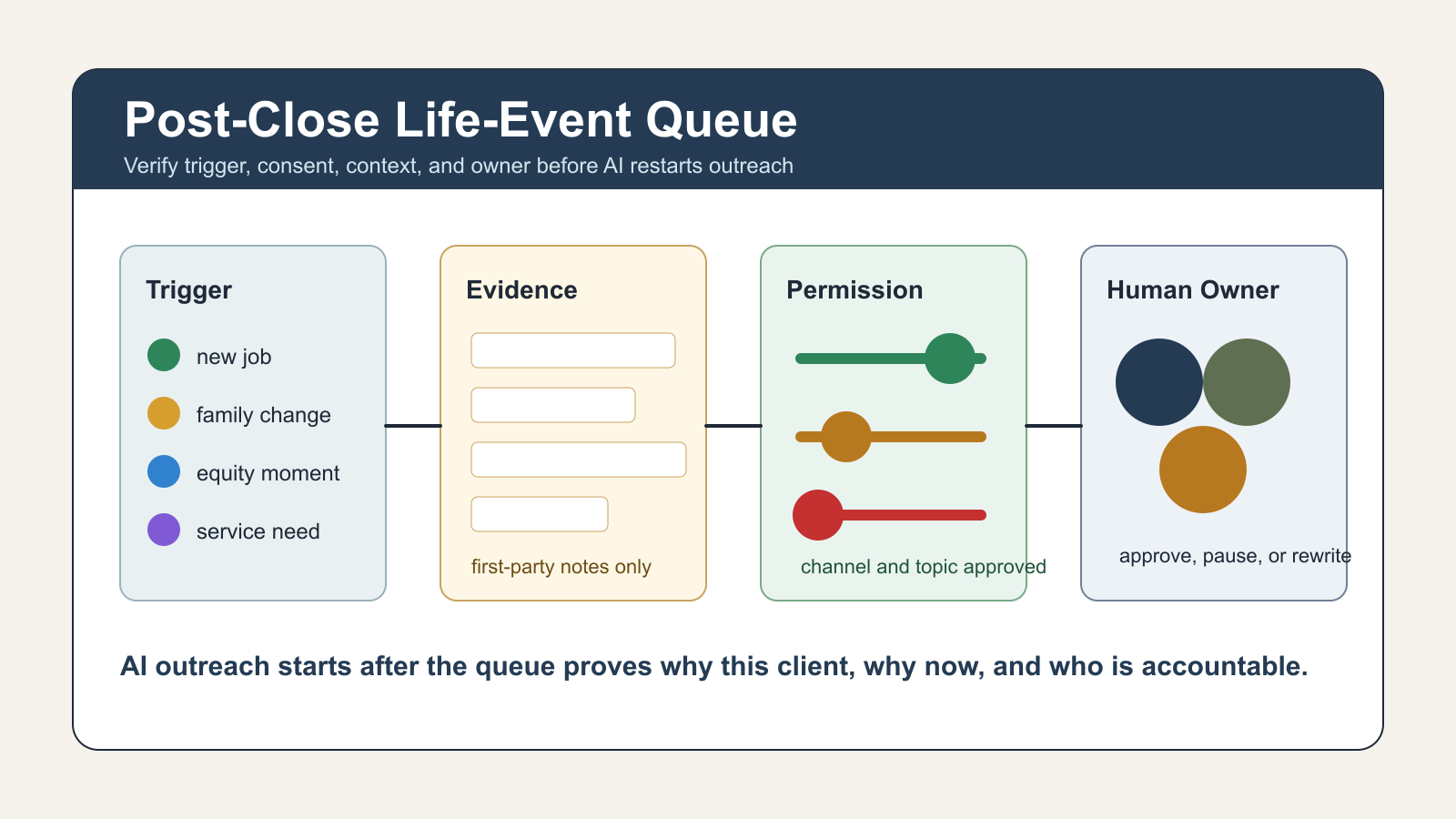
The better operating layer is a life-event queue. It is a small CRM workflow that holds possible post-close triggers until the team verifies four things: the trigger is real enough to act on, the client has permissioned the channel and topic, the message has current context, and a human owner is accountable for what happens next.
Why post-close outreach needs a queue now
The housing market makes past-client work more valuable and more sensitive at the same time. NAR's 2025 Profile coverage reported that 88% of buyers purchased through an agent or broker, and 91% of sellers used an agent. It also noted longer ownership cycles, with the typical seller owning for a record 11 years and buyers expecting to stay longer. That means the relationship window is longer, but obvious transaction moments are farther apart.
At the same time, clients are more exposed to AI in the homebuying process. Cotality's April 2026 housing AI study found that 75% of buyers assume AI already plays a role somewhere in the process, while 44% would pay for a human expert to verify AI-generated housing decisions. The same study found that many buyers are worried about AI recycling unverified information rather than using validated first-party data.
That is the post-close outreach problem in one sentence: clients may accept AI-assisted speed, but they still want the team to know what is verified, what is guessed, and what deserves human judgment.
A life-event queue gives the team that discipline before automation sends anything.
What belongs in the queue
Do not start with a complex prediction model. Start with a controlled intake list. A life-event queue can hold five practical trigger families:
-
Home anniversaries and tenure milestones. These are simple reminders, but they should still be checked against the relationship history. A first-year check-in has a different tone than an eight-year equity review.
-
Property and cost pressure signals. NerdWallet's 2026 Home Buyer Report found that 34% of homeowners consider themselves house poor and 62% say ownership has been more expensive than expected. That supports useful outreach around maintenance, tax, insurance, or budgeting, but only when the message is framed as help, not as an assumed pain point.
-
Household or job changes. These signals can be valuable, but they are also easy to misuse. A public job update, school change, marriage, divorce, new child, or caregiving clue should never be treated as a confident move trigger unless the client shared that context or the agent has verified it.
-
Service moments. A client who asks for a contractor, tax record, insurance contact, or neighborhood recommendation may be opening a service loop. The queue should capture the request, the promised follow-up, and whether any future outreach is appropriate.
-
Market-fit moments. Equity growth, inventory changes, mortgage-rate shifts, and neighborhood demand can justify an update, but the team should tie the outreach to the client's known goal instead of blasting generic market commentary.
The point is not to eliminate automation. The point is to keep automation from treating weak signals as permission.
The four fields every queued trigger needs
A usable life-event queue can be simple. Each candidate trigger should have four required fields before AI is allowed to draft or send.
First, record the source of the signal. Was it first-party CRM history, a client reply, a transaction anniversary, a service request, a public social update, a website visit, or a purchased data field? First-party and client-provided context should carry more weight than inferred third-party data. FTC privacy guidance is clear that businesses should be careful about personal information, honor privacy promises, and collect only what they need. That should shape how much data the AI sees and how confidently the team acts.
Second, assign confidence. Use plain language: verified, likely, weak, or do not use. A verified trigger might be a client saying, "We may need more space next year." A likely trigger might be a home anniversary plus prior conversation about school districts. A weak trigger might be a scraped job title change with no recent relationship context. Weak triggers should generate a human review task, not a client-facing message.
Third, check permission. The queue should know whether the client can be contacted by email, phone, text, or mail, and whether the topic is appropriate. A past client who accepts home maintenance tips has not necessarily asked for automated valuation language, lender introductions, or relocation assumptions.
Fourth, name the owner. Every AI-assisted outreach item should have a human who can approve, rewrite, pause, or take over. NAR's February 2026 RPR survey coverage said 92% of surveyed agents are using or planning to use AI, but accuracy, compliance, and client-facing use remain concerns. Naming an owner turns those concerns into an operating control instead of a vague warning.
How AI should behave inside the queue
AI should help prepare the work, not decide that the relationship is ready.
The useful AI tasks are mostly internal. It can summarize the last three client interactions. It can identify missing fields. It can group triggers by confidence. It can draft two versions of a check-in for an agent to review. It can recommend a next action such as "send maintenance resource," "ask permission to provide an equity update," or "do not contact until agent verifies context."
The risky tasks are the ones that convert inference into certainty. AI should not say the client is likely to move because of a job change. It should not mention family status unless the client provided that context. It should not generate urgency around taxes, insurance, or affordability without proof. It should not route the client to a partner before the team checks fit, choice, and disclosure rules.
A practical rule: if the message depends on a life event, the life event must be visible in the queue with source, confidence, permission, and owner. If those fields are missing, the AI can only create an internal task.
A simple workflow for real estate teams
Start with one post-close segment, not the entire database. For example, choose homeowners who closed 18 to 36 months ago and have had at least one positive service interaction since closing. Then run this workflow weekly:
-
Pull candidate triggers from the CRM: anniversary, service request, prior stated goal, saved search reactivation, website activity, or agent note.
-
Remove records with stale or missing contact permission.
-
Score each trigger as verified, likely, weak, or blocked.
-
Ask AI to prepare a short internal brief for the verified and likely records only.
-
Have the assigned agent approve the next action.
-
Log the outcome after the outreach: replied, no response, requested help, opted out, referred someone, or needs future review.
-
Feed only verified outcomes back into the CRM.
This gives the team a loop. Over time, it becomes obvious which triggers create useful conversations and which ones just create noise. The queue becomes a measurement system, not just a message generator.
What to measure
Do not judge this workflow by email volume or AI drafts produced. Measure relationship-safe outcomes:
- Percentage of queued triggers with verified source and permission.
- Percentage approved, paused, or rewritten by a human.
- Reply rate by trigger type.
- Opt-out or complaint rate by trigger type.
- Service requests completed.
- Referrals or repeat conversations created.
- Records improved with new first-party data.
These metrics keep the team focused on trust. A high send rate with weak data is not progress. A lower send rate with cleaner replies, fewer awkward messages, and better CRM context is progress.
The implementation standard
A past-client database is not a pile of names to reactivate. It is a relationship system. AI can make that system more consistent, but only if the operating rules come first.
Build the life-event queue before letting AI restart past-client outreach. Make every trigger prove its source. Make every message check permission. Keep sensitive assumptions out of the draft unless the client supplied them. Give every AI-prepared action a human owner.
That is how real estate teams get the benefit of faster post-close follow-up without turning trusted relationships into automated guesses.

Written by
Ben Laube
AI Implementation Strategist & Real Estate Tech Expert
Ben Laube helps real estate professionals and businesses harness the power of AI to scale operations, increase productivity, and build intelligent systems. With deep expertise in AI implementation, automation, and real estate technology, Ben delivers practical strategies that drive measurable results.
View full profile