Build a Listing Feedback Loop Before AI Suggests Price Cuts
Build a Listing Feedback Loop Before AI Suggests Price Cuts
AI pricing advice is tempting when a listing stalls. A seller asks whether to reduce, wait, stage, refresh photos, rewrite copy, change terms, or blame the market. An AI assistant can summarize comparable sales and draft a calmer explanation, but it should not be the first system that decides what the listing is telling the team. Before AI suggests price cuts, real estate operators need a listing feedback loop.
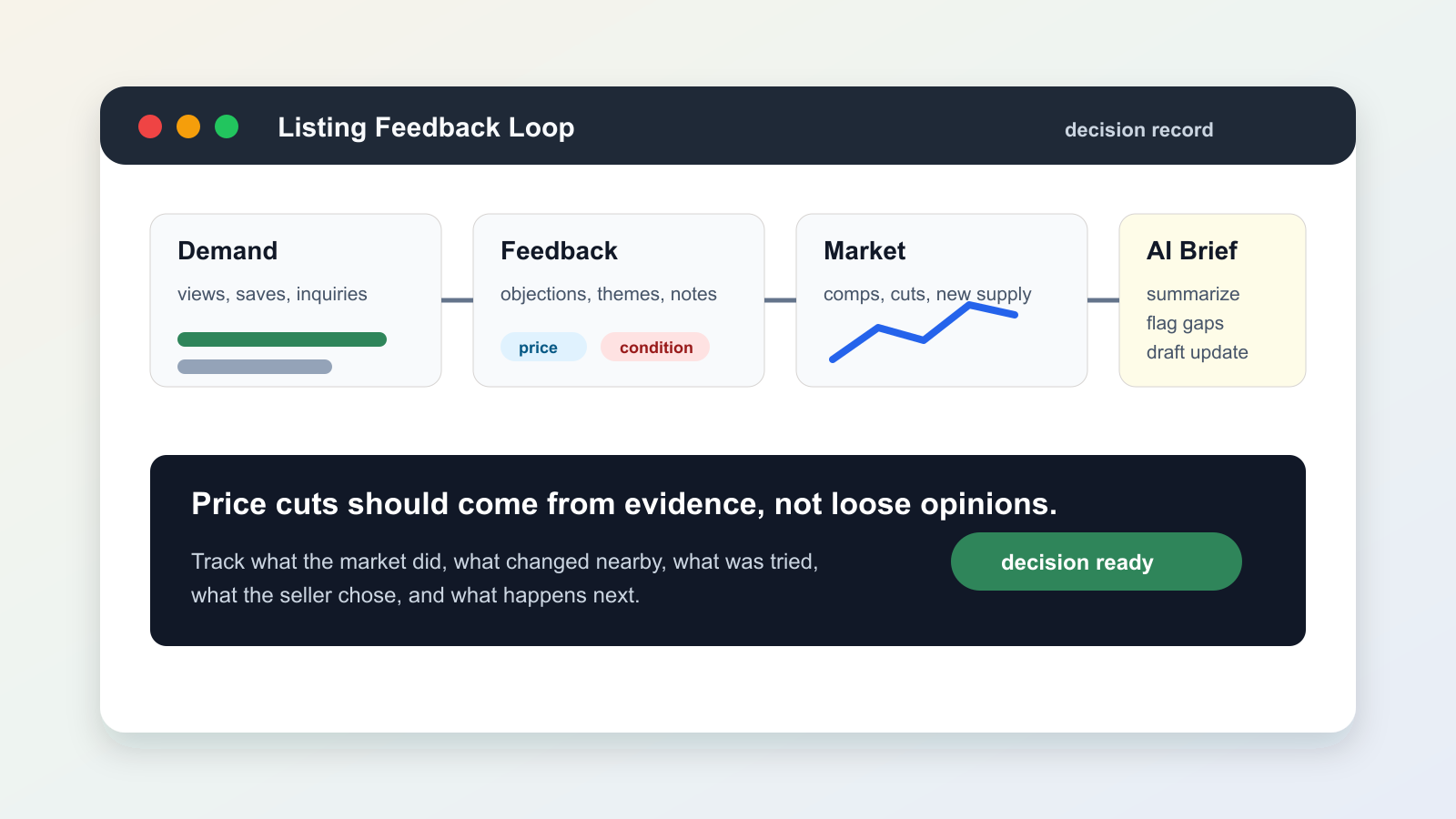
A listing feedback loop is the operating record between launch day and the next pricing conversation. It captures traffic, showing quality, agent comments, buyer objections, offer signals, seller constraints, market movement, concession options, and the decision history around every adjustment. The goal is not to automate the seller conversation. The goal is to make that conversation evidence based enough that AI can help explain the recommendation without inventing confidence.
The timing is right because the 2026 seller market is more fragmented than a single national headline suggests. Realtor.com reported in its April 2026 housing update that active listings rose 4.6% year over year, median list prices fell 1.4% year over year, and homes took about two days longer to sell than a year earlier. At the same time, new listings reached their highest April level since 2022 and pending sales posted a fourth straight month of year-over-year growth. That mix means demand exists, but sellers cannot assume every market, price band, and condition tier is behaving the same way.
Redfin's April 2026 analysis of February closings shows the other side of the pressure. More than one-third of February sellers lowered their list price, and those who cut reduced by about $40,915 on average, or 7.3%. The rate was far higher in parts of Texas and Florida than in tighter coastal or Northeast markets. That is exactly why a real estate team should not let a generic AI summary become the pricing strategy. Some listings need a reduction. Some need better presentation. Some need a concession. Some need a sharper buyer profile. Some need patience because the local data still supports the price.
The weak version of AI pricing advice
The weak version starts with a prompt: summarize the market and tell my seller what to do. That produces polished language, but it often skips the operational evidence that matters. Did online traffic drop after the first weekend? Did showings happen but no second visits follow? Are buyer agents objecting to price, condition, floor plan, insurance, HOA cost, commute, school preference, or financing terms? Did a nearby competitor reduce? Did a better listing come on the market yesterday? Did the seller reject a repair recommendation that buyers now keep mentioning?
Those distinctions matter. A listing with no showings is not the same problem as a listing with strong showings and no offers. A listing with repeated condition objections is not the same problem as a listing that is ten percent above the next best comparable. A property in a market with growing inventory needs a different cadence than a property in a market where new supply is still scarce. If the CRM, showing platform, MLS watchlist, seller notes, and ad performance data never meet in one record, the AI will only summarize fragments.
The seller relationship also becomes harder when feedback is informal. Agents remember comments from showings, screenshots from texts, and opinions from weekly calls, but sellers hear pressure. A feedback loop changes the tone. It shows the seller what the market has actually said, what the team already tried, what changed nearby, and what decision is now required.
What the loop should capture
Start with listing launch assumptions. Every listing should have a pre-live record that states the pricing thesis, target buyer, key value claims, known objections, required seller constraints, staging decisions, repair decisions, concession flexibility, and the first review date. If the seller chose a stretch price, record the reason and the evidence threshold that will trigger a new conversation.
Next, capture demand signals daily during the first two weeks and then on a defined cadence. That includes portal views, saves, inquiries, ad clicks, showing requests, completed showings, open house traffic, agent follow-up, second-showing requests, offer intent, and buyer financing profile when known. The team does not need perfect data. It needs the same data categories every time so the pattern is visible.
Then normalize feedback. Free-form showing comments are useful, but they need tags: price, condition, layout, location, neighborhood, noise, insurance, HOA, taxes, yard, parking, bedrooms, bathrooms, repairs, smell, photos, access, financing, and competing property. The loop should preserve original comments while also counting themes. Three vague comments about price are less useful than eight specific objections to deferred maintenance plus a new comparable that undercuts the listing.
Finally, track market movement. The team should maintain a small competitive set for every active listing: new competing listings, pending comparables, closed comparables, expired or withdrawn listings, price reductions, days-on-market changes, and incentive changes. Realtor.com's April data showed price cuts at 16.7% of active listings nationally, but the regional spread was meaningful, with the South and West higher than the Northeast and Midwest. A seller needs to know whether their listing is outside the local pattern, not whether a national average moved.
Where AI belongs
Once the loop exists, AI can do useful work. It can summarize the last seven days of evidence, separate buyer objections from agent opinion, compare feedback themes against the original pricing thesis, flag when the agreed review threshold has been met, draft a seller update, and prepare three decision paths: hold with a defined next checkpoint, improve presentation or terms, or adjust price.
AI should not make the final recommendation alone. It should produce a briefing for the human agent, broker, or team lead. The briefing should cite the evidence fields that support each path and identify missing data. If showing feedback is thin, the AI should say that. If the competitive set was not updated, it should say that. If the seller's constraint prevents the strongest move, it should surface the constraint rather than pretending the ideal strategy is available.
This is especially important because sellers are entering 2026 with confidence and tension at the same time. Realtor.com's spring seller survey found that most potential sellers expected to receive asking price or more, while a growing share also expected to make concessions. The same survey found that if a home did not sell within the desired timeline, sellers split between reducing price, waiting, or pulling the listing. Those are emotional choices. AI can make the update easier to understand, but the evidence record is what keeps the conversation disciplined.
NAR's March 2026 existing-home sales release reinforces the need for local precision. Sales were down month over month, inventory rose, and the national median price still increased year over year because supply remained constrained. That combination creates the exact operating problem teams face every week: more listings in some places, still-limited supply in others, price growth in aggregate, and buyers who are selective because affordability remains tight.
The practical implementation
Build the first version in the CRM or transaction system with four objects: listing plan, feedback event, competitive-set update, and seller decision. Each record needs an owner, timestamp, source, confidence level, next action, and link back to the listing. The seller decision record should capture the recommendation, what the seller chose, what evidence supported it, and when the next review will happen.
Use three dashboards. The agent dashboard shows each active listing's current signal: healthy, watch, intervention needed, or decision due. The team-lead dashboard shows stalled listings by cause: low traffic, weak showings, repeated condition objection, price-position risk, stale competitive set, or seller decision pending. The seller-facing view should be narrower: activity, feedback themes, nearby market movement, actions completed, and next decision point.
Set escalation rules before AI enters the workflow. For example: no completed showings after seven days triggers promotion and price-position review; showings with repeated price objections trigger comparable-set review; showings with repeated condition objections trigger staging, repair, credit, or copy review; a competing listing undercuts the price by a material amount; a seller misses a decision checkpoint; or feedback conflicts with the original buyer profile.
Then give AI bounded jobs. It can turn feedback into a weekly seller brief, draft call notes, classify comments, compare current demand against launch assumptions, create a broker review memo, and recommend missing evidence. It should not change the price, publish a reduction, alter MLS remarks, or send seller-facing advice without human approval.
The payoff is operational leverage. The agent stops relying on memory. The seller sees the market's actual response. The broker can coach earlier. Marketing can see whether the presentation problem is real. AI becomes valuable because it is working from a clean decision record.
Price cuts should never feel like a surprise generated by a tool. They should be the visible result of a disciplined listing feedback loop: what we expected, what the market did, what changed nearby, what we tried, what the seller decided, and what happens next.

Written by
Ben Laube
AI Implementation Strategist & Real Estate Tech Expert
Ben Laube helps real estate professionals and businesses harness the power of AI to scale operations, increase productivity, and build intelligent systems. With deep expertise in AI implementation, automation, and real estate technology, Ben delivers practical strategies that drive measurable results.
View full profile