Build a Move-In Utility Handoff Board Before AI Sends Buyer Checklists
Build a Move-In Utility Handoff Board Before AI Sends Buyer Checklists
AI can make buyer checklists feel personal, timely, and complete. That is useful after a purchase agreement moves toward closing, because buyers are juggling loan conditions, inspections, insurance, packing, movers, final walkthroughs, keys, and the first week in the house. But a polished checklist can also create a false sense of certainty. Before a real estate team lets AI send move-in instructions, it needs a move-in utility handoff board.
This is not about turning agents into utility coordinators. It is about separating verified operational facts from friendly reminder language. The Consumer Financial Protection Bureau's closing guidance tells buyers to review closing documents, inspect the home, plan the transition, and contact essential-service providers such as gas, electric, or water before closing. That sounds simple until the team is handling multiple closings, different possession terms, local providers, municipal services, HOA move-in rules, mail forwarding, and client questions about what has already been handled.
The pressure to automate this work is real. NAR's 2025 technology survey found that agents who are REALTORS are already using a mix of digital tools, and nearly half reported using AI-generated content. Clients may like faster communication, but faster is not the same as verified. A buyer who receives an AI-generated checklist that says utilities are "set" may reasonably assume someone confirmed provider setup, account ownership, start date, and access requirements. If the system only inferred that from a closing date, the team has created avoidable confusion.
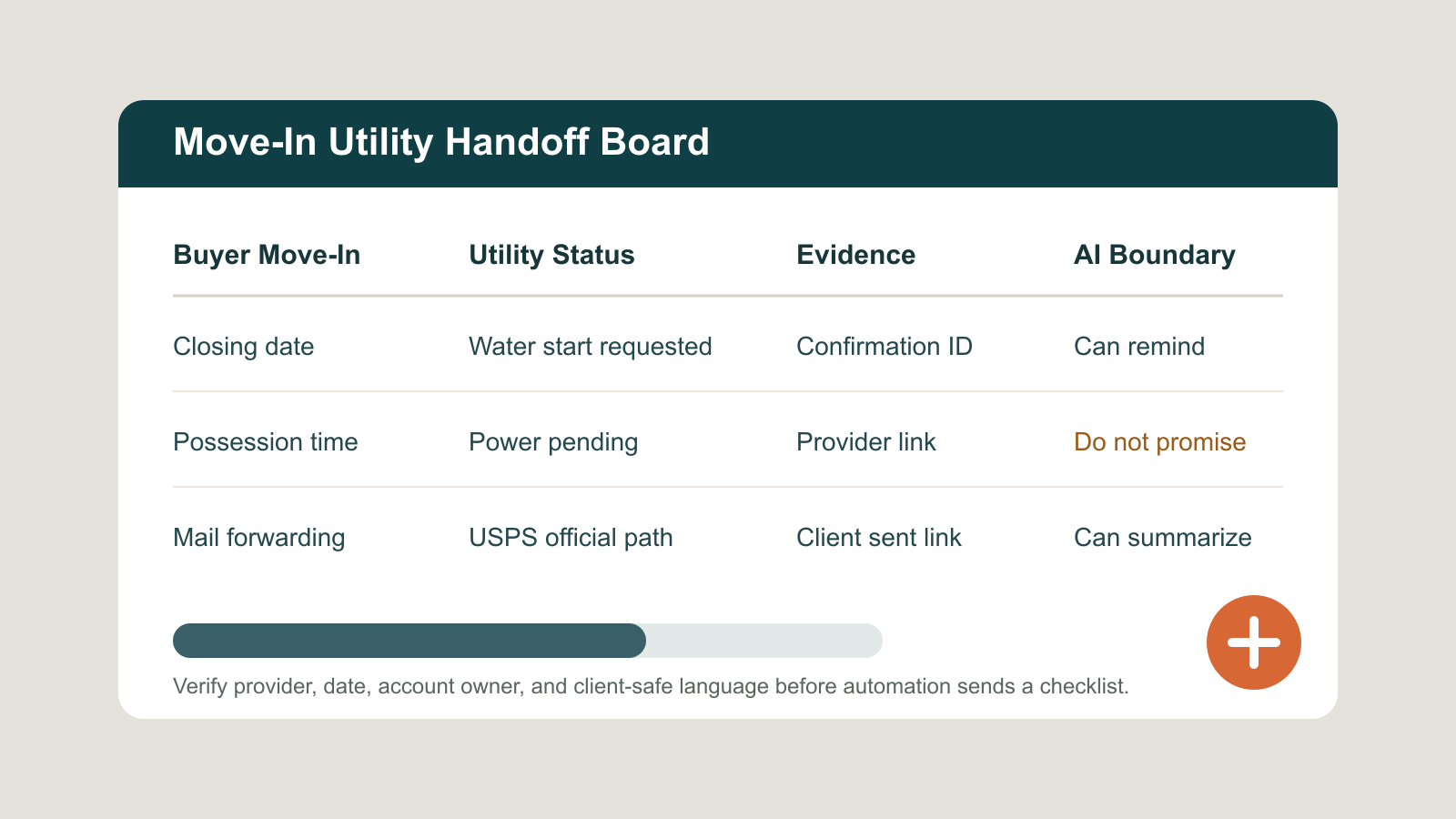
A move-in utility handoff board fixes the input layer. It gives AI a controlled set of fields it can turn into reminders without letting the model guess what has been scheduled, paid, transferred, or confirmed.
What the board should track
Start with one row per property, then split the row into services. The minimum service list is electric, gas or fuel, water, sewer, trash, internet, mail forwarding, security or access systems, HOA or building move-in requirements, and any municipal service that matters in the local market. Rural, condo, co-op, short-term rental, and new-construction files may need extra fields such as propane, septic, well service, gate access, parking permits, elevator reservations, smart-home transfer, solar account transfer, or builder warranty registration.
Each service should have the same core fields: provider name, official contact path, responsible party, current account owner, requested start or transfer date, required deposit or setup step, confirmation number, evidence link, buyer-facing status, and next checkpoint. The official contact path matters because move-in is a fertile moment for impersonation and low-quality third-party services. USAGov warns movers to use the official USPS change-of-address path and notes that outside companies may charge far more for a task handled directly through USPS. The FTC also warns consumers that scammers impersonate utility companies and pressure people into immediate payment through hard-to-recover methods.
That does not mean the agent should become the buyer's payment intermediary. In most teams, the safer pattern is to send the buyer the official provider path, track whether the buyer confirmed completion, and store only the evidence the buyer chooses to share. The board should not collect unnecessary account credentials, card data, Social Security numbers, or utility login details. It should track status, source, and language boundaries.
Use statuses that keep AI honest
Most AI checklist problems come from vague statuses. "Utilities" is not a status. "Handled" is not a status. A move-in board should use statuses that map directly to what AI is allowed to say.
Use "provider identified" when the team has named the likely service provider but the buyer has not acted. AI can say, "Here is the provider we have on file; please confirm directly with the provider." It should not say service is scheduled.
Use "buyer link sent" when the team has sent the official setup link or contact path. AI can remind the buyer to complete setup. It should not say the provider accepted the request.
Use "buyer reported requested" when the buyer says they submitted a setup or transfer request. AI can acknowledge the buyer's report and ask for a confirmation number if the team needs one. It should still avoid saying the service will be active.
Use "confirmation received" only when the buyer or provider supplies a confirmation number, email, screenshot, or other non-sensitive proof. AI can mention that the team has a confirmation on file, while avoiding payment details or account credentials.
Use "risk or exception" when the provider requires a deposit, in-person identity proof, HOA approval, meter access, landlord release, seller coordination, municipal inspection, or a start date that does not match possession. AI should stop using routine checklist language and route the item to a human.
Use "not team-managed" when the team intentionally does not track the service. AI can still include a general reminder, but it must not imply the team will verify completion.
These statuses let AI help without overstating. The model formats the message; the board controls the claim.
Build a client-safe language layer
The board should include a client-safe note for each service. That note is the only field AI can use for outward-facing language. The internal note might say, "Buyer asked about water; city site says setup must be requested two business days before start; buyer has not sent confirmation." The client-safe note should be narrower: "Please request water service directly with the city before your move-in date and send us the confirmation number if you want it tracked in your file."
This separation matters because utility setup can touch payments, identity checks, occupancy timing, possession, municipal rules, and building access. NIST's AI Risk Management Framework emphasizes managing AI risk across design, deployment, use, and evaluation. In practical real estate operations, that means the workflow should decide which facts are allowed into the client message before the model drafts it.
A useful prompt is deliberately constrained:
Draft a buyer move-in reminder using only the approved service rows, client-safe notes, official provider paths, current statuses, and next checkpoints. Do not claim service is active, scheduled, paid, transferred, or guaranteed unless the row status is confirmation received. Do not request credentials, full account numbers, Social Security numbers, payment card details, or wire payments.
The prompt works because the board has already removed guesswork. Without the board, the same prompt is just a wish.
Watch the handoff points
The most important part of the workflow is not the reminder. It is the handoff between contract facts, closing facts, possession facts, and buyer action.
Closing date is not always possession date. Possession may depend on funding, recording, post-closing occupancy, leaseback terms, seller move-out timing, building move-in windows, or local practice. The board should store the contract possession term separately from the closing appointment. AI should never infer that a buyer can start service, schedule movers, or enter the home purely from the closing appointment.
Provider identity is also not always obvious. Some areas have separate water, sewer, trash, electric, gas, internet, recycling, and municipal billing. Condos and HOAs may include some services in dues while requiring separate setup for others. The board should identify which services are buyer-managed, seller-managed until possession, association-managed, municipality-managed, or not verified.
Finally, the handoff board should include a scam-safe payment rule. The FTC warns that utility impersonators often create urgency and demand payment through methods that are difficult to recover. A practical checklist should tell buyers to contact providers through official websites, bills, or known phone numbers, and to treat urgent payment demands, gift cards, cryptocurrency, payment apps, barcodes, and pressure tactics as red flags. That is not legal advice; it is basic operational hygiene.
The minimum viable workflow
A team can start with a CRM object, spreadsheet, or transaction board. It does not need a custom app on day one. The first version needs five rules.
First, AI cannot send a service-specific move-in reminder unless the provider row exists. Second, every provider row must include an official contact path or be marked not verified. Third, every provider row must carry one approved status. Fourth, any exception status routes to a human before the buyer gets a checklist. Fifth, every sent checklist stores the source rows, timestamp, channel, and reviewer.
Once those rules are stable, automation can do more. AI can draft the weekly buyer checklist, detect missing provider rows, turn provider confirmations into structured updates, flag mismatched possession and service dates, and prepare a concise internal risk note for the agent. The human still decides when the facts are complete enough to send.
The payoff is operational calm. Buyers get reminders that are specific without being overconfident. Agents stop rewriting the same checklist from memory. Transaction coordinators can see which move-in items are merely suggested and which are confirmed. The team reduces the chance that AI will promise active water, power, internet, keys, mail forwarding, or access before the evidence exists.
The practical rule is simple: AI can make the move-in message easier to read, but the handoff board has to make the move-in facts safe to use.

Written by
Ben Laube
AI Implementation Strategist & Real Estate Tech Expert
Ben Laube helps real estate professionals and businesses harness the power of AI to scale operations, increase productivity, and build intelligent systems. With deep expertise in AI implementation, automation, and real estate technology, Ben delivers practical strategies that drive measurable results.
View full profile