Build a Seller Objection Triage Board Before AI Replies to Pushback
Seller resistance is becoming a data problem before it is a messaging problem. A seller says the price feels low, the commission feels high, the repair request is unfair, the showing feedback is biased, or the offer timing is inconvenient. The natural temptation is to let AI draft the reply because the CRM already has comps, notes, feedback, and old emails.
That is exactly where teams can create risk. AI can make an objection sound handled while skipping the work that actually changes the seller's decision: classifying the objection, checking whether the evidence is current, deciding who owns the reply, and logging what was approved.
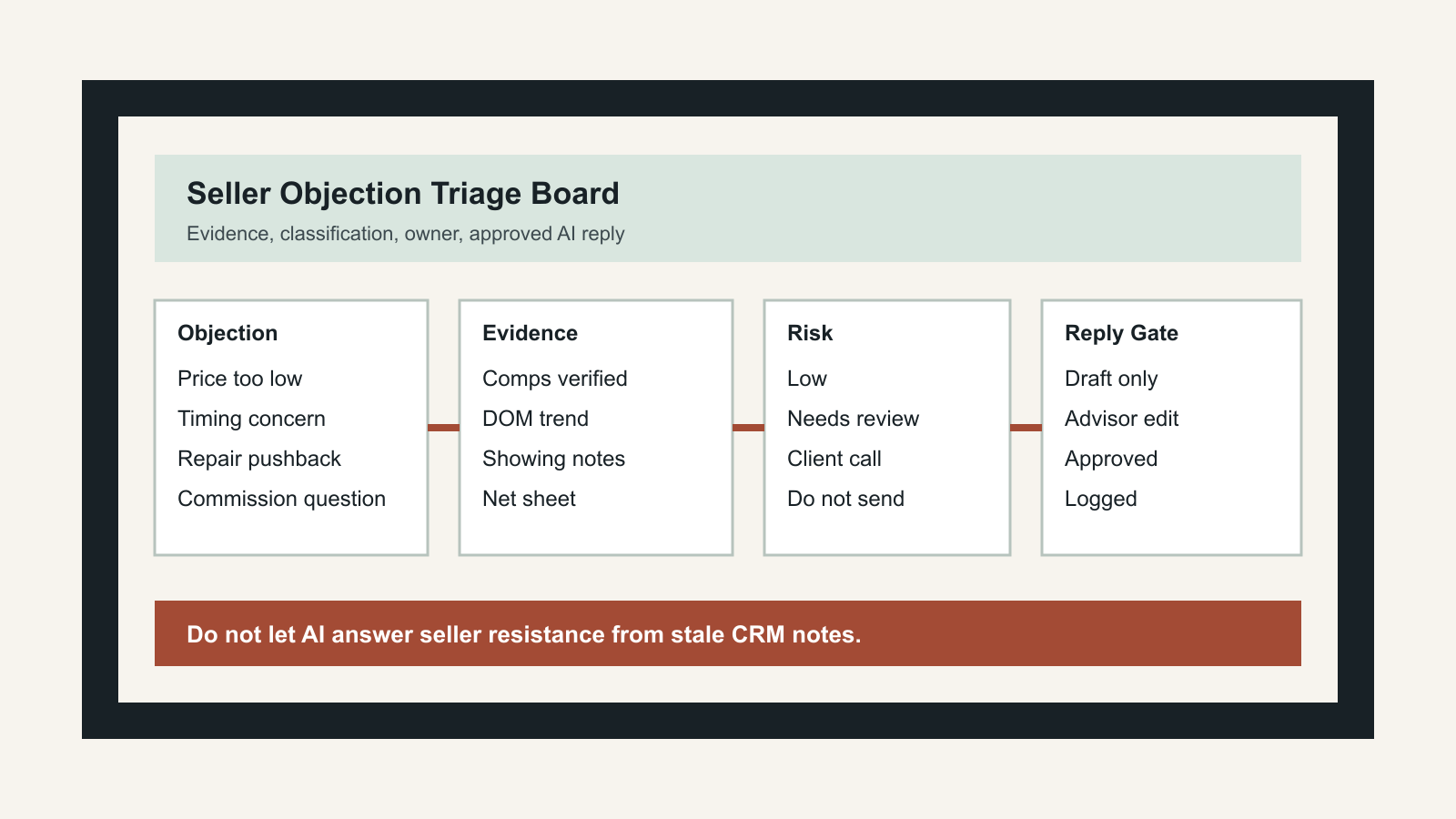
Build a seller objection triage board before AI replies to pushback.
The board is not another content calendar. It is an operating surface for moments when a seller resists advice and the team needs to separate emotion, market evidence, negotiation posture, and client approval before any automated response leaves the business.
Why this matters now
The 2026 listing environment is uneven. Realtor.com reported that March 2026 active listings were up 8.1% year over year, median list prices were down 2.2% year over year, and the median listing spent 57 days on market, four days slower than the prior year. Price cuts were still present in 16.2% of active listings, with larger shares in the South and West.
Redfin's April 2026 analysis showed a different but related pressure: 34.2% of February home sellers lowered their list price, the highest February share in its records, and sellers who cut price reduced by an average of about $40,915, or 7.3%.
Those numbers do not mean every seller should cut. They mean seller advice is more conditional than a generic AI reply can safely handle. A seller in a low-inventory neighborhood with strong showing activity needs a different answer than a seller in a market with rising inventory, weak saves, stale listing photos, and no second-showing demand.
At the same time, AI is moving into normal real estate work. Cotality's April 2026 homebuyer research found that 75% of buyers assume AI already plays a role somewhere in the homebuying process, while 44% would pay to have a human expert verify AI-generated housing decisions. RPR's February 2026 survey of NAR members found that AI is already common in real estate workflows, but agents cited accuracy, compliance, and misinterpretation of market data as core concerns.
That combination is the point. Clients increasingly expect speed, but they do not want speed to replace judgment. Seller objection handling is one of the places where the distinction matters most.
What the board tracks
A useful seller objection triage board has six columns.
First, capture the objection in the seller's words. Do not summarize too early. "We are not giving the house away" is not the same as "I need a minimum net to buy the next place." One is an emotional price anchor. The other is a financial constraint.
Second, classify the objection. Use plain categories such as price, timing, repairs, access, commission, marketing, offer terms, net proceeds, showing feedback, property condition, or trust. The classification matters because it determines which evidence should be attached.
Third, attach the evidence packet. A pricing objection might need active competition, days on market, showing volume, saved-search data, recent closed comps, price-per-square-foot movement, and seller net scenarios. A repair objection might need inspection scope, contractor availability, credit alternatives, lender constraints, and buyer risk. A commission objection might need service scope, exposure plan, negotiation role, and expected net impact. AI should not draft confidently until the evidence packet is visible.
Fourth, mark the data freshness. Market numbers, showing feedback, offer terms, vendor estimates, insurance notes, and loan constraints all age differently. A triage board should show last verified date, data owner, and stale-status. If the reply depends on a two-week-old comp set in a shifting market, the right action is to refresh the analysis, not generate a smoother paragraph.
Fifth, assign the human owner. Some objections are safe for a coordinator to prep. Some require the listing agent. Some require broker review. Some should not be answered in writing until a call happens. The board should make that escalation obvious.
Sixth, decide the AI permission level. Use simple labels: no AI, draft only, draft with evidence, send after advisor approval, or approved template. The point is not to block AI. The point is to keep AI inside the level of judgment the evidence supports.
The workflow
Start with new objections from calls, texts, emails, open-house notes, showing feedback, and seller portal comments. Every item enters the board with source, timestamp, seller, listing, and owner.
The first pass is classification. If the objection is ambiguous, tag it as unclear and require a human follow-up before AI drafts anything. This prevents the common failure where AI answers the wrong problem politely.
The second pass is evidence. The owner attaches the minimum proof for the objection category. For a price objection, that might be a refreshed comp pull, active competition, current showing volume, and net sheet. For a timing objection, it might be seller move deadline, buyer pool seasonality, current days on market, and carrying-cost estimate. For a repair objection, it might be inspection item, estimate range, buyer financing context, and negotiation alternatives.
The third pass is risk. Low-risk objections can move to a prepared reply. Medium-risk objections get an AI draft that is edited by the listing advisor. High-risk objections become a call task with a summary only. The board should make the difference visible because the most dangerous reply is often the one that sounds reasonable but skips consent, facts, or strategy.
The fourth pass is approval. AI can draft variations, simplify language, propose a call agenda, or turn evidence into a short seller update. The final answer should still show who approved it, what evidence it relied on, and where the reply was logged.
The fifth pass is learning. After the seller responds, mark outcome: accepted, still resistant, needs revised evidence, moved to call, price changed, terms changed, or no action. Over time, the team learns which objections were real constraints and which were symptoms of missing explanation.
How to keep it from becoming another unused CRM view
Keep the board narrow. Do not use it for every routine listing update. Use it when seller resistance changes the next action, the advice carries financial consequence, or the reply could create trust, compliance, or negotiation risk.
Use structured fields before long notes. Category, evidence status, data age, owner, risk, and AI permission should be visible without opening the record. Long narrative belongs in the detail panel.
Make stale evidence fail loudly. If the board shows price advice is based on old comps, AI should not draft a confident price recommendation. The next task should be "refresh market evidence" with a named owner.
Separate objection type from emotional intensity. A seller can be calm about a serious issue or angry about a small one. The board should track both. AI can help rephrase a response, but the business still needs to know whether the issue is economically material.
Do not let the board become a blame log. Its purpose is not to prove the seller is wrong. Its purpose is to show what the team knows, what it does not know, and what level of response is appropriate.
A simple first version
A small team can build this without custom software.
Create one CRM view or spreadsheet with these fields: listing, seller, objection text, objection category, source, source date, evidence required, evidence attached, evidence last verified, risk level, owner, AI permission, approved reply, reply channel, outcome, and next review date.
Then write five objection-category checklists:
- Price: comps, active competition, days on market, showing volume, online engagement, net sheet.
- Timing: seller deadline, buyer demand, seasonality, carrying cost, alternate plan.
- Repairs: item severity, estimate range, credit options, buyer financing, vendor capacity.
- Marketing: channel exposure, showing feedback, listing assets, audience fit, next experiment.
- Terms: offer strength, contingencies, close date, occupancy, deposit, fallback options.
Only after those fields are filled should AI generate a draft response. The prompt can be short: use the attached evidence, acknowledge the seller's concern without arguing, avoid promises, state the recommended next step, and flag anything that needs a call.
The operating rule
AI should help the team prepare the reply. It should not decide what the seller needs to hear.
Seller objections are often a mix of money, timing, fear, pride, and incomplete information. When AI replies from stale CRM notes, it can flatten that mix into a confident answer that misses the actual constraint. When the team runs objections through a triage board first, AI becomes useful in the right place: turning verified evidence and human judgment into clear communication.
That is the standard for real estate automation in 2026. Move faster, but make the evidence, owner, and approval path visible before the message goes out.

Written by
Ben Laube
AI Implementation Strategist & Real Estate Tech Expert
Ben Laube helps real estate professionals and businesses harness the power of AI to scale operations, increase productivity, and build intelligent systems. With deep expertise in AI implementation, automation, and real estate technology, Ben delivers practical strategies that drive measurable results.
View full profile