Build a Seller Readiness Board Before AI Touches Listing Prep
Build a Seller Readiness Board Before AI Touches Listing Prep
AI is starting to show up in every listing workflow: comp summaries, listing descriptions, photo captions, seller updates, email campaigns, social posts, price-adjustment notes, and follow-up sequences. That can save time, but it also creates a problem for real estate teams. The model only sees the context the business has structured. If seller expectations, prep status, pricing evidence, staging decisions, disclosure risks, and approval history are scattered across texts, spreadsheets, vendor threads, and memory, AI will make the listing operation sound organized before it actually is.
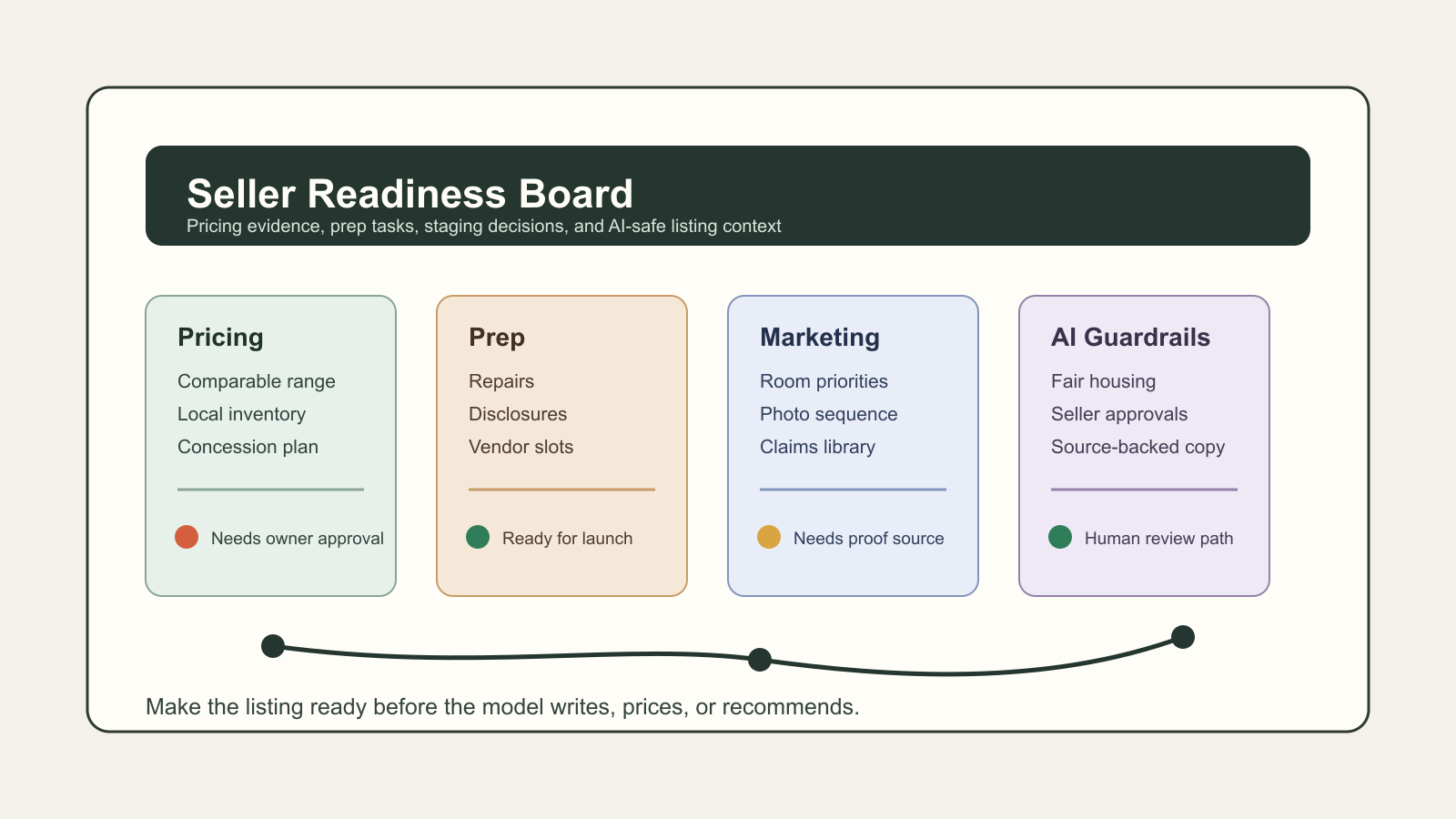
The better first move is a seller readiness board. It is not another dashboard for vanity metrics. It is a working system that says whether a listing is ready for market, which facts AI is allowed to use, which claims are backed by evidence, which seller decisions are still unresolved, and who owns the next step.
That matters more in 2026 because the seller side of the market is more nuanced than a simple shortage story. NAR reported on April 13 that existing-home sales fell 3.6% month over month in March, while unsold inventory rose to 1.36 million units, or 4.1 months of supply. NAR still described inventory as constrained, but the direction is not uniform. Realtor.com reported in its April 2026 housing data that active inventory rose 4.6% year over year, list prices fell year over year for the sixth straight month, and new listings reached their highest April volume since 2022.
At the same time, sellers are not entering the market with low expectations. Realtor.com's Spring Seller Survey found that 83% of people planning to sell in the next 12 months expect to receive asking price or more, while 39% expect to make concessions, up from 30% in 2025. That combination creates the operating tension: sellers are optimistic, buyers have more choices in many markets, and teams need tighter preparation before marketing automation scales the message.
Why AI should not start with copy
Most listing teams reach for AI at the visible edge of the work. They ask it to write a description, generate a social caption, build a postcard, summarize a neighborhood, or produce an email sequence. Those tasks are useful, but they are downstream. If the source data is weak, AI just makes weak listing prep more fluent.
A seller readiness board moves the starting point upstream. Before a model writes anything, the board should answer five questions. What is the pricing thesis? What facts can be used publicly? What property work must happen before photography? What buyer objections are likely? What approvals are needed before content, price guidance, or outreach goes live?
This matters because listing prep contains judgment, not just information. A roof age, foundation note, insurance concern, room dimension, school boundary, HOA rule, repair estimate, or seller timeline can change how the property should be positioned. Those details should not be buried in a coordinator's inbox while an AI tool creates confident marketing language from a thin prompt.
What the board should track
Start with a pricing lane. This does not need to replace the CMA. It needs to summarize the operating interpretation of the CMA: target list price, acceptable range, comparable anchors, inventory pressure, days-on-market expectation, concession stance, and the first price-review date. In a market where list prices, inventory, and buyer leverage vary by region, the board should force the team to state the local thesis instead of relying on national headlines.
Second, add a prep lane. Track repairs, cleaning, decluttering, landscaping, photography readiness, access instructions, disclosure packet status, HOA or condo documents, vendor appointments, and seller decisions that affect launch timing. Each item needs an owner and due date. A vague note that says "prep in progress" is not useful context for AI or people.
Third, add a staging and presentation lane. NAR's 2025 Profile of Home Staging found that 83% of buyer agents said staging made it easier for buyers to visualize a property as a future home, and 60% said staging affected some buyers. That does not mean every home needs full staging. It means the team should decide, document, and connect the decision to the marketing plan. Which rooms matter most? Which objections should photos reduce? Which improvements are cosmetic, and which affect perceived value?
Fourth, add a claims library. This is the list of statements the team is allowed to use in public copy: renovated kitchen, new HVAC, walkable location, rental potential, energy-efficient upgrades, flexible floor plan, proximity to transit, or specific neighborhood amenities. Every claim should have a proof source or a clear owner who approved it. AI can then draft from a controlled source set rather than inventing stronger language than the facts support.
Fifth, add an approval lane. The seller should not be surprised by pricing logic, launch timeline, repair dependencies, concession strategy, or marketing language. Store approval dates, open questions, and final decisions. That protects the team from re-litigating decisions later and gives AI systems a clean boundary for what can be used in client-facing communication.
The fields that make it operational
A lightweight board can run inside a CRM, Airtable, Notion, a project-management tool, or a custom app. The tool matters less than the field discipline. Each listing should have a readiness status, target launch date, pricing thesis, prep blockers, disclosure status, vendor status, staging decision, marketing claim status, seller approval status, and next owner.
Add a simple risk label: green, yellow, or red. Green means AI may draft from approved context. Yellow means AI may summarize internally but not create client-facing copy. Red means no AI-generated external content until the owner resolves the blocker. Red blockers include missing seller approvals, disputed facts, incomplete disclosure information, unclear property condition, unverified claims, sensitive fair housing language, and pricing guidance that has not been reviewed by the responsible agent.
That simple policy prevents a common automation mistake: using AI to accelerate the exact part of the workflow that still needs human judgment.
Where AI belongs after the board exists
Once the board is in place, AI becomes much more useful. It can turn the pricing thesis into a seller update. It can summarize prep blockers before a team meeting. It can draft three listing description options from approved claims. It can generate a photographer brief from the staging lane. It can produce a price-review agenda when days on market or showing feedback crosses a threshold. It can flag missing fields before launch.
The important shift is that AI is no longer guessing the workflow. It is operating from structured readiness data. That makes the output faster, safer, and more specific.
For example, a model should not be asked, "Write a luxury listing description for this home." It should receive approved facts, room priorities, excluded claims, seller tone preferences, local buyer objections, fair housing constraints, and the launch strategy. That prompt is less glamorous, but it produces copy that is easier to approve and less likely to create cleanup work.
A two-week build plan
Day one is the audit. Pull the last ten listings and identify where launch friction appeared: pricing revisions, late repairs, missing disclosures, seller approval delays, photo reshoots, vague property claims, or post-launch objections. Convert those recurring problems into board fields.
By day three, create the minimum board with four statuses: intake, prep, ready for launch, and live optimization. Add required fields for pricing thesis, prep blockers, staging decision, claims library, and approvals. Do not overbuild. If agents cannot update it in minutes, they will work around it.
By day seven, connect the board to the listing meeting. No listing should leave the meeting without an owner for each yellow or red field. The board becomes the meeting artifact, not a separate admin exercise.
By day ten, add AI only to internal drafts. Let it summarize open blockers, generate seller-update drafts, create internal launch checklists, and prepare content options. Keep external copy behind human approval until the team has confidence in the field discipline.
By day fourteen, review one live listing and one upcoming listing. Ask where the board prevented confusion, where fields were missing, and where AI saved time without weakening judgment. Then tighten the fields.
The practical payoff
The seller readiness board gives the team a shared operating picture before the market gets to judge the listing. It reduces rework, makes approvals visible, improves pricing conversations, and gives AI a reliable source of truth. It also helps the seller experience feel more professional because the team is not improvising from scattered notes.
The market is not giving every seller the same conditions. Some metros still feel tight; others are giving buyers more leverage. Some sellers expect asking price or better; more are preparing for concessions. In that environment, the advantage goes to teams that can translate market evidence into clear seller decisions and clean execution.
AI can absolutely help with listing prep. But it should not be the first system the business installs. Build the board first. Make the work visible. Turn listing readiness into structured context. Then let AI draft, summarize, and accelerate from facts the team is willing to stand behind.

Written by
Ben Laube
AI Implementation Strategist & Real Estate Tech Expert
Ben Laube helps real estate professionals and businesses harness the power of AI to scale operations, increase productivity, and build intelligent systems. With deep expertise in AI implementation, automation, and real estate technology, Ben delivers practical strategies that drive measurable results.
View full profile