Ask AI Vendors for Workflow Proof, Not Another Demo
Ask AI Vendors for Workflow Proof, Not Another Demo
AI vendors are getting very good at demos. A sales engineer can show a polished agent that summarizes a lead, writes a follow-up, updates a CRM field, drafts a listing description, and explains the next best action in a clean interface. That matters, but it is not enough evidence to buy the system.
The better question for a real estate team in 2026 is: can the vendor prove the workflow works when it touches messy operating reality?
That shift is practical, not skeptical. AI is already inside real estate workflows. NAR reported in February 2026 that 92% of surveyed agents are using AI now or plan to use it, while accuracy, compliance, and market-data misinterpretation remain top concerns. NAR's 2025 REALTOR Technology Survey also shows why adoption is attractive: agents use technology primarily to save time and improve the client experience, and CRM remains one of the top lead-generating technologies. The demand is real. The buying discipline has to catch up.
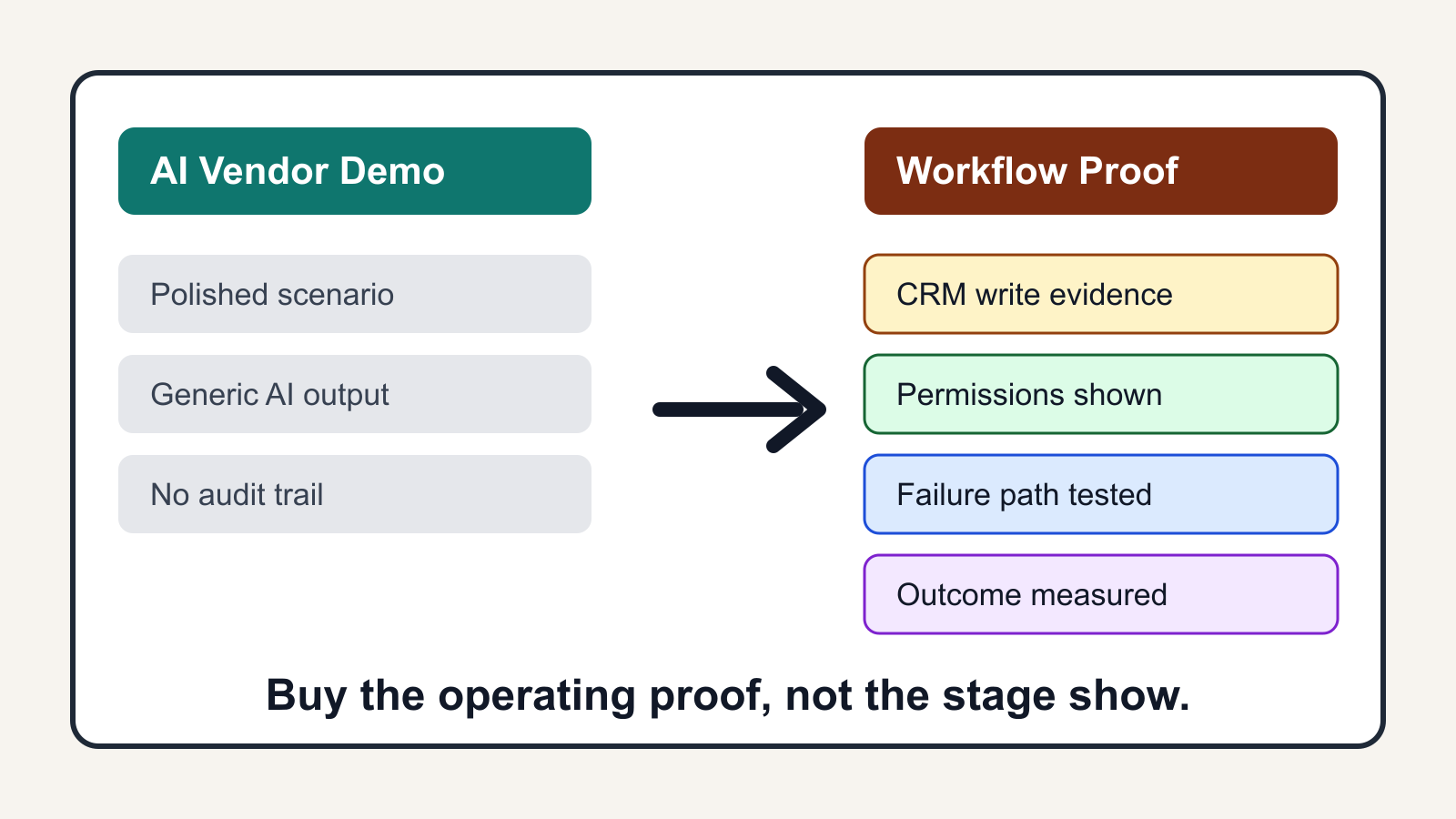
A demo proves that a tool can perform under conditions the vendor chose. Workflow proof shows what happens inside your actual operating constraints: your lead sources, your CRM stages, your consent rules, your transaction handoffs, your brand voice, your exception cases, and your audit requirements.
The workflow proof standard
Before buying an AI vendor, ask for a proof session built around one real business process. Keep it narrow. A seller lead comes in from a valuation form. A buyer replies to a property alert. A past client asks for a referral. A listing coordinator needs property notes turned into compliant marketing copy. Pick one workflow that already matters and ask the vendor to run it end to end.
The proof should show five things.
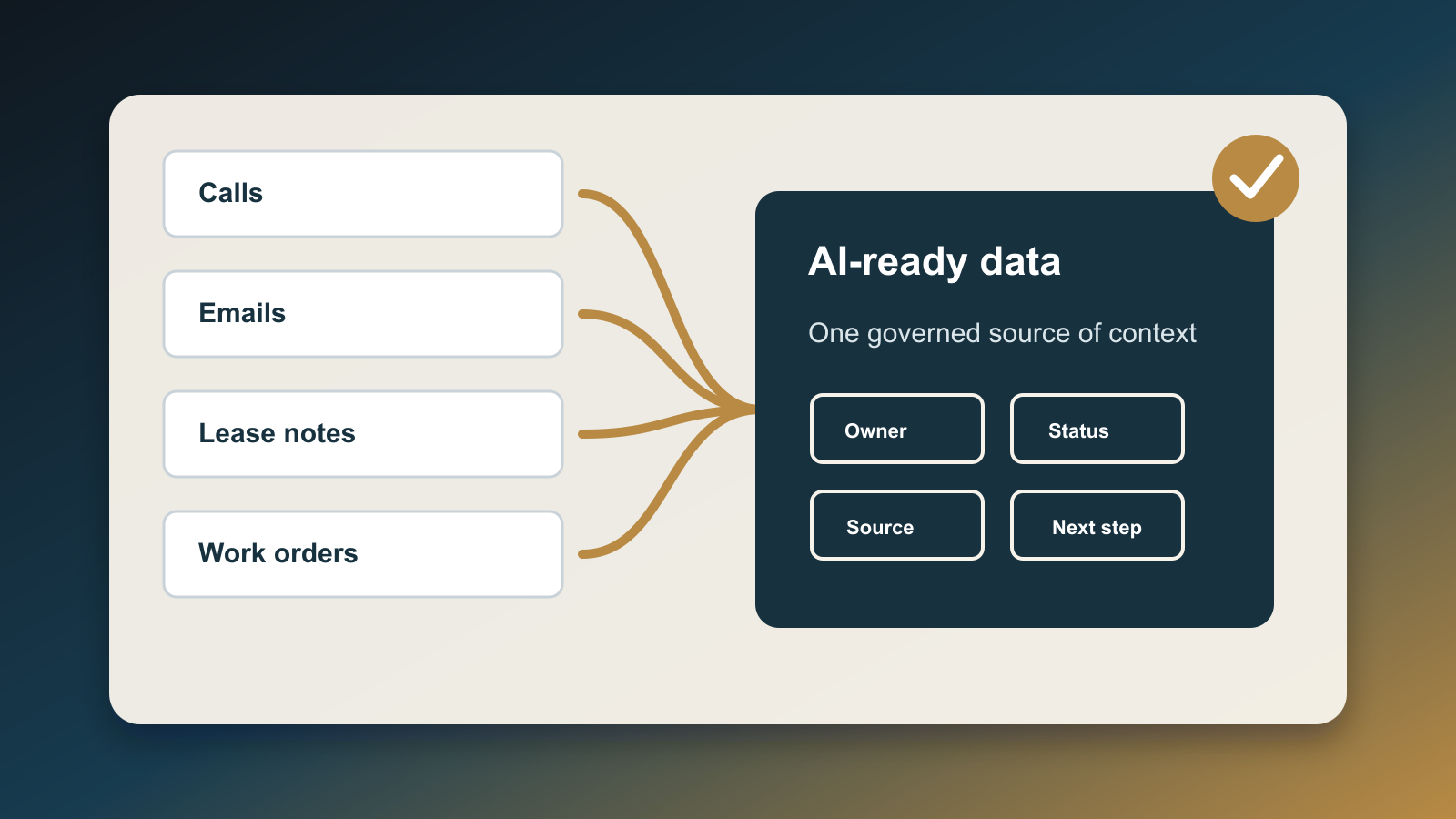
First, the system should identify the source of truth. If the agent says a lead is ready for outreach, where did that confidence come from? Was it the CRM stage, the inquiry text, website behavior, a prior email, or a manually entered note? McKinsey's April 2026 work on agentic infrastructure makes the same point at enterprise scale: agents need reliable operational data, clear sources of truth, ownership, logs, and metrics. Real estate teams need the lighter version of that idea before the AI touches clients.
Second, the vendor should show permission boundaries. What can the AI read? What can it write? What requires human approval? Can it send a text, change a stage, assign ownership, create a task, or only draft a recommendation? If the answer is buried in product language, that is a buying risk. You need a visible permission model because customer-facing automation turns small configuration mistakes into client experience problems.
Third, the proof should include a failed or uncertain case. Do not only test the happy path. Give the system a duplicate contact, a lead with missing consent, a vague seller request, a bad phone number, or conflicting notes. The vendor should show where the work goes when the AI is not confident enough to act. A mature platform will route the issue to a queue, preserve the evidence, and make the next human step obvious.
Fourth, the vendor should show the audit trail. A useful AI system should leave behind more than a generated message. It should show what data was used, what action was recommended, who approved it, what changed in the CRM, and what happened afterward. This is where many demos become thin. They show the output but not the operating record.
Fifth, the vendor should connect the workflow to a measurable outcome. The right metric is not prompts run or emails drafted. It is business proof: speed to lead, appointment booked, stale lead revived, duplicate record resolved, task completed, listing copy approved, client question answered, or follow-up logged. Deloitte and ServiceNow's March 2026 Workflow Automation Outlook argues that leading organizations are moving beyond piecemeal automation toward end-to-end outcomes, AI-ready foundations, governance, service-led CRM, and measurable impact. That is the lens a real estate operator should bring into procurement.
What to ask in the buying room
A good vendor evaluation should sound operational. Ask the vendor to narrate the exact data path. Ask which fields are required for the workflow to perform well. Ask what happens when those fields are empty. Ask whether the agent can distinguish a new buyer lead from an old database contact who re-engaged. Ask how it handles multiple owners, team inboxes, opt-outs, MLS or brokerage restrictions, and Fair Housing-sensitive language.
Then ask for the evidence. You want to see the created CRM task, the changed field, the note added, the message draft, the approval record, and the dashboard metric. If the tool claims to save time, ask which step disappeared and which human responsibility replaced it. If the tool claims to improve conversion, ask how it attributes the result.
PwC's AI Agent Survey reinforces the gap: companies are increasing AI investment and seeing productivity gains, but many have not transformed how work gets done. PwC also points to trust, change readiness, workforce engagement, and connecting agents across workflows as the areas where value is still being won or lost. In other words, the product feature is only part of the decision. The operating model is the purchase.
A simple scorecard
Use a five-point scorecard for every AI vendor that wants access to customer data or CRM actions.
- Source-of-truth clarity: The vendor can show exactly which records, fields, documents, and events drive the recommendation.
- Permission control: The vendor can separate read, draft, write, send, assign, and escalate permissions by role and workflow.
- Exception handling: The vendor can route uncertainty to a queue with evidence instead of hiding it in chat history.
- Auditability: The vendor can show who or what took each action, when it happened, what changed, and how to reverse or review it.
- Outcome measurement: The vendor can connect automation to completed work in the CRM or operating system, not just activity inside the AI product.
A vendor does not need to score perfectly on day one. It does need to be honest about gaps. If a platform cannot show permission boundaries or audit trails, keep it away from client-facing automation until those controls exist. Use it for drafting, research, or internal summaries, where the business risk is lower.
The practical decision
Real estate teams do not need to slow down AI adoption. They need to move the buying conversation from novelty to operating proof.
That means fewer abstract demos and more workflow trials. Fewer feature lists and more evidence of CRM writes, approvals, exceptions, and outcomes. Fewer promises about autonomous agents and more clarity about where humans supervise the work.
The best AI vendor for a brokerage, team, or service business is not the one with the most impressive demo. It is the one that can show how automation behaves when the lead is incomplete, the customer preference matters, the CRM is imperfect, the compliance risk is real, and the business still needs proof that the work got done.
Sources
- NAR REALTOR News, "You've Tried AI, But Can You Trust It?" February 12, 2026: https://www.nar.realtor/magazine/real-estate-news/technology/youve-tried-ai-but-can-you-trust-it
- NAR, "REALTOR Technology Survey," 2025: https://www.nar.realtor/research-and-statistics/research-reports/realtor-technology-survey
- McKinsey, "Reimagining tech infrastructure for (and with) agentic AI," April 23, 2026: https://www.mckinsey.com/capabilities/mckinsey-technology/our-insights/reimagining-tech-infrastructure-for-and-with-agentic-ai
- Deloitte, "2026 Workflow Automation Outlook," March 2, 2026: https://www.deloitte.com/us/en/about/press-room/servicenow-workflow-automation-outlook.html
- PwC, "AI Agent Survey," May 2025 survey coverage: https://www.pwc.com/us/en/tech-effect/ai-analytics/ai-agent-survey.html

Written by
Ben Laube
AI Implementation Strategist & Real Estate Tech Expert
Ben Laube helps real estate professionals and businesses harness the power of AI to scale operations, increase productivity, and build intelligent systems. With deep expertise in AI implementation, automation, and real estate technology, Ben delivers practical strategies that drive measurable results.
View full profile