Build a Buyer Education Room Before AI Handles Follow-Up
AI follow-up is getting faster. That is not the same as getting better.
Sales teams, real estate agents, and local service operators are moving AI into the first few minutes of the buyer journey: inquiry replies, listing questions, appointment nudges, post-showing recaps, lender reminders, seller intake, and long-cycle nurture. The promise is simple. More leads get touched. Fewer prospects wait. Human teams spend less time writing the same answer again.
But faster follow-up creates a new problem. If the AI only sends messages, the customer still has to assemble the decision for themselves.
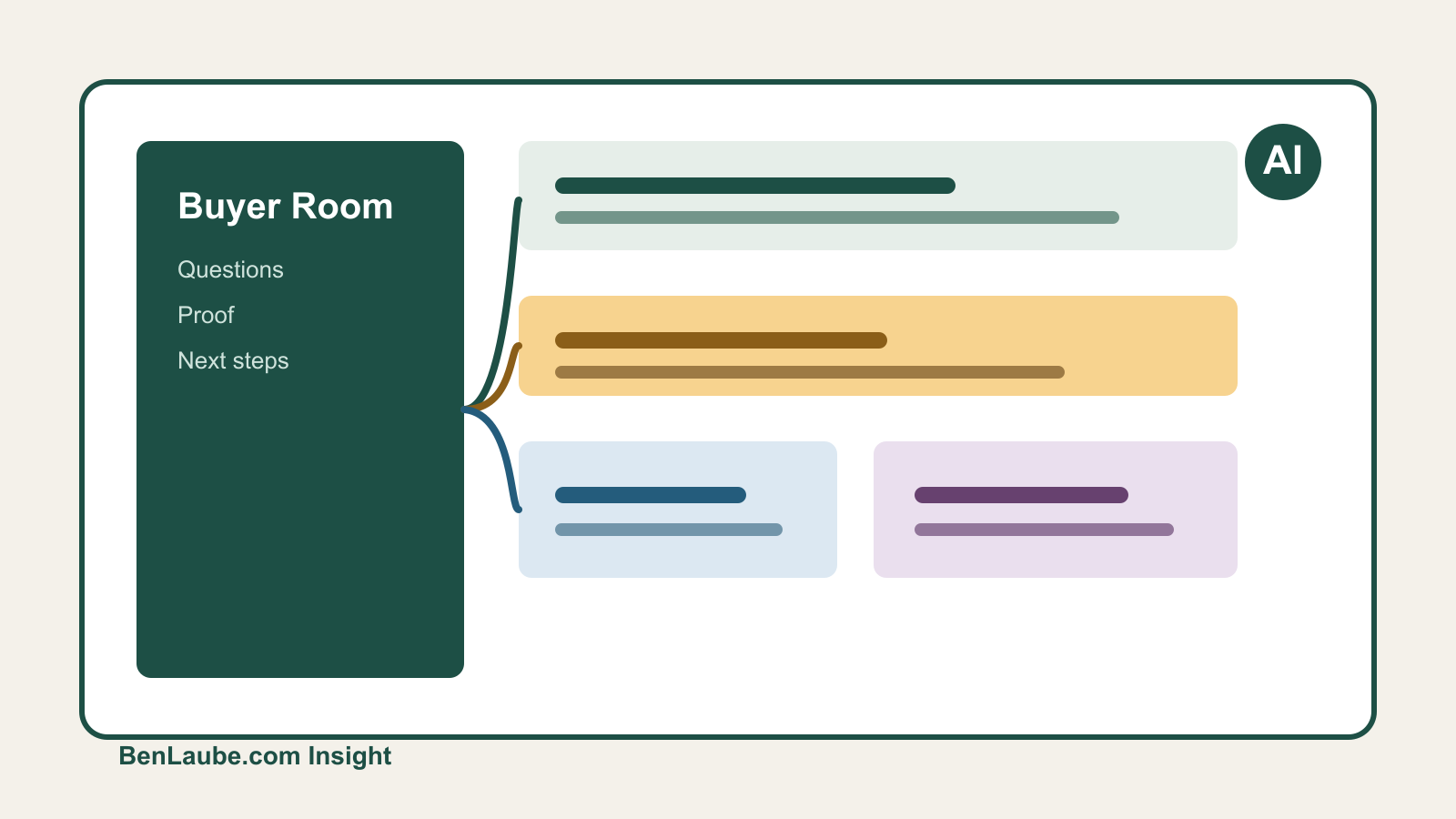
The next useful system is not another drip sequence. It is a buyer education room: a lightweight, stage-specific place where each prospect can see the questions, proof, comparisons, next steps, and human handoff that match the decision they are trying to make.
Buyers Are Becoming More Self-Directed
Gartner reported in March 2026 that 67% of surveyed B2B buyers prefer a rep-free experience, and 45% used AI during a recent purchase. That is not a real estate survey, but the behavior matters across markets. Buyers are getting comfortable doing more research before they speak with a salesperson, and AI is now part of how they compare options.
Real estate has a different trust pattern. NAR's April 2026 generational trends coverage reported that 88% of buyers purchased through an agent and 91% of sellers worked with an agent. The lesson is not that people want to remove the professional. The lesson is that they want to arrive better informed, move at their own pace, and still have a trusted person when the decision gets real.
That makes the education layer more important. A prospect who asks an AI assistant about buying power, pricing strategy, neighborhood tradeoffs, showing readiness, inspection risk, or listing timing should not receive only a clever paragraph. They should receive a structured room that helps them understand the decision and prepares the human conversation.
The Buyer Education Room
A buyer education room is a private or semi-private digital workspace tied to one lead, client, household, property, or deal stage. It can be simple. It does not need to be a portal rebuild.
At minimum, it contains five modules.
First, the current question. What is the buyer, seller, investor, or client trying to decide right now? Do they need to know whether they are ready to buy, how to price a listing, whether to tour a home, how to compare neighborhoods, or what happens after an offer?
Second, the approved answer. This is the plain-language explanation the team is comfortable standing behind. It should not be generated from scratch every time. AI can adapt it, but the core explanation should come from an approved library.
Third, the proof. Include links, calculators, checklists, comps, market snapshots, policy pages, testimonials, case notes, or process documents that support the answer. This is where the room becomes more useful than an email.
Fourth, the next step. The room should show the correct action for that stage: schedule a consult, upload documents, review financing assumptions, request a valuation, confirm search criteria, approve listing prep, or wait for a human review.
Fifth, the owner. Every room needs a human or operational owner. AI can prepare the path, but the business still needs accountability for what happens next.
Why This Beats Another Sequence
Traditional nurture treats everyone in a segment the same until they click, reply, or unsubscribe. AI follow-up can personalize the language, but it often keeps the same old structure: send a message, wait, send another message, hope the CRM score improves.
A buyer education room changes the unit of work. Instead of asking, "What should we send next?" the system asks, "What does this person need to understand before the next decision?"
That distinction matters because AI is already showing up in sales workflows. Salesforce's 2026 State of Sales reporting says 87% of sales organizations use some form of AI for tasks such as prospecting, forecasting, lead scoring, or drafting emails. Sellers also expect agents to reduce research time and drafting time. The risk is that teams spend the saved time creating more outreach rather than building clearer buyer support.
If an AI system can draft a follow-up in seconds, the scarce asset is no longer the message. The scarce asset is the decision architecture behind the message.
Build Rooms From Reusable Blocks
Do not start with a giant portal. Start with reusable blocks that match real questions.
For a buyer lead, the blocks might be:
- Buying readiness checklist
- Financing assumption summary
- Neighborhood tradeoff explainer
- Tour priority worksheet
- Offer process overview
- Inspection and appraisal timeline
- Human consult link
For a seller lead, the blocks might be:
- Pricing strategy explainer
- Prep-versus-price tradeoff
- Marketing plan proof
- Showing readiness checklist
- Net proceeds worksheet
- Timeline from consult to launch
- Human review owner
For a service business or consulting offer, the blocks might be:
- Problem diagnosis checklist
- Before-and-after workflow example
- Implementation timeline
- Data or access requirements
- Pricing model explanation
- Proof of prior work
- Call booking path
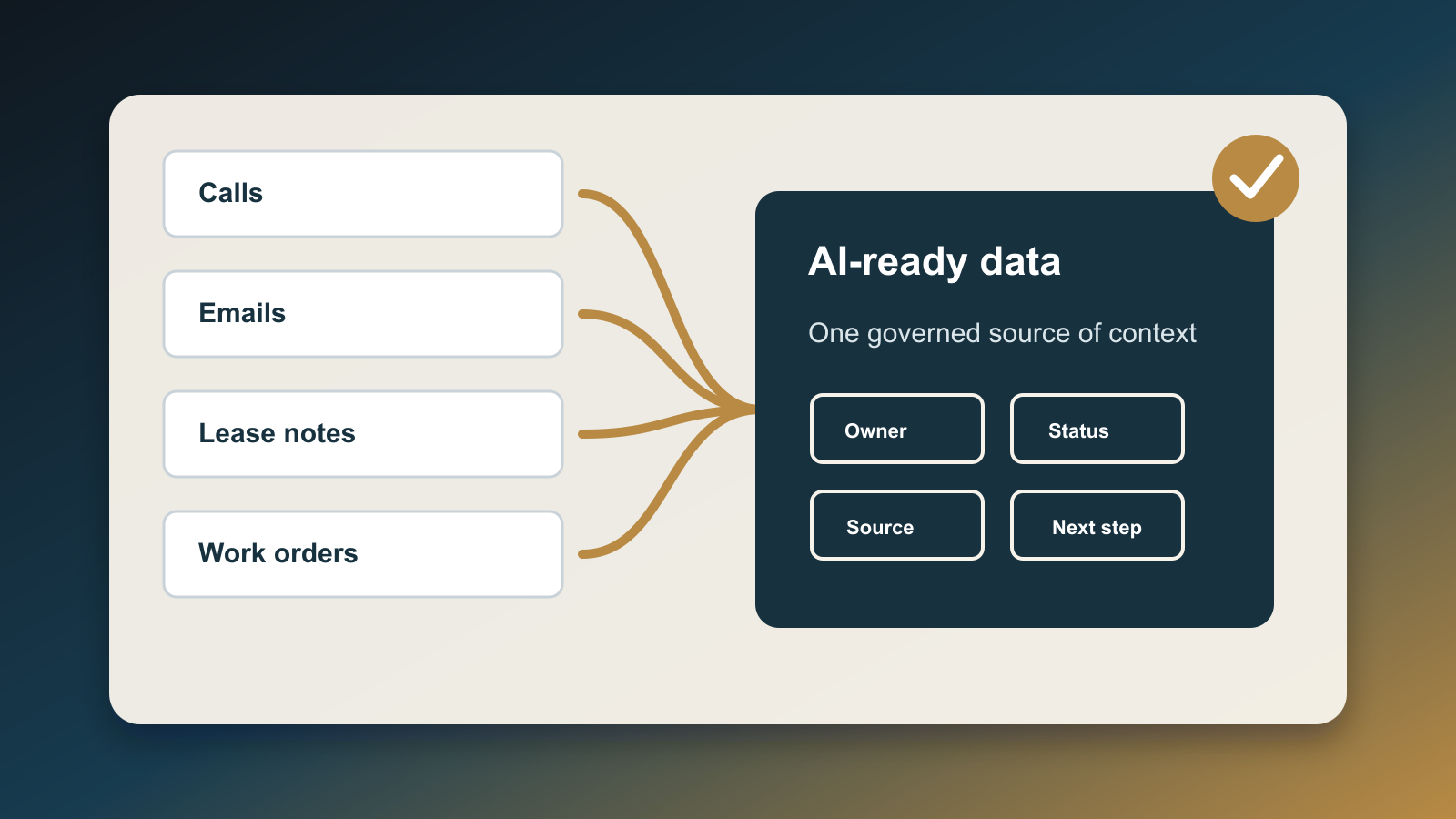
Each block should have metadata: audience, funnel stage, topic, required data, compliance notes, expiration date, and owner. That metadata lets AI assemble the right room without inventing the underlying guidance.
Connect the Room to the CRM
The room should not live apart from the operating system. It should write back to the CRM.
Capture at least six fields: room created, question answered, assets shown, prospect action, next owner, and next due date. If the room includes calculators, market data, or advice-adjacent material, capture the proof source and review status as well.
This gives the team a better follow-up trigger than opens and clicks. A lead who reviewed the financing assumptions and saved three neighborhoods needs a different human conversation than a lead who only downloaded a generic buying guide.
NAR's current technology survey shows why this matters in real estate specifically. Agents adopt technology primarily to save time and improve the client experience, and CRM remains one of the top lead-generating technologies. A buyer education room connects those goals. It saves time by reusing approved explanation blocks, and it improves the client experience by giving the prospect a clearer path.
Add Guardrails Before Automation
AI should not be allowed to assemble every room from every source. The higher the stakes, the tighter the guardrails.
NAR's February 2026 RPR survey coverage found that agents are using or planning to use AI at high rates, but accuracy, compliance, market-data interpretation, and fair housing concerns remain prominent. Those concerns are exactly why the education room needs controlled source blocks, expiration dates, and escalation rules.
Use three guardrail levels.
Green blocks are safe for AI to send automatically. Examples include process timelines, consultation prep, document checklists, office hours, and general education.
Yellow blocks require context. Examples include pricing ranges, affordability assumptions, neighborhood comparisons, investment framing, and campaign recommendations. AI can prepare the room, but a human should review before the room is sent or before the claim is treated as advice.
Red blocks require escalation. Examples include legal advice, lending decisions, fair housing-sensitive targeting, tax guidance, appraisal conclusions, guaranteed outcomes, or anything that promises a result the team cannot directly control.
This structure lets automation move quickly without turning every answer into an unmanaged claim.
Measure Understanding, Not Message Volume
The wrong metric for AI follow-up is total messages sent. That rewards noise.
A better scorecard asks whether the education room moved the buyer closer to a confident next step. Track room completion, most-used blocks, unanswered questions, handoff quality, meeting show rate, cycle time, and the percent of human calls that begin with the client already understanding the next decision.
Gartner's research points to value clarity as the new enablement mandate. That phrase is useful because it moves the goal away from content production. The room succeeds when the buyer can explain the value, risk, process, and next step in their own words.
The Practical Starting Point
Pick one recurring decision in your business. Do not start with the whole funnel.
For real estate, start with "Am I ready to buy?" or "What is my home worth?" For a service business, start with "Is this problem worth fixing now?" For a marketing or CRM system, start with "Which lead source deserves follow-up?"
Write the approved answer. Attach proof. Define the next step. Assign an owner. Add CRM fields. Then let AI create the first draft of the room only from those approved pieces.
This is where AI follow-up becomes useful. It stops being a faster way to send more words and becomes a system for helping people make better decisions.
The businesses that win with AI will not be the ones that reply the fastest. They will be the ones that make the next decision easiest to understand.

Written by
Ben Laube
AI Implementation Strategist & Real Estate Tech Expert
Ben Laube helps real estate professionals and businesses harness the power of AI to scale operations, increase productivity, and build intelligent systems. With deep expertise in AI implementation, automation, and real estate technology, Ben delivers practical strategies that drive measurable results.
View full profile