Build a Data Retention Board Before AI Learns From Client Files
Build a Data Retention Board Before AI Learns From Client Files
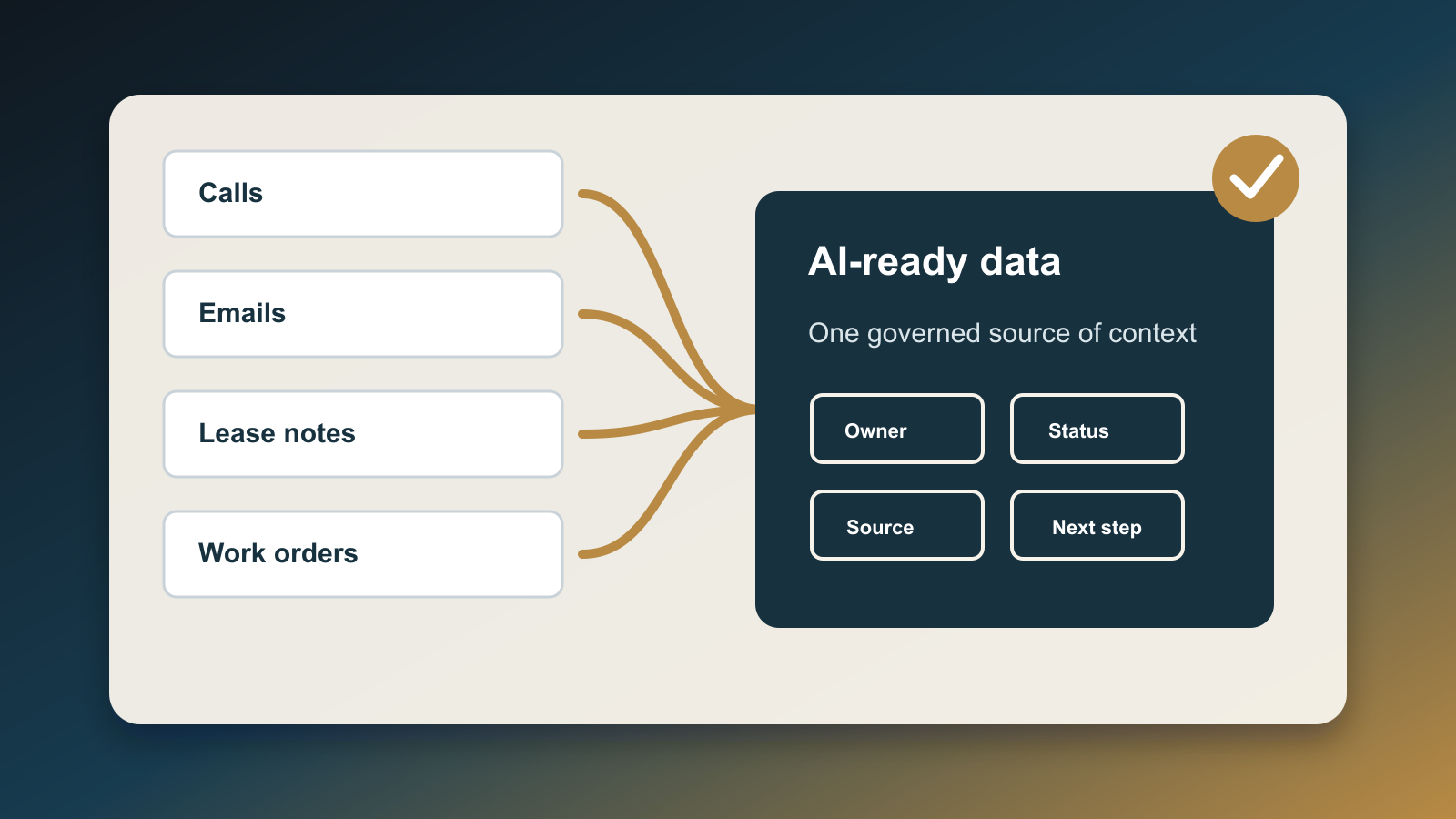
Real estate teams are moving from occasional AI experiments to daily AI workflows. That changes the risk profile of old CRM notes, buyer documents, listing packets, call transcripts, email threads, inspection attachments, lender updates, and transaction files. A model does not know whether a file is current, expired, sensitive, disputed, or only saved because nobody cleaned up the folder. It only sees available context.
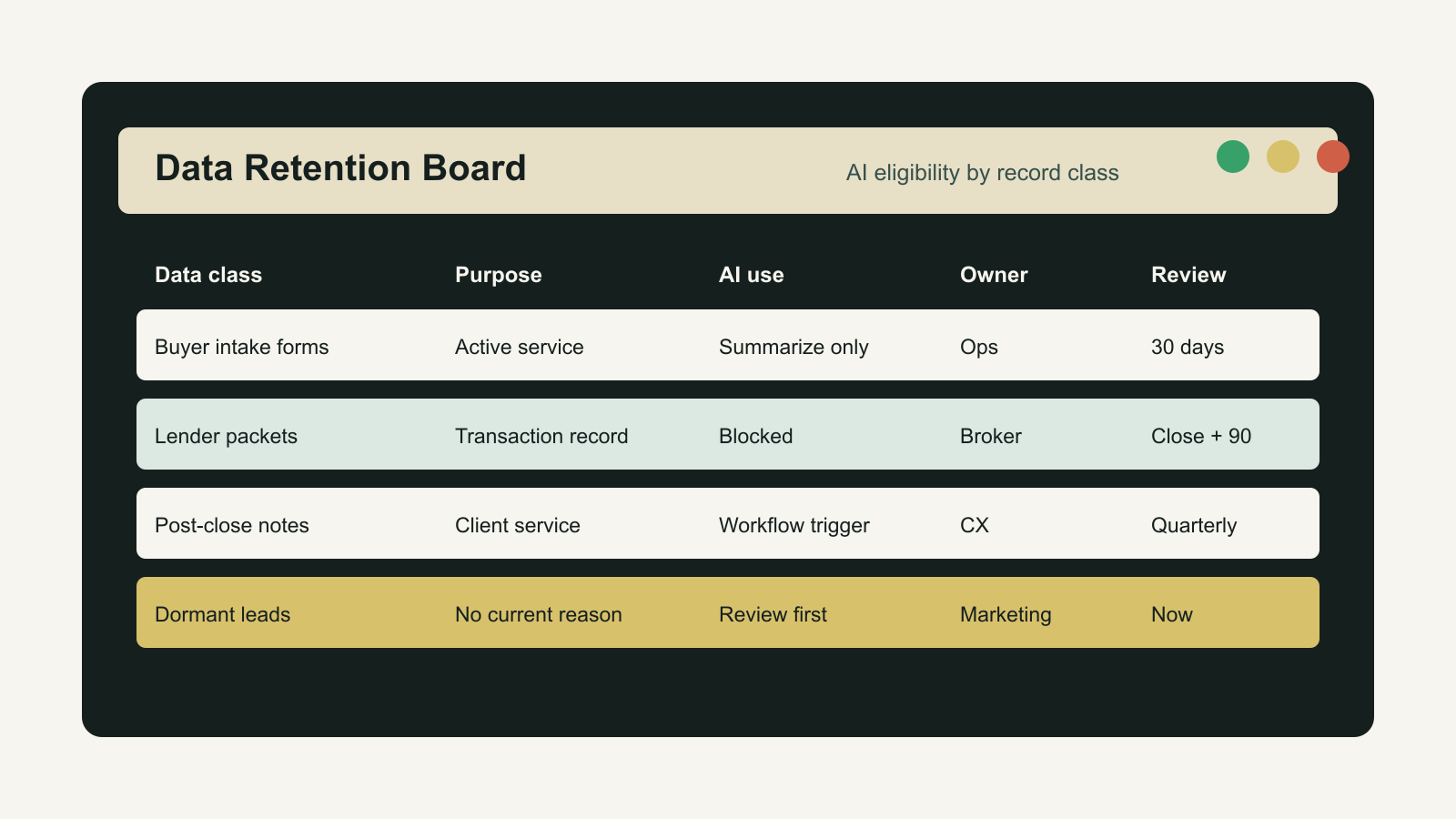
That is why the next practical AI control for brokerages is a data retention board: a plain operating view that tells the team what client information exists, why it is still being kept, who may use it, and whether it is eligible for AI summarization or automation. This is not a legal memo. It is the operational layer that keeps AI from treating every historical record as approved working memory.
The timing matters. IBM's May 5, 2026 Think announcement framed enterprise AI as an operating model problem, not a tool problem, with agents, data, automation, and hybrid governance working together. Cisco's 2026 privacy benchmark shows the same pressure from another angle: privacy programs are expanding because AI is forcing new data governance responsibilities, and only a small share of organizations describe their governance committees as mature. In real estate, RPR's February 2026 survey reported that most agents are using or planning to use AI, while accuracy, compliance, and client-facing use remain top concerns. Those facts point to the same practical conclusion: before AI touches client files, the file estate needs rules.
The board is not a document archive
A normal archive answers, "Where is the file?" A retention board answers better questions:
- What is the business purpose for keeping this data?
- Is the record active, closed, expired, disputed, or deletion-ready?
- Is it safe for AI to summarize, cite, classify, or trigger a workflow from it?
- Who approved the retention rule?
- What should happen when the retention window expires?
This turns scattered storage into a controlled operating surface. A transaction coordinator can see that closing documents must remain accessible to the right people. A marketing lead can see that old lead notes are not automatically available for reactivation campaigns. A broker can see which data classes are blocked from AI use unless a human approves the request. The point is not to slow work down. The point is to stop old data from quietly becoming new AI input.
Start with five columns, not a policy binder
Most teams do not need a heavyweight governance system to begin. They need a board that covers the records that AI workflows are most likely to touch.
First, list the data class. Use working labels people recognize: buyer intake forms, listing agreements, transaction emails, showing notes, lender communications, inspection attachments, repair invoices, post-close check-in notes, web leads, call transcripts, and vendor conversations.
Second, assign the retention reason. Examples include active representation, closed transaction record, service history, referral relationship, compliance review, dispute support, marketing consent, or no current reason. That last option matters. A retention board that cannot say "no current reason" becomes an archive with nicer columns.
Third, mark AI eligibility. Use simple states: blocked, summarize only, classify only, workflow trigger allowed, client-facing generation allowed, or requires broker review. This gives operators a way to route AI safely without asking every person to interpret privacy and compliance risk in the moment.
Fourth, set the owner. Every row needs a person or role that can answer why the data exists. Ownership should sit with operations, brokerage leadership, marketing, transaction management, or client service depending on the class. If nobody owns a category, AI should not use it.
Fifth, define the next action date. Retention is not a permanent label. Closed files, old leads, stale consent, and abandoned intake data need review dates. The board should create work: renew, archive, delete, anonymize, restrict, or approve for a specific AI use case.
Use the board as an AI access gate
The most useful implementation is not a spreadsheet that sits outside the workflow. The useful version sits between the CRM, document storage, and the AI tool.
When an agent asks AI to summarize a client history, the system should check the board. Active buyer notes might be eligible for internal summary. A lender email with sensitive financial details might be blocked from model input or limited to a human-reviewed summary. A five-year-old inquiry with no active consent might be restricted from reactivation automation. A closed transaction file might be available only to produce an internal timeline, not marketing copy.
This is where retention becomes an implementation advantage. The team can move faster because the rules are already visible. Instead of debating each request, operators check the row and proceed within the allowed use. The board becomes the first version of a policy engine.
Make client trust visible
Consumer tolerance for unclear AI data use is low. Malwarebytes' March 2026 privacy survey found broad concern about AI using personal data without consent. Whether a real estate team cites that exact number or not, the operating lesson is simple: clients are less forgiving when they suspect their information is being used in ways they did not expect.
A retention board gives the team a clear answer when a client asks what is happening with their information. The answer should not be "our CRM has it." The answer should be specific: this category is kept for this purpose, only these roles can use it, AI can or cannot touch it, and the record is reviewed on this schedule. That kind of clarity is hard to improvise after a complaint.
The FTC's business guidance also points toward basic data discipline: collect what is needed, protect sensitive information, and dispose of it securely when it is no longer needed. A brokerage does not need to turn every AI workflow into a legal proceeding to apply that principle. It needs an operational inventory that stops unnecessary data from being preserved forever and reused casually.
What to block first
Start with high-risk categories. Do not let AI freely ingest full lender packets, identity documents, medical or hardship explanations, detailed financial records, dispute-heavy transaction notes, private family circumstances, or raw call recordings. These can still have legitimate business uses. That does not mean they should become broad model context.
Next, block stale data. Dormant leads, expired buyer preferences, old showing feedback, and unverified notes are dangerous because they look useful. AI can turn old context into confident recommendations: re-engage this person, recommend this neighborhood, mention this family detail, or assume this budget. Stale context is where automation becomes awkward at best and harmful at worst.
Then block data with unclear permission. If the team cannot explain why a record exists and what consent or business purpose supports its use, the AI eligibility column should default to blocked. That is the safest default and the easiest one to defend operationally.
Turn the board into weekly operations
The board should create a short weekly routine. Review new data classes added by tools, forms, integrations, or agents. Check anything marked deletion-ready or review-due. Sample AI outputs to confirm they only used eligible categories. Log exceptions where someone needed temporary access. Update the rule when the exception reveals a real workflow, and reject the exception when it only reflects convenience.
This weekly rhythm matters because AI tools multiply quickly. IBM's 2025 breach research highlighted the cost and risk of weak AI governance and shadow AI. For small teams, the equivalent problem is not a formal enterprise breach scenario. It is a pile of browser extensions, note-takers, lead tools, chatbots, and automations pulling from the same messy client history. The retention board gives the business one place to decide what those tools should not touch.
The implementation test
A data retention board is working when three things are true.
First, the team can name every client data category AI is allowed to use. Second, the team can name every category AI is blocked from using. Third, the team can show what happens when a record gets old, loses its purpose, or needs review.
That is the difference between AI as a shortcut and AI as an operating system. Shortcuts consume whatever is nearby. Operating systems enforce state, permission, and lifecycle. Real estate teams do not need enterprise bureaucracy to get there. They need a board that makes retention visible before automation starts treating every client file as memory.

Written by
Ben Laube
AI Implementation Strategist & Real Estate Tech Expert
Ben Laube helps real estate professionals and businesses harness the power of AI to scale operations, increase productivity, and build intelligent systems. With deep expertise in AI implementation, automation, and real estate technology, Ben delivers practical strategies that drive measurable results.
View full profile