Build a Local Sponsorship Proof Board Before AI Buys Community Ads
Build a Local Sponsorship Proof Board Before AI Buys Community Ads
Local sponsorships are one of the easiest places for AI to make a confident bad recommendation. A model can see that the brokerage sponsored the spring baseball league, a school fundraiser, a neighborhood festival, or a chamber event. It can also see invoices, logo placements, social posts, landing pages, QR scans, and a few new contacts in the CRM. That is enough for a generic automation system to say, "double down."
That is not enough for an operator.
The local advertising market is getting more competitive and more measurable at the same time. BIA revised its 2026 U.S. local advertising forecast to $184.5 billion and called out growth in mobile, social, video, streaming, advertising technology, and key verticals including real estate. IAB's 2026 outlook says buyers are moving toward performance-led strategies while agentic AI becomes part of planning, activation, and measurement. Its 2025 Internet Advertising Revenue Report says U.S. digital advertising reached nearly $300 billion, with growth increasingly tied to performance-driven and AI-powered execution.
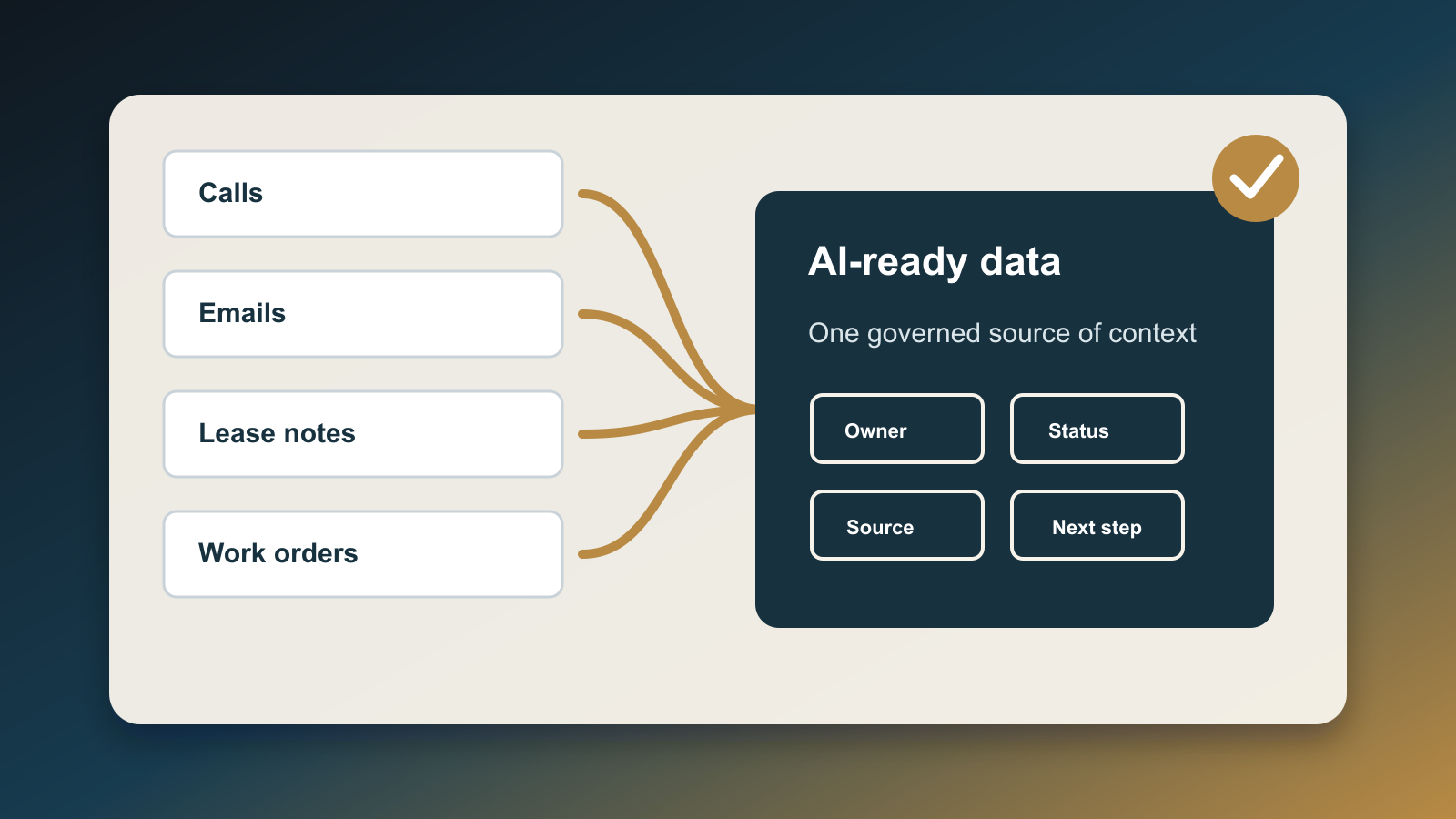
That creates a practical problem for real estate teams. Community sponsorships often sit outside the clean digital path that AI tools prefer. They produce local presence, goodwill, referral context, and offline conversations, but the evidence is usually scattered across email, photos, vendor invoices, sign-in sheets, agent notes, social posts, and CRM records. If an AI media assistant is allowed to compare those sponsorships against paid search, social ads, portals, or retargeting without a proof layer, it will either undervalue community work because the data is sparse or overvalue it because the visible artifacts look active.
The fix is not to force every sponsorship into a fake last-click attribution model. The fix is to build a local sponsorship proof board before AI recommends the next spend decision.
What the board is for
A sponsorship proof board is an operating surface that answers one question: what did this local spend actually create that the business can verify?
It should not be a brand scrapbook. Photos from the booth are useful, but they are not the board. A logo placement is useful, but it is not proof. A thank-you post from the event organizer is useful, but it does not prove business impact. The board should turn each sponsorship into a tracked business asset with evidence, follow-up ownership, and a clear decision state.
For a brokerage, team, or local business, the board should show:
- the sponsorship commitment and cost
- the audience the event was supposed to reach
- the exact assets delivered
- the proof that those assets actually ran
- the contacts, conversations, referrals, or appointments created
- the CRM records tied to those contacts
- the follow-up sequence assigned after the event
- the next decision: repeat, revise, pause, or replace
That last state matters. AI should not be asked, "Was this sponsorship good?" It should be asked, "Given this evidence, what decision should we make next?"
Why AI needs this guardrail
AI marketing systems are getting better at finding patterns across channels, but they still need disciplined inputs. IAB's 2026 outlook describes AI moving deeper into media planning and optimization, with cross-platform measurement becoming more important as buyers connect automated implementation to outcomes. That is exactly where local sponsorships break if the CRM and marketing stack do not agree on what happened.
The inputs are messy because community marketing is relationship-heavy. A parent may scan a QR code at a tournament, ask an agent a question three weeks later at a school event, and finally request a valuation after seeing a market update in email. A rigid ad platform may credit the email. A human agent may credit the relationship. An AI system may credit whichever record is cleanest.
The proof board gives the AI a better set of facts:
- this event created ten identified homeowner conversations
- three conversations already existed in the CRM
- two became seller-intent follow-ups
- one referral came through a sponsor partner
- the landing page produced low volume but high local relevance
- the agents did or did not complete follow-up within the agreed window
That structure lets AI assist with pattern recognition without pretending that a neighborhood sponsorship behaves like a search keyword.
The minimum data model
Start with a simple table. Each row is one sponsorship, not one vendor invoice.
Use these fields:
- Sponsorship name
- Sponsorship type: school, youth sports, nonprofit, chamber, builder, lender partner, neighborhood event, local media, or creator partnership
- Market area
- Target audience
- Spend committed
- Assets promised
- Assets verified
- Event or campaign dates
- Landing page or QR destination
- CRM campaign code
- Partner or organizer contact
- Internal owner
- Follow-up owner
- Contacts captured
- Existing CRM contacts touched
- New CRM contacts created
- Conversations logged
- Appointments created
- Referrals created
- Content assets produced
- Compliance notes
- Decision state
- Renewal date
Do not overbuild this on day one. The point is to force a basic proof chain. If the team cannot say what was promised, what ran, who saw it, who followed up, and what happened next, the AI should not be allowed to recommend increasing spend.
The evidence tiers
Not all proof is equal. The board should separate evidence into tiers so the next decision is not driven by the most visible artifact.
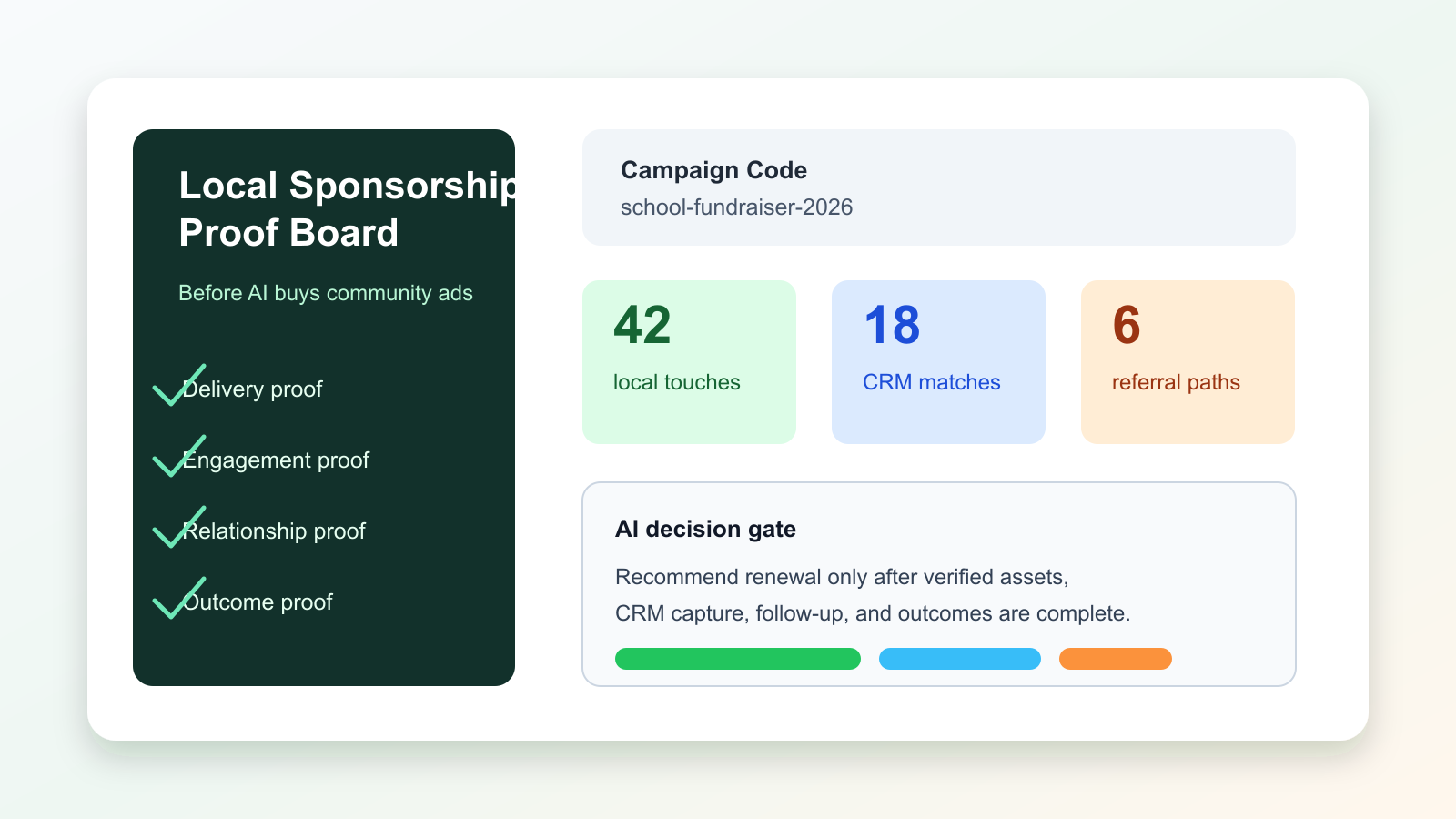
Tier one is delivery proof. This includes invoice, contract, logo placement, signage photo, program mention, email placement, organizer confirmation, booth attendance, social post URL, or event recap. Delivery proof says the sponsorship happened. It does not say it worked.
Tier two is engagement proof. This includes QR scans, landing page visits, form starts, event sign-ins, direct messages, replies, conversations logged by agents, social comments from local accounts, and partner introductions. Engagement proof says people interacted with the sponsorship.
Tier three is relationship proof. This includes CRM contacts matched to the event, notes from known homeowners, referral-source updates, partner introductions, follow-up tasks completed, and segment movement inside the CRM. Relationship proof says the sponsorship strengthened or created identifiable business relationships.
Tier four is outcome proof. This includes booked consultations, listing appointments, buyer consultations, recruiting conversations, referral agreements, vendor partnerships, closed business, or pipeline movement. Outcome proof says the sponsorship contributed to measurable business value.
AI should read those tiers differently. A sponsorship with strong delivery proof and weak engagement proof needs better activation. A sponsorship with strong engagement proof and weak relationship proof needs better CRM capture. A sponsorship with strong relationship proof and weak outcome proof may need a longer nurture window. A sponsorship with weak proof across all tiers should not renew automatically.
How to wire it into the CRM
The board only works if it connects to the CRM at the moment of capture. This does not require a complex attribution platform. It requires naming discipline.
Create one campaign code per sponsorship. Use the same code on QR links, landing pages, form hidden fields, event import sheets, agent note templates, and follow-up tasks. Add a simple source detail value such as "school-fundraiser-2026" or "downtown-market-sponsor-may-2026." Then require agents to select that value when they log an event conversation.
For contacts already in the CRM, do not overwrite the original source. Add the sponsorship as a touchpoint. This avoids the common mistake of turning every later interaction into a new "source." A sponsorship can influence a past client, a sphere contact, a vendor, a buyer lead, or a recruit. The board needs to see those touches without destroying source history.
For new contacts, capture consent and context at the same time. If the person scanned a QR code for a market report, log the topic and the permission basis for follow-up. If they spoke with an agent at an event, log the conversation summary and the next promised action. AI follow-up is only useful when it knows what the person actually asked for.
The AI decision gate
Once the board exists, the AI workflow should have a clear gate:
No sponsorship recommendation can be generated unless the sponsorship has a complete proof package.
That package should include cost, target audience, verified assets, CRM campaign code, engagement summary, follow-up completion rate, and decision state. If any of those are missing, AI can summarize the gap, draft the organizer follow-up, or prepare the CRM cleanup list. It should not recommend renewal, budget increase, or replacement.
This is how the board changes the operating model. AI is not just a media buyer. It becomes a review assistant that distinguishes between missing evidence and poor performance.
What this looks like in practice
Imagine a brokerage sponsors a youth sports league for $2,500. The old review process asks whether the logo was visible, whether agents felt the event was worthwhile, and whether any obvious leads came in.
The proof board asks better questions:
- Did the league deliver every promised asset?
- Which neighborhoods and households were represented?
- Did the QR code point to a useful local resource?
- Were scans tagged with the campaign code?
- Did agents log conversations within 24 hours?
- Were existing clients touched by the sponsorship?
- Did any partner introductions happen?
- Did follow-up tasks get completed?
- Did any contacts move into a seller, buyer, recruit, or referral segment?
- What would have to change for renewal to make sense?
Now AI can help. It can compare engagement by sponsorship type, flag missing follow-up, summarize organizer performance, identify which agents converted conversations into CRM records, and recommend the next test. But it is working from a structured proof board, not a pile of anecdotes.
The KPI stack
Use a small KPI stack that respects the nature of local sponsorships:
- Delivery completion rate
- Cost per verified local touch
- CRM match rate
- New contact capture rate
- Follow-up completion rate
- Appointment or referral creation rate
- Partner introduction count
- Segment movement by audience type
- Renewal recommendation with evidence tier
The most useful KPI is often not immediate ROI. It is proof quality. A sponsorship that creates weak outcomes but clean evidence is easy to improve. A sponsorship that "felt good" but produced no reliable evidence is operationally risky because AI cannot learn from it.
The operator's rule
Do not ask AI where to spend local marketing dollars until the business can prove what its current local spend did.
That rule is especially important now because local media and digital ad markets are becoming more automated, more fragmented, and more performance-oriented. Real estate teams already use social media, AI-generated content, CRM tools, and local relationships in the same operating week. The winning teams will not be the ones that let AI chase the cleanest metric. They will be the ones that give AI enough local proof to respect the work that actually creates trust.
Build the board first. Then let AI recommend the next sponsorship, the next partner conversation, and the next follow-up sequence.

Written by
Ben Laube
AI Implementation Strategist & Real Estate Tech Expert
Ben Laube helps real estate professionals and businesses harness the power of AI to scale operations, increase productivity, and build intelligent systems. With deep expertise in AI implementation, automation, and real estate technology, Ben delivers practical strategies that drive measurable results.
View full profile