Build a Relocation Signal Board Before AI Sends Move-Ready Campaigns
Build a Relocation Signal Board Before AI Sends Move-Ready Campaigns
AI can make past-client marketing feel alive again. It can watch CRM notes, summarize property history, draft check-ins, score homeowners, and trigger campaigns the moment a model thinks someone may be ready to move. That is useful only if the underlying signal is real.
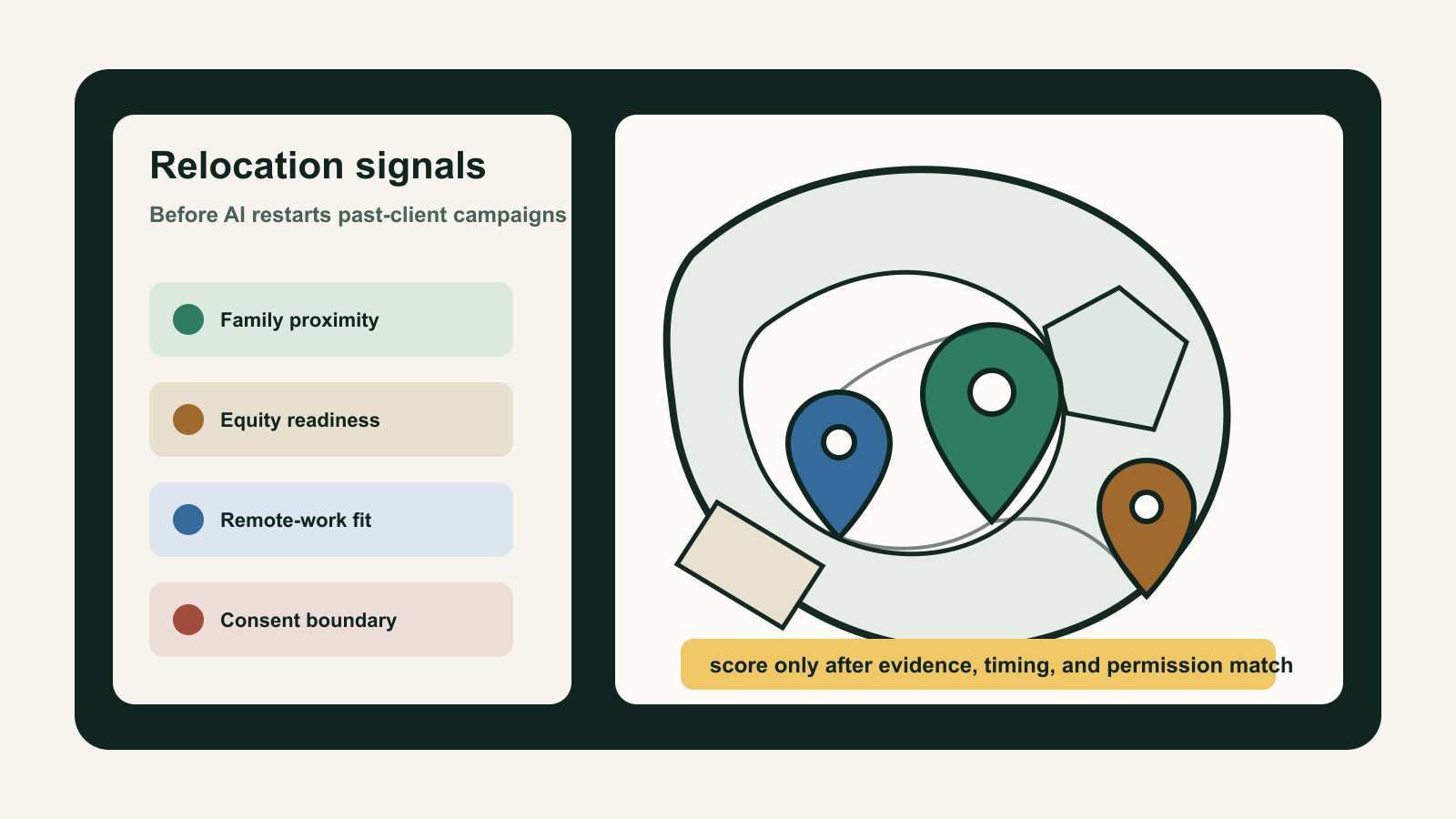
Relocation is not a generic nurture event. It is usually tied to a personal constraint: family proximity, retirement, caregiving, work flexibility, taxes, safety, space, affordability, or a household change that has not yet been said out loud. If an AI workflow turns weak clues into a "ready to move" sequence, the message can feel intrusive, premature, or simply wrong. The better operating move is to build a relocation signal board before AI restarts past-client campaigns.
The market data makes this worth separating from normal follow-up. NAR's Migration Trends report says recent clients most often chose a specific area to be closer to family and friends, followed by getting more home for the money. The same report notes that job location did not play a role for many movers because remote work changed the geography of the decision. NAR's 2026 generational reporting also shows adults ages 61 to 79 remain a major force in buying and selling, with equity helping many older owners move closer to family, downsize, retire, or choose a different lifestyle. That is not a single lead source. It is a set of life-event patterns that need context.
At the same time, AI use inside real estate is no longer theoretical. NAR's 2025 Technology Survey found agents using AI tools at daily, weekly, and monthly cadences, and clients responding positively to technology in the transaction. The risk is not that AI enters the workflow. The risk is that AI gets permission to infer relocation intent from stale CRM history before the team defines what evidence is strong enough.
What goes on the board
A relocation signal board is a small operating layer between the CRM and the campaign engine. It does not replace the CRM. It tells the CRM which past clients are eligible for human review, which ones should stay in normal care, and which signals are too sensitive or too speculative to use.
Start with the evidence class. Every signal should be labeled by where it came from. Direct signals include a client saying they want to be closer to family, asking about downsizing, mentioning a job change, requesting a valuation, or asking about another market. Observed signals include home equity changes, long tenure, a school or caregiving note already present in the CRM, a saved search, or repeated engagement with relocation content. External signals include public market data, local affordability shifts, and migration patterns. AI should treat those three classes differently.
Direct signals can trigger a named-owner task. Observed signals should trigger review. External signals should only shape audience strategy, not individual outreach. That separation keeps the team from pretending a model knows a client's intent when it only knows a pattern.
Next, add the move driver. Most teams keep past clients in broad buckets such as homeowner, seller lead, investor, or sphere. Relocation campaigns need sharper labels: closer to family, more home for the money, lower tax burden, retirement, downsizing, remote-work flexibility, school change, caregiving, lifestyle upgrade, or neighborhood mismatch. These are not copy themes. They are decision contexts. A client moving for caregiving should not receive the same AI-written message as a client exploring a lower-tax state.
Then add timing confidence. A relocation board should separate "monitor," "ask permission," "human review," and "active plan." Monitor means the signal is weak and should not produce a campaign. Ask permission means a relationship owner can send a low-pressure check-in that invites the client to update preferences. Human review means there is enough context for an agent or operator to decide the next step. Active plan means the client has confirmed intent and the CRM can support follow-up, referrals, valuations, vendor coordination, and transaction prep.
The permission layer matters
Relocation signals often touch sensitive personal context. A past client may have a parent who needs care, a child moving back home, a divorce, a new job constraint, a retirement plan, or a budget problem. The FTC's business guidance is a useful baseline: companies should be clear about how they use personal information and keep sensitive data protected. For a real estate CRM, that means the AI workflow needs a visible permission field, not just a marketing segment.
The permission field should answer five questions. Did the client agree to this channel? Did they agree to this topic? Is the information first-party, inferred, or purchased? Who is allowed to see it? When should it expire? If the team cannot answer those questions, the AI should not personalize the message around that signal.
This is where many automated campaigns break trust. The copy is polished, but the premise is unsupported. A client who receives "thinking of moving closer to family?" because a model inferred age, home tenure, or engagement with a market report may feel watched. A client who previously mentioned helping a parent may appreciate a thoughtful human note if the agent has context and permission. The difference is not the sentence. It is the operating record behind the sentence.
How AI should use the board
AI should not decide that someone is move-ready. It should help the team maintain the board.
Use AI to summarize client history into candidate signals, but require the summary to cite the CRM fields or notes it used. Use it to classify the move driver, but keep confidence visible. Use it to draft three types of outreach: a neutral preference-update note, a human review brief, and a confirmed-plan checklist. Do not let it jump directly from signal detection to a sales sequence.
A practical board can use these columns:
- Client and household context
- Last verified relationship owner
- Evidence class
- Move driver
- Signal source
- Timing confidence
- Permission status
- Recommended next action
- Human reviewer
- Expiration date
- Outcome
The expiration date is important. A life-event signal gets stale quickly. A client who said in February that they may relocate for family should not be treated the same way in November unless the relationship owner has updated the record. AI is good at remembering old context. Operators have to decide when old context is no longer fair to use.
What to automate first
The first automation should be a weekly review queue, not a campaign. Have the system find past clients with new direct signals, high-value observed signals, or stale relocation notes. Ask AI to produce a one-paragraph brief for the relationship owner: what changed, where the evidence lives, what the likely move driver is, and what action is allowed.
The second automation can be a preference-refresh workflow. This is not a hard sell. It asks the client whether their plans, home goals, preferred locations, or communication preferences have changed. The response updates the board and gives AI better first-party context.
The third automation can be market-matched content. If a client has confirmed interest in moving closer to family or getting more home for the money, AI can help assemble useful context: valuation prep, timing tradeoffs, neighborhood comparisons, referral options, or a move-readiness checklist. That content should still be reviewed by the relationship owner before it becomes direct advice.
The operating standard
The relocation signal board gives the team one rule: AI may accelerate a confirmed relationship process, but it may not invent intent. That rule is easy to say and hard to enforce unless the CRM has fields that distinguish evidence, timing, permission, and ownership.
For real estate teams, this is where practical AI strategy becomes operations. The market is creating real relocation moments: equity-rich owners, family-driven moves, remote-work flexibility, affordability pressure, and longer home tenures. AI can help surface those moments, but the team has to decide what counts as a respectful next step.
A good relocation campaign does not start with a model score. It starts with a board that says what the team knows, how it knows it, whether it has permission to use it, and who is responsible for the next human touch.
Sources

Written by
Ben Laube
AI Implementation Strategist & Real Estate Tech Expert
Ben Laube helps real estate professionals and businesses harness the power of AI to scale operations, increase productivity, and build intelligent systems. With deep expertise in AI implementation, automation, and real estate technology, Ben delivers practical strategies that drive measurable results.
View full profile