Build a Review Response Desk Before AI Manages Reputation
Build a Review Response Desk Before AI Manages Reputation
Online reputation used to be treated like a marketing chore: ask for reviews, reply when someone complains, and hope the star rating stays healthy. That is too thin for 2026. Reviews now feed local search, social proof, AI recommendations, buyer confidence, seller confidence, and the private decision a client makes before they ever fills out a form.
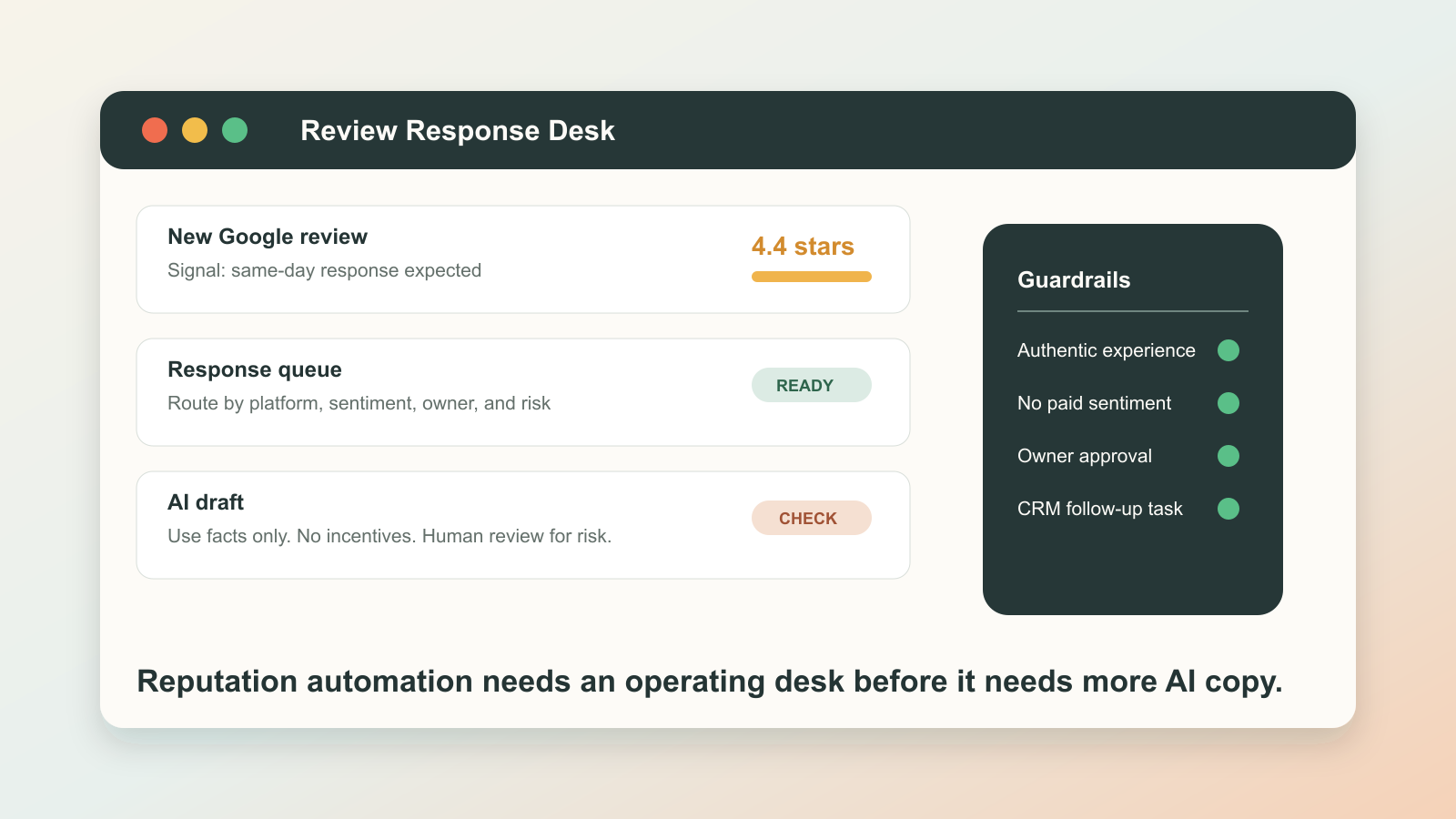
The practical move is to build a review response desk before letting AI manage reputation. A desk is not another inbox. It is an operating layer that captures every review, identifies the platform and risk, assigns an owner, gives AI the right facts, requires human approval where needed, and turns reputation signals into CRM follow-up.
Reviews are no longer one channel
BrightLocal's 2026 Local Consumer Review Survey found that 97% of consumers read reviews for local businesses, and that the average consumer uses six different review sites when choosing a business. That matters for real estate teams because the review record is scattered. Google may be the biggest surface, but it is no longer the only surface clients trust.
The same survey shows why response discipline matters. BrightLocal reported that 80% of consumers are more likely to use a business that responds to every review, 42% are unlikely to use a business that ignores reviews entirely, 89% expect business owners to respond, and 81% expect a reply within a week. Generic replies are not harmless either: half of consumers said templated or generic responses make them unlikely to choose a business.
AI makes this both easier and riskier. It can draft a thoughtful response in seconds, but it can also turn a sensitive complaint into polished legal exposure, make promises the business cannot keep, or reply with a generic tone that tells prospects nobody actually read the review.
AI recommendations raise the stakes
The review surface is expanding because AI tools are becoming a recommendation layer. BrightLocal's March 2026 AI trust report found that 45% of consumers use AI tools for local business recommendations, up from 6% the prior year. The main 2026 review survey also says AI tools like ChatGPT have become one of the most common sources for local recommendations.
This changes the reputation job. The business is not only persuading the person who wrote the review. It is leaving public evidence for prospects, search engines, map platforms, and AI systems that summarize local options. A stale, ignored, inconsistent, or suspicious review profile can now travel farther than the original review page.
Real estate has an added reason to care. NAR's 2025 Home Buyers and Sellers Generational Trends report shows that agent experience, honesty and trustworthiness, and reputation are material factors when buyers choose an agent. For sellers, reputation is even more direct: the report lists reputation of agent as the top factor for choosing a listing agent across all sellers. A review response desk is not vanity management. It is sales infrastructure.
Compliance cannot be an afterthought
Reputation automation also sits inside a stricter rules environment. The FTC's Consumer Reviews and Testimonials Rule went into effect on October 21, 2024 and addresses deceptive or unfair conduct involving reviews and testimonials. The FTC guidance says courts can impose civil penalties for knowing violations. Google Business Profile guidance separately says reviews and ratings should reflect a genuine, unbiased experience, and it treats paid, fake, or manipulated engagement as prohibited content.
That means the review workflow has to separate legitimate review requests from prohibited pressure. Asking satisfied clients to share an honest experience is different from offering a reward for a positive review. Asking for more detail is different from asking someone to remove or revise a negative review in exchange for a benefit. Letting AI draft responses is different from letting AI invent facts, claim an issue was resolved when it was not, or imply a private outcome that should not be disclosed.
The desk should make those boundaries operational instead of relying on memory.
What belongs in the desk
Start with one intake table. Every review should create a record with platform, URL, reviewer name if available, rating, sentiment, topic, transaction or service relationship if known, date received, response deadline, assigned owner, compliance risk, and follow-up status. The owner should know whether the review belongs to sales, service, broker leadership, marketing, or a specific agent.
Second, add a response policy. Positive reviews can usually follow a simple structure: thank the client, reference the actual service theme, avoid private details, and reinforce the standard of care. Neutral reviews should acknowledge the mixed experience, ask for a direct conversation when useful, and create an internal improvement task. Negative reviews need triage before public response. The desk should identify whether the issue involves fair housing, legal claims, confidential transaction details, compensation, vendor complaints, discrimination allegations, safety concerns, or a possible fake review.
Third, give AI a bounded drafting role. The prompt should include the public review, approved facts from the CRM, the relationship type, the response policy, forbidden claims, and the platform. It should not be allowed to invent an apology for facts the business has not verified, disclose transaction specifics, argue with the reviewer, promise compensation, or ask for a changed rating. AI writes a candidate response. A human owner approves it.
Fourth, connect the desk to CRM follow-up. A review is a relationship signal. A positive review can trigger a thank-you task, referral conversation, testimonial permission request, or case-study note. A negative review can trigger service recovery, manager review, process repair, or vendor follow-up. A recurring complaint theme should become an operating issue, not just a marketing problem.
Fifth, measure the right things. Do not stop at average star rating. Track response time, unanswered review count, review recency by platform, response personalization quality, unresolved complaints, repeat complaint themes, compliant review requests sent, and CRM follow-up completed. The metric that matters is not whether AI replied quickly. It is whether the business responded accurately and did the operational work behind the response.
The minimum implementation
Build the first version with one shared queue and three response lanes: thank, recover, and escalate.
The thank lane handles straightforward positive reviews. AI can draft from approved templates, but the final reply should mention a real service detail when available. The recover lane handles neutral or negative reviews where the business has enough context to acknowledge the concern and invite a direct conversation. The escalate lane catches anything with legal, brokerage, fair housing, privacy, platform policy, compensation, or authenticity risk.
Add a weekly review meeting. Ten minutes is enough. Look at unanswered reviews, late responses, unresolved recoveries, new complaint themes, review request compliance, and which public comments should create CRM tasks. The meeting is where reputation turns back into operations.
Then automate carefully. Use AI to classify incoming reviews, draft first responses, summarize themes, and suggest CRM tasks. Keep the human in control of final replies and any response that could create risk. The point is speed with judgment, not speed instead of judgment.
Bottom line
AI can make review management faster, but speed is not the scarce asset. Judgment is. A real estate team needs a review response desk that knows where reviews live, who owns the response, what rules apply, what facts can be used, and what follow-up should happen after the reply is posted.
Build that desk first. Then let AI assist inside it. The result is a reputation system that looks responsive in public, learns from clients in private, and keeps the CRM aligned with what the market is already saying about the business.
Sources
- BrightLocal, Local Consumer Review Survey 2026, February 11, 2026: https://www.brightlocal.com/research/local-consumer-review-survey/
- BrightLocal, Nearly Half of Consumers are Asking AI for Business Recommendations, March 10, 2026: https://www.brightlocal.com/research/lcrs-ai-trust/
- Federal Trade Commission, The Consumer Reviews and Testimonials Rule: Questions and Answers, accessed May 2, 2026: https://www.ftc.gov/business-guidance/resources/consumer-reviews-testimonials-rule-questions-answers
- Google Business Profile Help, Fake & Misleading Content & Reviews, accessed May 2, 2026: https://support.google.com/business/answer/7400114?hl=en
- National Association of REALTORS, 2025 Home Buyers and Sellers Generational Trends Report, April 1, 2025: https://www.nar.realtor/sites/default/files/2025-04/2025-home-buyers-and-sellers-generational-trends-04-01-2025.pdf

Written by
Ben Laube
AI Implementation Strategist & Real Estate Tech Expert
Ben Laube helps real estate professionals and businesses harness the power of AI to scale operations, increase productivity, and build intelligent systems. With deep expertise in AI implementation, automation, and real estate technology, Ben delivers practical strategies that drive measurable results.
View full profile