Build a Valuation Review Gate Before AI Sends Home Estimates
Build a Valuation Review Gate Before AI Sends Home Estimates
AI can turn a few property facts into a confident home estimate in seconds. That speed is useful inside a real estate operation, but it becomes risky when the number reaches a seller, buyer, investor, lender partner, or past client before anyone has checked the evidence behind it.
A home value estimate is not just another marketing sentence. It can change seller expectations, buyer confidence, pricing strategy, refinance conversations, appraisal anxiety, and trust in the agent. When the market is moving unevenly, an AI-generated estimate can sound precise while hiding stale comparable sales, rate-sensitive demand, local inventory shifts, renovation uncertainty, and missing property context.
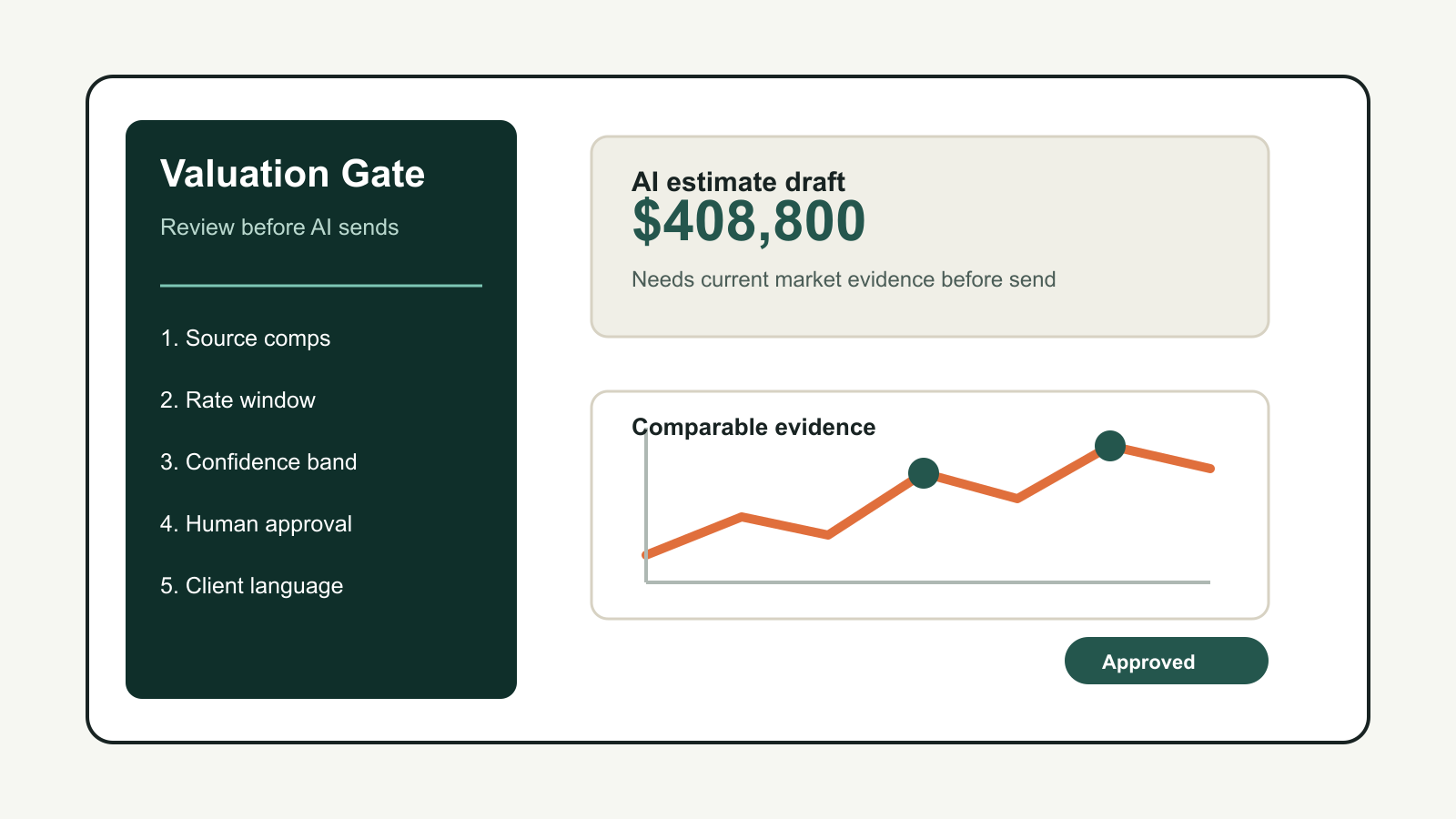
The operating answer is a valuation review gate. Before AI sends a home estimate, CMA summary, equity update, price-watch message, or seller nurture email, the system should prove where the number came from, what changed recently, how confident the team is, who approved the wording, and what the client is allowed to do next.
Why this belongs in the workflow now
Valuation language is getting more sensitive because AI adoption and market volatility are rising at the same time. NAR's 2025 technology survey found that 46% of REALTORS reported using AI-generated content, and a separate NAR/RPR survey published in February 2026 found that accuracy was the top AI concern among surveyed agents. That is the exact tension valuation workflows create: AI can draft quickly, but a wrong or overconfident price signal can damage a real client conversation.
Market data also changes the risk profile. Freddie Mac's Primary Mortgage Market Survey showed the 30-year fixed-rate mortgage averaged 6.30% as of April 30, 2026, with purchase demand reacting to modestly lower rates and more inventory. NAR's March 2026 existing-home sales release reported a median existing-home price of $408,800, a 4.1-month supply, and the 33rd consecutive month of year-over-year price increases. NAR's March pending-home-sales release also showed national contract signings up 1.5% month over month but down 1.1% year over year.
That combination means a national or metro-level headline is not enough. A valuation message needs local, current, property-specific evidence. Otherwise AI may take a broad data point and make it feel like a precise recommendation.
There is also a regulatory signal worth treating seriously. The FHFA page for the federal final rule on quality control standards for automated valuation models lists an October 1, 2025 effective date and describes standards for confidence in estimates, protection against data manipulation, conflict avoidance, random testing and review, and compliance with nondiscrimination laws. Even when a brokerage workflow is not directly making a covered credit decision, those standards point to the kind of discipline valuation systems need.
What the gate should decide
The gate should not ask, "Can AI write this?" It should ask five stricter questions.
First, what is the valuation source? Separate MLS comparable sales, active listings, pending listings, appraisal history, tax records, AVM output, RPR-style reports, agent notes, seller-provided upgrades, and public market statistics. Do not let the final client-facing sentence hide whether the number came from sold comps, active competition, or an automated estimate.
Second, how fresh is the evidence? A comparable from six months ago may be useful background in one neighborhood and misleading in another. The gate should store sale date, list-to-sale ratio, days on market, concessions when known, property condition notes, and the date the data was pulled.
Third, what is the confidence band? AI should not convert weak evidence into a single strong number. Use bands such as high confidence, directional, needs human review, and do not send. A condo with three nearly identical recent sales may support a tighter range. A renovated rural home, luxury listing, mixed-use property, or neighborhood with few recent sales should default to a wider range and human language.
Fourth, what changed since the last message? If rates, inventory, price reductions, competing listings, local demand, or property condition changed, the gate should force a new review. The best valuation workflow is event-driven, not calendar-driven.
Fifth, who owns the final claim? The gate should store the reviewer, approval time, allowed audience, approved channel, and expiration date. A number approved for an internal seller-prep note is not automatically approved for a postcard, email blast, website lead magnet, or lender conversation.
The minimum data model
A practical valuation review gate can start with one table in the CRM or operations database. Each row should represent one valuation claim, not just one property.
Use these fields as the minimum:
- Property address or property ID
- Client or household ID
- Valuation purpose: seller nurture, CMA prep, equity update, buyer analysis, price reduction, refinance prompt, or internal research
- Source type: MLS comps, AVM, appraisal, tax record, agent analysis, public market report, or mixed
- Source links or attachments
- Comp set date range
- Current inventory notes
- Rate and affordability context date
- Estimate range, not just point estimate
- Confidence level
- Known exclusions, such as unfinished renovation, missing square footage, unusual lot, unverified improvements, or limited comps
- Compliance flags, including fair-housing sensitivity and audience restrictions
- Approved client-facing language
- Reviewer
- Approval status
- Expiration date
- Follow-up action
This turns valuation from a loose AI prompt into an auditable operating object.
Where AI fits safely
AI can still help. It should summarize comparable evidence, explain why a confidence band is wide, draft seller-friendly language, identify missing data, flag stale comps, and prepare alternate versions for a client email, CRM note, or call prep sheet.
But AI should not be allowed to invent the estimate, imply certainty, erase uncertainty, or send a recommendation when the evidence is thin. The model should work from the review gate, not around it.
A safe prompt pattern is simple: "Use only the approved valuation row below. Do not add comparables, market claims, or price recommendations that are not present. Preserve the approved range and confidence level. Include the required caveat. If evidence is insufficient, draft a request for review instead of a client message."
That prompt is not magic. It works because the data model gives the AI less room to improvise.
Client-facing language should be constrained
Most valuation mistakes happen in tone, not just math. AI loves clean certainty. Real estate valuation usually needs measured language.
Replace "Your home is worth $408,800" with "Based on the reviewed comparable set, the current working range is $395,000 to $415,000 before final pricing review." Replace "Prices are rising" with "The reviewed market data shows price growth nationally, but the local comp set still needs confirmation." Replace "Now is the time to sell" with "This may be worth reviewing if your goals, timeline, and property condition still match the assumptions in the estimate."
The gate should keep approved language snippets for different confidence levels. High-confidence ranges can be more direct. Directional estimates should say what is missing. Low-confidence estimates should not go out until a human has reviewed the property.
How to implement it without slowing the team down
Start with the highest-risk sends. Do not try to govern every internal note on day one. Put the gate in front of automated equity updates, seller nurture campaigns, home-value landing page follow-up, CMA summaries, price-improvement messages, and AI-drafted market updates.
Then add three automations:
- Block send when confidence is low, evidence is expired, or no reviewer is assigned.
- Route review when the property has limited comps, unusual condition, recent renovation, or a high-value estimate swing.
- Log every sent valuation message back to the client record with the estimate range, source date, and approval ID.
That gives managers a useful audit trail without forcing agents to rebuild their whole CRM.
The operating rule
Do not let AI be the first system that decides what a home is worth. Let AI assist the analyst, summarize the evidence, and draft the message after the valuation claim has been reviewed.
The practical standard is straightforward: no source, no range, no confidence label, no expiration date, no owner, no send.
That is how real estate teams get the speed of AI without turning a home estimate into an unreviewed promise.
Sources reviewed

Written by
Ben Laube
AI Implementation Strategist & Real Estate Tech Expert
Ben Laube helps real estate professionals and businesses harness the power of AI to scale operations, increase productivity, and build intelligent systems. With deep expertise in AI implementation, automation, and real estate technology, Ben delivers practical strategies that drive measurable results.
View full profile