Build a Well and Septic Evidence Board Before AI Answers Rural Buyer Questions
Build a Well and Septic Evidence Board Before AI Answers Rural Buyer Questions
AI can make rural-property communication faster, but it should not be allowed to improvise around private wells, septic systems, water tests, service records, or buyer-sensitive health questions. Those subjects sit in a messy overlap between property condition, local rules, lender expectations, inspection timing, seller disclosure, and personal risk tolerance. A helpful assistant can summarize status, chase missing records, and prepare the next message. A risky assistant turns half-known facts into confident reassurance.
That is why rural and suburban real estate teams need a well and septic evidence board before they let AI answer buyer questions. The board is not a replacement for inspectors, health departments, attorneys, lenders, or licensed contractors. It is a structured place to separate what the team knows, what the client has provided, what a third party has confirmed, what is still missing, and what the AI is allowed to say.
The timing matters because real estate AI adoption is no longer theoretical. The National Association of REALTORS reported in its 2025 technology survey that 46% of agents who are REALTORS use AI-generated content, while eSignature, social media, drone photography, and other tools remain embedded in daily practice. That pattern creates an operational problem: the easier it becomes to generate polished client language, the more important it becomes to prove that the language is grounded in clean transaction evidence.
Private water and onsite wastewater are exactly the kind of topics where a polished message can outrun the file. EPA says private well owners are responsible for the safety of their household drinking water because private wells are not federally regulated under the Safe Drinking Water Act in the way public systems are. CDC advises well owners to test at least annually for total coliform bacteria, nitrates, total dissolved solids, and pH, and to use a state-certified laboratory. EPA also emphasizes septic inspection, pumping, water-efficiency, drainfield protection, and maintenance records as practical parts of septic ownership.
Those facts do not mean an agent should diagnose the system. They mean the transaction file needs a source-of-truth layer before AI drafts messages about it.
What the board should hold
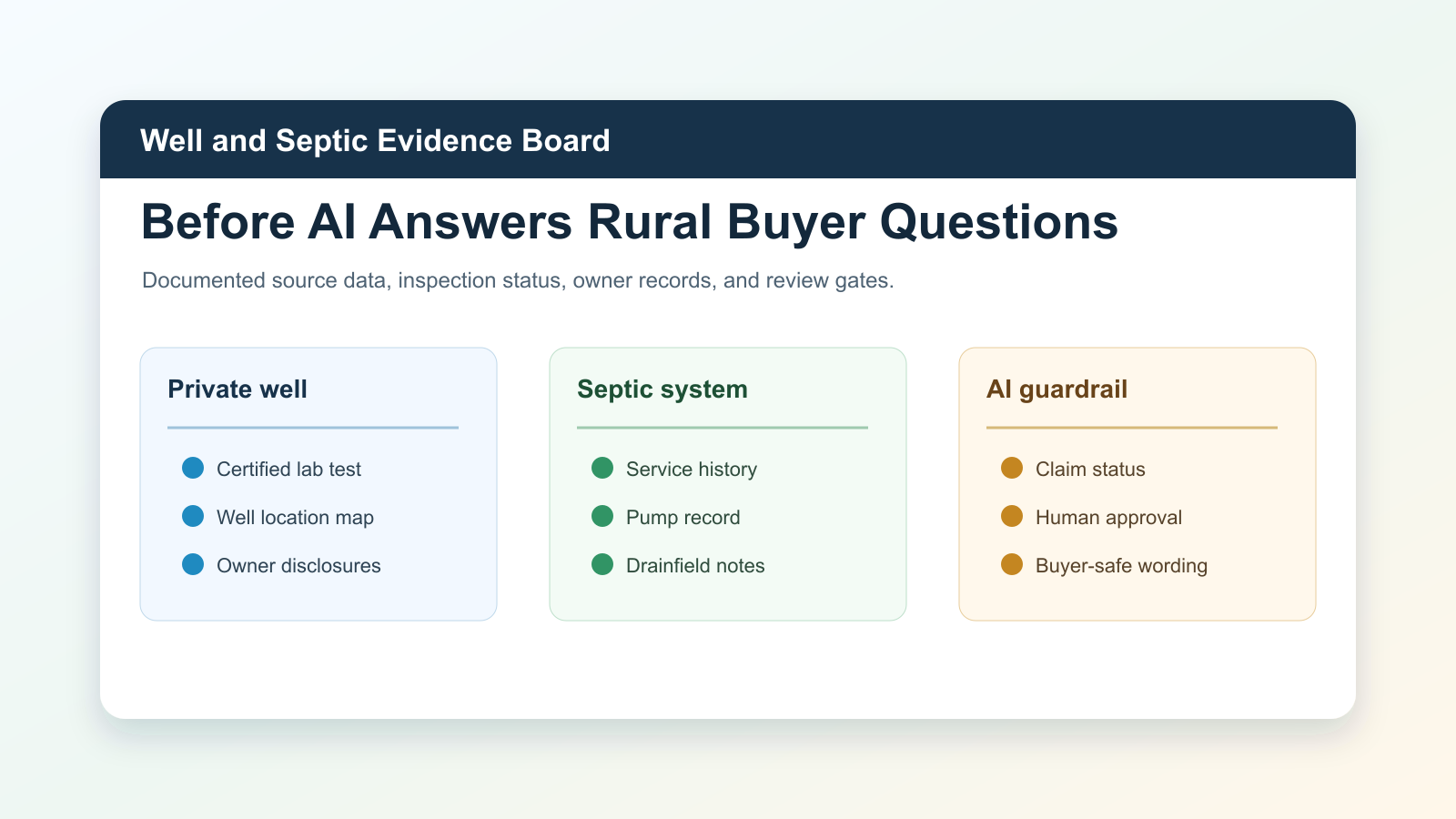
Start with a property system record for each private utility or onsite system. A well record should track whether the property uses a private well, shared well, public water connection, cistern, spring, or unknown source. It should capture the visible documentation: well log if available, location sketch, age if known, pump or treatment equipment notes, recent lab report, historical issue disclosures, and any health department or local authority references the client has provided.
A septic record should do the same for wastewater. Track whether the property uses public sewer, conventional septic, alternative septic, shared system, holding tank, or an unverified system. Capture permit records when provided, tank and drainfield location if known, service provider, inspection date, pumping date, repair history, maintenance contract, and any seller-provided notes about backups, odors, surfacing water, slow drains, or restricted drainfield access.
The important field is not the narrative. It is the evidence status. Every item should be marked as one of four states: client supplied, third-party verified, stale, or missing. That single distinction prevents the AI from treating a seller comment, a listing description, a lab result, and a county record as equivalent truth.
Add buyer-question routing
Most AI mistakes in this category will not come from the first summary. They will come from follow-up questions: Is the water safe? Is the septic system fine? Can I build a pool there? Will the lender accept it? Should I waive the inspection? Can we ask the seller to fix it? Is that smell normal?
A well and septic evidence board should route those questions before drafting a response. Some questions can be answered from the file, such as whether a lab report has been received or whether the septic inspection is scheduled. Some questions require a qualified third party, such as interpreting a contaminant result, diagnosing system condition, or estimating repair scope. Some questions require contract or lender context, such as whether a result affects contingency timing, closing conditions, or financing.
Make the routing explicit. Put each common buyer question into one of these buckets:
- Status update: AI may summarize documented dates, received files, and pending tasks.
- Evidence gap: AI may say the file does not yet contain enough documentation and name the missing item.
- Specialist handoff: AI must refer to an inspector, certified lab, septic professional, health department, lender, or counsel as appropriate.
- Human approval: AI can draft, but a team lead must approve before the message goes out.
This keeps the assistant useful without letting it drift into technical, legal, health, or financing conclusions.
Make the data operational, not decorative
The board should be built for daily transaction work. A good version has a row per property, not a folder of static PDFs. It includes owner-facing language status, evidence owner, deadline, dependency, and next action. A coordinator should be able to answer five questions in under a minute:
- What do we know about water source and wastewater system?
- Which evidence is current and third-party verified?
- Which buyer or lender question is blocked by missing documentation?
- Who owns the next action?
- What is AI allowed to say right now?
That last question is the governance layer. NIST's AI Risk Management Framework frames AI risk management around mapping, measuring, managing, and governing risk across the lifecycle. In a real estate team, that can be translated into a practical rule: do not let the AI generate client-facing certainty from unverified property-condition data.
Suggested fields
Use fields that force discipline:
- Property address and transaction stage.
- System type: public, private, shared, alternative, unknown.
- Source document: disclosure, inspection, lab report, county record, service invoice, contractor note.
- Source date and document owner.
- Verification level: unreviewed, client supplied, third-party verified, outdated, disputed.
- Buyer question category: safety, maintenance, repair, financing, disclosure, timing, cost, use restriction.
- Allowed AI response: summarize status, ask for missing evidence, draft for human review, blocked.
- Required human reviewer.
- Next action and due date.
- Client-safe wording note.
The client-safe wording note matters. For example, the AI should not say, "The well is safe." It can say, "The file includes a lab report dated X, and the team is waiting for the buyer or appropriate professional to review it." It should not say, "The septic is fine." It can say, "The file includes a service record dated X and an inspection is scheduled for Y." That difference is the difference between operational clarity and unauthorized reassurance.
How to launch it in a real team
Do not start by building a custom application. Start with the next five rural or semi-rural transactions and create the evidence board in the team's CRM, transaction platform, Airtable, Notion, or even a controlled spreadsheet. The tool matters less than the fields and approval rules.
For each transaction, backfill only the documents that already exist. Do not ask the coordinator to create a perfect historical archive. Then add one weekly review: which records are missing, which buyer questions are blocked, and which AI draft templates need stricter wording.
After two weeks, connect the board to automation. AI can generate missing-document requests, internal task summaries, and first-draft buyer updates. But the board should enforce three hard stops:
- No safety claims without the relevant report and human approval.
- No system-condition conclusions without the appropriate professional source.
- No financing or contract implications without lender, attorney, or broker review where required.
That is enough to make AI useful without pretending it is a well inspector, septic contractor, lender, or lawyer.
The business payoff
The board creates value beyond risk control. It makes rural-property transactions easier to manage, reduces repeated questions, shortens handoffs between agents and coordinators, and gives managers a cleaner view of where deals are getting stuck. It also helps the team learn which sources are most often missing: old pump records, lab reports, drainfield location, permit history, shared-well agreement, or documented maintenance.
That pattern becomes a training asset. New agents learn what to collect. Coordinators know which reminders to send. Brokers can review higher-risk files earlier. AI gets a narrower, cleaner context window. Buyers get more precise updates.
The right question is not whether AI should help with well and septic communication. It should. The question is whether the team has given AI enough verified structure to avoid creating false confidence. A well and septic evidence board is the practical middle ground: faster communication, cleaner files, and a clear line between documented status and professional judgment.
Sources

Written by
Ben Laube
AI Implementation Strategist & Real Estate Tech Expert
Ben Laube helps real estate professionals and businesses harness the power of AI to scale operations, increase productivity, and build intelligent systems. With deep expertise in AI implementation, automation, and real estate technology, Ben delivers practical strategies that drive measurable results.
View full profile