Real Estate Automation Breaks at the Handoff
Real Estate Automation Breaks at the Handoff
Most real estate teams do not have a shortage of tools. They have a shortage of clean handoffs.
A lead fills out a form, a portal alert hits an inbox, a buyer replies to a nurture email, a seller asks for a valuation, or an old client reappears after seeing a post. The technology usually captures the signal. The failure happens in the next ten minutes: who owns it, what they know, what message goes out, what gets logged, and what happens if nobody responds.
That is why the next practical automation project for many real estate operators is not another AI tool. It is a handoff map.
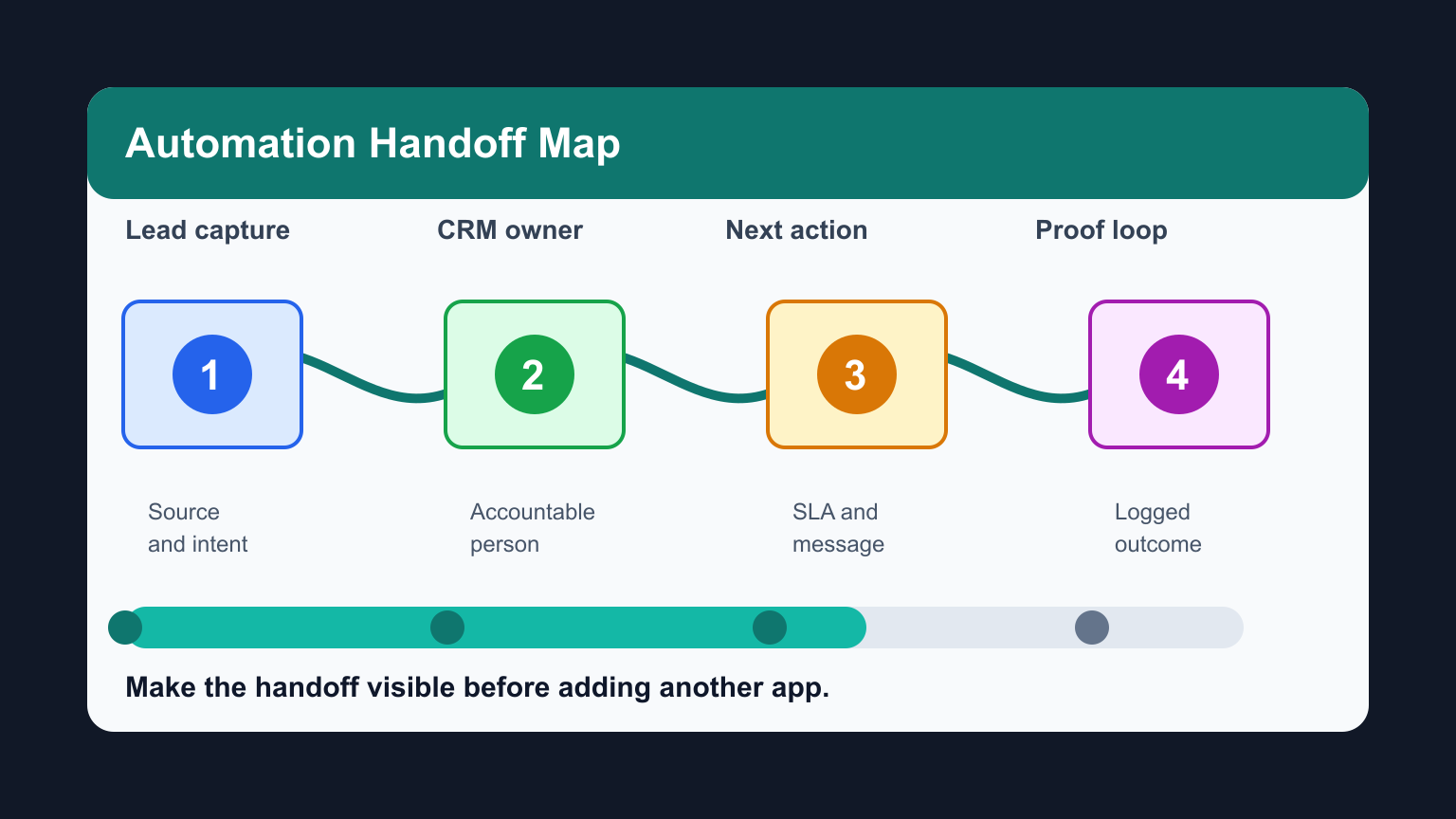
A handoff map is a simple operating layer that defines how work moves from one person, system, or stage to the next. It turns "the CRM has it" into a visible chain of accountability: trigger, owner, required context, response SLA, next action, fallback, and proof that the step happened. Once that exists, AI and automation can help. Without it, AI accelerates confusion.
Why this matters now
Real estate technology adoption is already high. NAR's 2025 Technology Survey found that eSignature, social media, drone photography, and AI-generated content are now normal parts of the agent toolkit. NAR also reported that 46% of agents who are REALTORS use AI-generated content, while 20% use AI tools daily and 22% use them weekly.
The broader sales market is moving the same way. Salesforce's 2026 State of Sales research reported that sales teams named AI and AI agents their top growth tactic for 2026. It also found that 87% of sales organizations already use AI for work such as prospecting, forecasting, lead scoring, or email drafting.
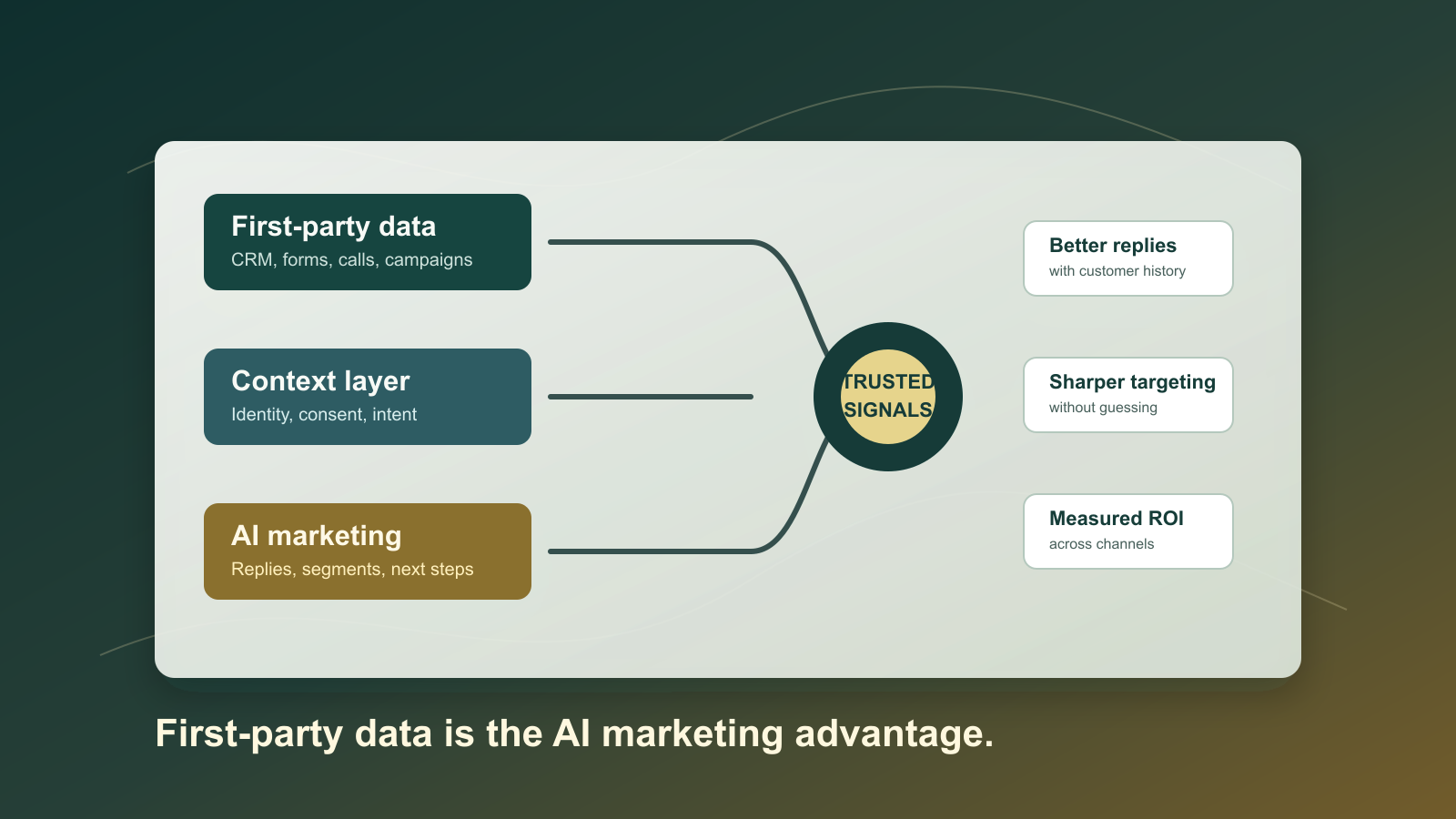
But the same Salesforce report points at the constraint: disconnected systems and messy data. Over half of sales leaders with AI said disconnected systems are slowing AI initiatives, and 74% of sales professionals are focusing on data cleansing. That is not a software feature problem. It is an operating-system problem.
McKinsey's 2025 State of AI survey tells the same story at the company level. AI use is widespread, but most organizations are still experimenting or piloting rather than scaling. One of McKinsey's key findings is that high performers are redesigning workflows, not just adding models.
For a brokerage, team, or solo agent, that means the advantage is not "we use AI." The advantage is that every lead, client, listing, and transaction has a reliable path through the business.
The handoff problem in real estate
Real estate work is full of small transitions that feel obvious until they fail.
A Zillow lead needs to become a CRM record, then a text, then a call task, then a buyer consultation, then a saved search, then a financing checkpoint. A listing inquiry needs source attribution, property context, appointment routing, showing notes, and follow-up. A past-client referral needs relationship context before anyone sends a generic message. A seller lead needs a valuation workflow, not just a "new lead" tag.
Automation fails when those transitions are implied instead of designed.
The symptoms are familiar:
- Leads have source data but no intent data.
- A CRM task exists, but nobody owns the outcome.
- The first response is fast, but the second response never happens.
- AI drafts the email, but the CRM lacks the facts needed to make it useful.
- A lead changes stage, but the next workflow does not start.
- A team member handles the client, but the system never learns what happened.
This is how teams end up with expensive software and inconsistent execution. The business is technically automated, but the customer experience still depends on memory.
Build the map before the agent
A good handoff map is not complicated. It should fit on one page for each major workflow.
Start with five columns.
1. Trigger
What exact event starts the workflow? Examples: new portal lead, open-house scan, home valuation form, buyer consult booked, inspection completed, contract signed, referral received, no response after three touches.
Be specific. "New lead" is too broad. "Seller valuation request from website with address and phone number" is usable.
2. Required context
What must be available before the next step is useful? For a buyer lead, that may be price range, location, financing status, timeline, and preferred contact method. For a seller lead, it may be property address, estimated equity, motivation, timeline, and prior relationship.
This column protects the team from shallow automation. If the context is missing, the workflow should collect it or flag it. It should not pretend the record is ready.
3. Owner
Who owns the next outcome? Not who receives a notification. Not which system stores the task. One person or role owns the outcome until it moves stages.
This is where many CRM implementations break. The task is assigned, but the outcome is not. A handoff map should say who is accountable for contact, qualification, appointment setting, client prep, or transaction follow-through.
4. SLA and fallback
How quickly should the owner act, and what happens if they do not? A hot buyer inquiry might require a two-minute first response, a ten-minute call attempt, and a same-day fallback to another team member. A past-client check-in can move slower. A contract milestone might require same-day confirmation.
Automation is useful here because it can monitor the clock. But it needs the clock defined first.
5. Proof
What logged event proves the handoff happened? Examples: call disposition, SMS sent, appointment booked, consultation completed, lender intro made, showing feedback recorded, seller CMA delivered, nurture sequence selected, next task scheduled.
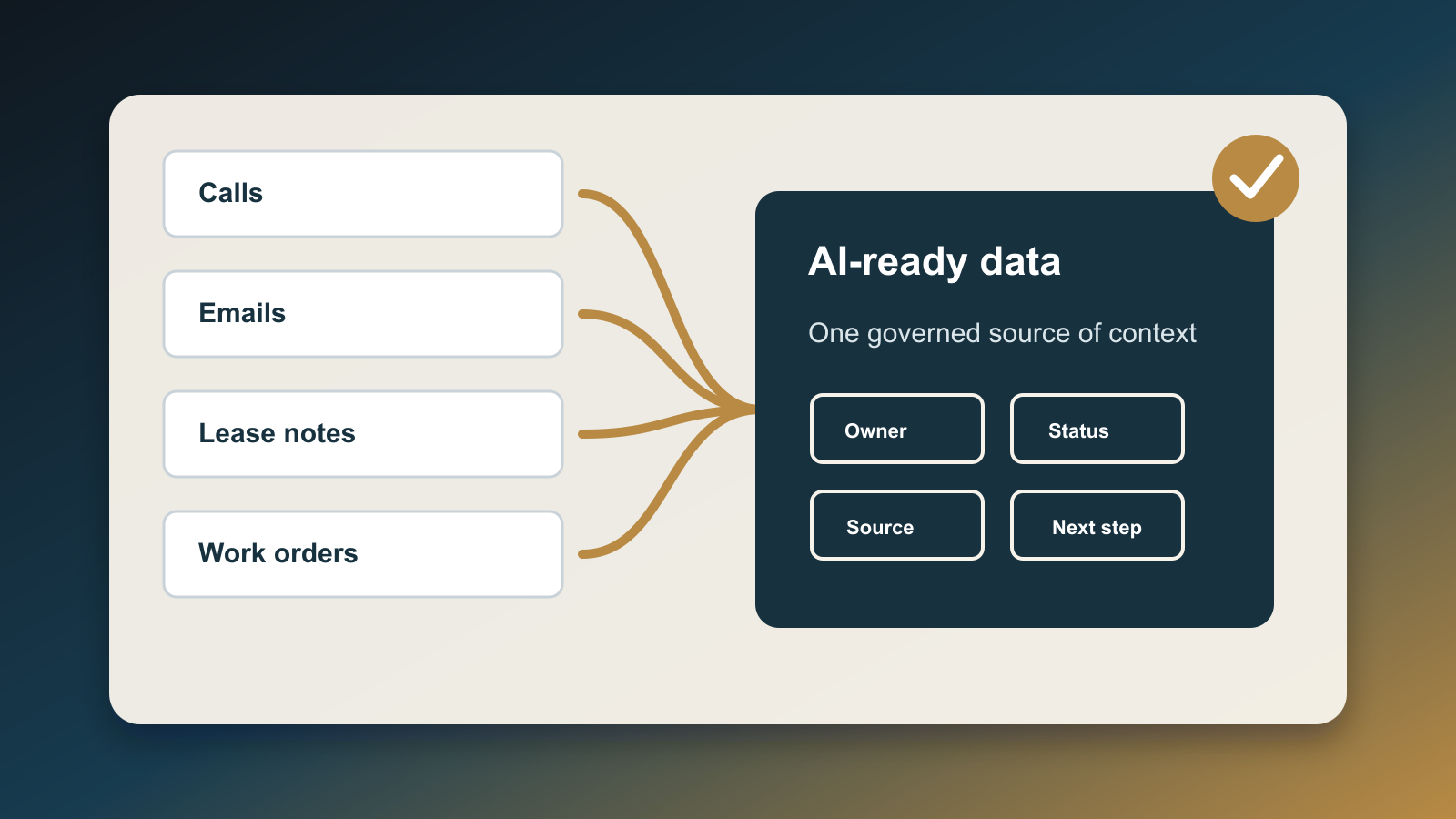
This is the difference between activity and operations. If proof is not logged, the system cannot learn from the workflow. AI cannot summarize what never made it back into the record.
Where AI fits
Once the handoff map exists, AI becomes much more useful.
It can summarize the lead record before a call. It can draft a first response using property and source context. It can classify intent from a reply. It can identify missing fields. It can recommend the next action. It can generate a recap after a consultation. It can check whether the promised follow-up was logged.
But AI should not be asked to invent the operating model. The team should define the workflow, then let AI reduce friction inside it.
This keeps the system practical. You do not need a giant transformation program. Pick one workflow with measurable leakage: new internet buyer leads, seller valuation requests, open-house follow-up, past-client referrals, or post-consultation nurture. Map it. Fix the fields. Define ownership. Add the SLA. Then automate the boring parts.
A useful first workflow
For many real estate teams, the best place to start is the seller valuation request.
It has clear business value, enough context to personalize, and a predictable handoff sequence:
- Website form captures address, contact details, source, and motivation.
- CRM creates or updates the contact without duplicating the household.
- System checks whether the person is a past client, sphere contact, or net-new lead.
- Owner receives a task with property and relationship context.
- AI drafts a first response, but the agent approves or edits it.
- If no response happens inside the SLA, fallback routing starts.
- After contact, the outcome is logged: appointment booked, nurture started, not ready, bad data, or no response.
- The next workflow starts from the outcome, not from a generic drip campaign.
That is the foundation for smarter automation. It also creates cleaner data for future AI agents, valuation workflows, and marketing segmentation.
The operator standard
The standard is simple: every important customer moment should have a visible next owner and a visible proof event.
If a lead can sit in the CRM without an owner, the handoff is not designed. If a client can change stage without a next action, the handoff is not designed. If an AI tool needs to guess what happened, the handoff is not designed.
Real estate teams do not need to pause AI adoption. They need to make AI adoption operational. Build the handoff map first. Then use automation to make the map run every day.
Sources
- Salesforce, "The Productivity Gap: New Survey Shows 9 in 10 Sellers Are Betting on AI and Agents To Help" (February 3, 2026): https://www.salesforce.com/news/stories/state-of-sales-report-announcement-2026/
- McKinsey, "The state of AI in 2025: Agents, innovation, and transformation" (November 5, 2025): https://www.mckinsey.com/capabilities/quantumblack/our-insights/the-state-of-ai/
- National Association of REALTORS, "REALTORS Embrace AI, Digital Tools to Enhance Client Service, NAR Survey Finds" (September 18, 2025): https://www.nar.realtor/newsroom/realtors-embrace-ai-digital-tools-to-enhance-client-service-nar-survey-finds
- HubSpot, "2026 state of marketing: Data from 1,500+ global marketers" (updated April 10, 2026): https://blog.hubspot.com/marketing/hubspot-blog-marketing-industry-trends-report

Written by
Ben Laube
AI Implementation Strategist & Real Estate Tech Expert
Ben Laube helps real estate professionals and businesses harness the power of AI to scale operations, increase productivity, and build intelligent systems. With deep expertise in AI implementation, automation, and real estate technology, Ben delivers practical strategies that drive measurable results.
View full profile