The Exception Queue Is the AI Agent Interface
The Exception Queue Is the AI Agent Interface
AI agents are moving from interesting demos into the operating layer of sales, marketing, service, and real estate workflows. That changes the implementation question. The useful question is no longer, "Can the agent draft the email, update the CRM, summarize the lead, or recommend the next action?" Most modern systems can do some version of those tasks. The useful question is, "Where does the work go when the agent is not confident enough to act?"
For a real estate team, the answer should not be another chat window. It should be an exception queue.
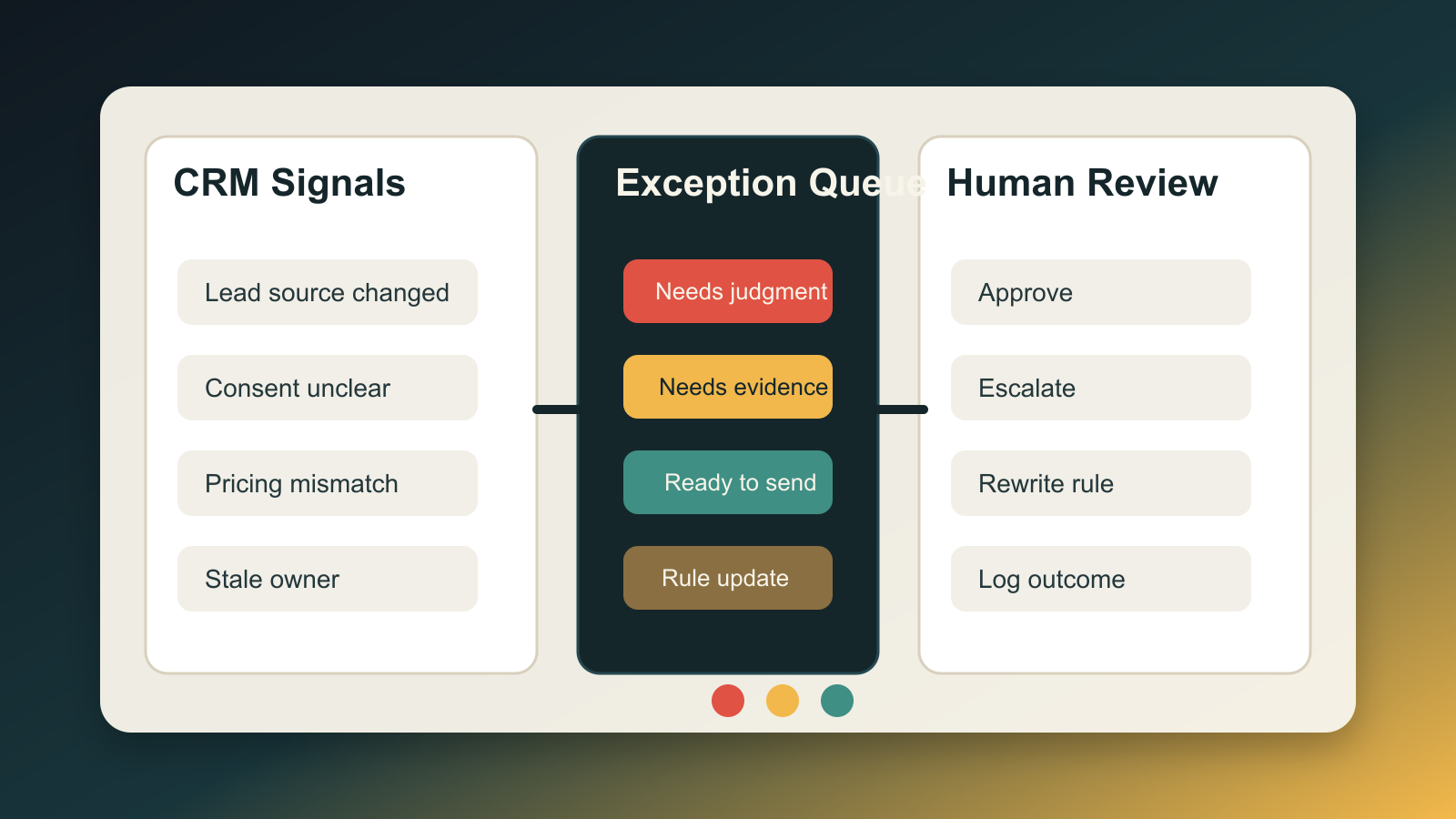
An exception queue is a visible list of cases where the system has enough information to notice that work needs attention, but not enough authority, evidence, or confidence to finish the work automatically. It is where an AI agent sends a lead with unclear consent, a listing inquiry with conflicting intent, a stale CRM owner, a duplicate contact, a pricing claim that needs verification, or a follow-up sequence that should pause because the customer replied with a sensitive life event.
That queue becomes the practical interface between automation and judgment. It gives the team a place to approve, rewrite, escalate, reject, or convert a one-off problem into a better operating rule.
Why this matters now
The timing is not theoretical. Gartner reported on April 28, 2026 that only 13% of organizations believe they have the right AI agent governance in place, while agent use is expected to multiply sharply inside large enterprises. Gartner's recommended controls include agent inventory, identity and permission models, information governance, and ongoing monitoring and remediation. Those ideas sound like enterprise IT concerns, but the same pattern shows up in smaller operating teams: once agents touch customer data and tools, someone has to see what they are doing, where they are stuck, and where they should stop.
Grant Thornton's April 2026 AI Impact Survey points at the same problem from the accountability side. The firm found that 78% of senior leaders lack full confidence they could pass an independent AI governance audit within 90 days. It also found that nearly three in four organizations are piloting, scaling, or running autonomous AI, yet only one in five has tested a response plan for AI failures. That is the gap an exception queue helps close. It turns failure handling from a vague promise into a daily operating surface.
Microsoft's March 30, 2026 security guidance on agentic AI makes the risk more concrete: agents can retrieve sensitive data, invoke tools, and act using real identities and permissions. When boundaries are unclear, an agent can create downstream impact across multiple systems. In real estate operations, that may look less dramatic than an enterprise security breach, but the business damage is still real: the wrong prospect receives a message, a lead is routed to the wrong person, a seller receives generic advice, or an assistant updates the CRM without preserving why the change was made.
The lesson is simple. Do not wait for a perfect autonomous workflow. Build the place where imperfect automation becomes reviewable work.
The queue should be designed around decisions
A weak exception queue is just an error list. It says, "Something failed." That is not enough for business operators.
A useful queue is organized around decisions. Each row should make the next action obvious: approve the agent's draft, ask for more evidence, assign a human owner, pause the workflow, merge a duplicate, update the rule, or mark the case as not automatable. The queue should show the contact, workflow, triggering rule, evidence, risk level, owner, deadline, and final outcome.
This matters because AI governance becomes real only when it changes the shape of work. A policy document says humans review risky activity. An exception queue shows which risky activities are waiting, who owns them, how long they have been waiting, and what happened after review.
For real estate teams, that can be a lightweight operating system:
- New internet lead with complete source, consent, and property context: agent drafts the response and logs the activity.
- New lead with missing source or ambiguous consent: agent creates an exception and blocks outbound automation.
- Past client asks a routine vendor question: agent drafts an answer from approved knowledge and routes it for quick approval.
- Past client mentions a legal, financial, family, or negotiation-sensitive issue: agent pauses the sequence and assigns the contact to a person.
- CRM contact has duplicate phone numbers, mismatched property interests, or a stale owner: agent proposes cleanup but waits for approval before changing the record.
The system is still productive, but it is productive in a way that exposes judgment instead of hiding it.
Context beats raw data
HubSpot's April 2026 Spring Spotlight framed its product direction around a useful implementation point: AI works better when it knows the business. HubSpot describes the gap between impressive demos and business outcomes as a context problem, not merely a data access problem. That distinction is important for exception queues.
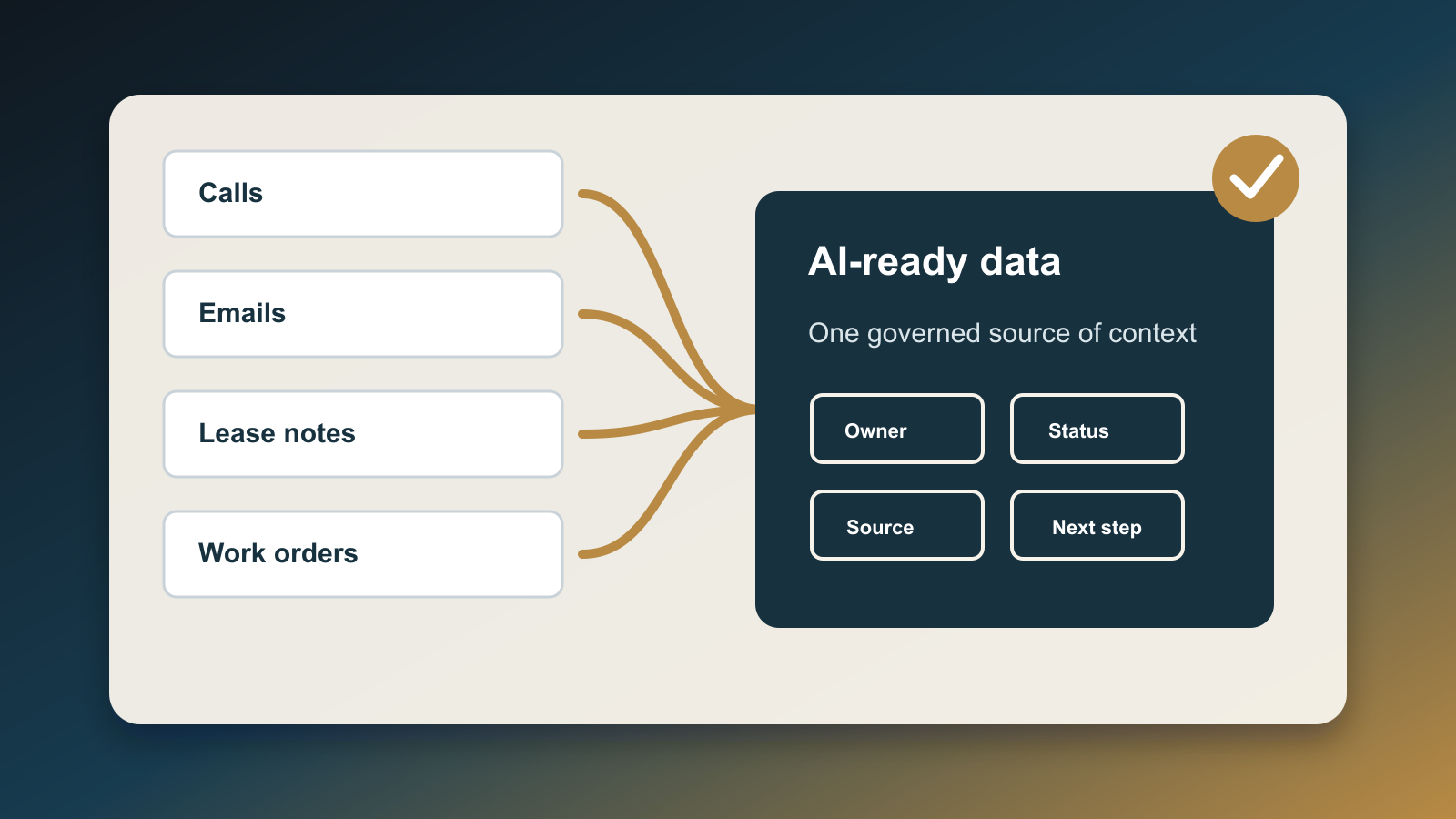
A CRM field can say a lead came from a portal. Context says the same person also attended an open house, asked about financing six months ago, clicked a downsizing guide, and recently replied that they are waiting for a job transfer. Without that context, an agent may technically follow the rules while still doing clumsy work.
The exception queue should therefore capture both data and context. Each exception should answer four questions:
- What did the agent want to do?
- What evidence supported that action?
- What missing or conflicting context prevented automation?
- What did the reviewer decide?
Those four fields create a feedback loop. If the same exception keeps appearing, the team has found either a data-quality issue, a missing policy, a weak prompt, an integration problem, or a process that should stay human-led.
This is also a sales productivity issue
Salesforce's February 2026 State of Sales announcement reported that AI and agents are now a top sales growth tactic, with 87% of sales organizations using some form of AI and 54% of sellers saying they have used agents. The same research also noted that disconnected systems are slowing AI initiatives for many sales leaders with AI, and that sales teams are putting more emphasis on data cleansing.
That finding maps directly to real estate teams. Many agents do not have one clean customer system. They have a CRM, transaction management, email, phone, calendar, website forms, portal leads, spreadsheets, and vendor notes. If automation spans those systems without an exception process, the team gets speed without clarity.
The queue fixes the workflow economics. Instead of asking a human to review every automated action, it asks humans to review the actions that reveal uncertainty. That is how small teams can scale oversight without turning AI into another full-time inbox.
A good target is not "zero exceptions." Zero exceptions usually means the system is hiding ambiguity or doing very little useful work. A healthier target is a queue that shrinks for repeatable issues and stays active for genuinely judgment-heavy work.
The real estate version
The National Association of Realtors' 2025 Technology Survey found broad use of digital tools and rising use of AI-generated content among agents. That confirms the adoption curve, but it also exposes the implementation gap. Using AI for listing copy is one thing. Letting agents route leads, update records, draft client messages, and trigger follow-up sequences is a different level of operational responsibility.
Real estate teams should start with one exception queue before expanding agent autonomy. The first version can be simple:
- A CRM view named "AI Exceptions."
- A required reason code such as consent unclear, data conflict, sensitive context, duplicate record, missing owner, low confidence, or policy review.
- A reviewer field and due date.
- A proposed action generated by the agent.
- A final disposition: approved, edited, escalated, rejected, merged, rule changed, or not automatable.
- A short outcome note that can be reused to improve the workflow.
This can live inside an existing CRM or project board. It does not require a new platform at first. The point is to create an operating habit: agents do the repeatable work, and humans work the edge cases that actually need human judgment.
What to build first
The first useful build is a lead follow-up exception queue. Lead follow-up has enough volume to matter, enough customer context to benefit from AI, and enough risk to need review.
Start with five triggers:
- Missing or unclear consent for outreach.
- Duplicate contact or conflicting phone/email data.
- Property request that conflicts with known budget, timeline, or location.
- Message content that mentions legal, financial, medical, family, or negotiation-sensitive details.
- Agent confidence below a defined threshold because source data is stale, incomplete, or contradictory.
Then measure four numbers each week: exceptions created, exceptions resolved, median resolution time, and rules changed because of repeated exceptions. Those numbers show whether automation is learning from operations or simply creating a new review burden.
The exception queue is not a retreat from automation. It is how automation becomes operationally durable. It gives AI agents a way to be useful before they are fully trusted, and it gives the business a way to learn where trust is earned.
The teams that get this right will not be the ones with the most agents. They will be the ones with the clearest review surfaces, the fastest feedback loops, and the best memory of why each important decision was made.
Sources
- Gartner, "Gartner Identifies Six Steps to Manage AI Agent Sprawl," April 28, 2026.
- Grant Thornton, "A widening AI proof gap is emerging," April 2026.
- Microsoft Security Blog, "Addressing the OWASP Top 10 Risks in Agentic AI with Microsoft Copilot Studio," March 30, 2026.
- HubSpot, "Spring 2026 Spotlight," updated April 14, 2026.
- Salesforce, "State of Sales Report for 2026," February 3, 2026.
- National Association of Realtors, "REALTORS Embrace AI, Digital Tools to Enhance Client Service," September 18, 2025.

Written by
Ben Laube
AI Implementation Strategist & Real Estate Tech Expert
Ben Laube helps real estate professionals and businesses harness the power of AI to scale operations, increase productivity, and build intelligent systems. With deep expertise in AI implementation, automation, and real estate technology, Ben delivers practical strategies that drive measurable results.
View full profile