AI Search Is Becoming a Real Estate Referral Channel
AI Search Is Becoming a Real Estate Referral Channel
Real estate teams should stop treating AI search as an abstract SEO trend. It is becoming another referral surface. A buyer, seller, investor, or relocation client can now ask an AI tool which local agents understand a neighborhood, who has recent seller reviews, what teams work well with first-time buyers, or which brokerage appears most credible for a specific property type. The answer may not come from one ranking page. It is assembled from public evidence.
That changes the operating question. The goal is not just to rank for a keyword. The goal is to make the business easy for search engines, AI systems, and cautious humans to verify.
The urgency is no longer theoretical. BrightLocal reported on March 10, 2026 that 45% of consumers had used AI tools for local business recommendations in the prior year, up from 6% in the prior survey cycle. The same report found that most AI users still check the underlying sources or real reviews before trusting a recommendation. That is the pattern real estate operators should design around: AI may introduce the business, but proof still closes the trust gap.
The referral path is fragmenting
A traditional local marketing plan had a clean mental model: Google Business Profile, portal listings, a few landing pages, maybe some social proof. That is too narrow now. BrightLocal's 2026 Local Consumer Review Survey found that 97% of consumers read reviews for local businesses, the average consumer uses six review sites, and AI tools have moved into the recommendation journey. Positive reviews are not always the end of the path either. BrightLocal also found that after reading positive reviews, many consumers keep researching, and 54% check the business website.
For real estate, that matters because the purchase cycle is longer, more emotional, and higher risk than most local services. A buyer may find the home online, but the agent still has to earn confidence. NAR's 2025 Home Buyers and Sellers Generational Trends report shows why digital proof cannot be thin: 43% of all buyers looked online for properties as their first step, 51% found the home they purchased on the internet, and buyers still used real estate agents at high rates during the search process. The online layer starts the journey. The trust layer decides who gets contacted.
Google's own direction points the same way. Its May 20, 2025 update described AI Mode as a search experience that can break a question into subtopics, issue multiple queries, and return helpful links. Whether a real estate team appears in that kind of answer depends less on slogan-heavy copy and more on whether the public web contains consistent, specific evidence about the business.
What AI systems need to see
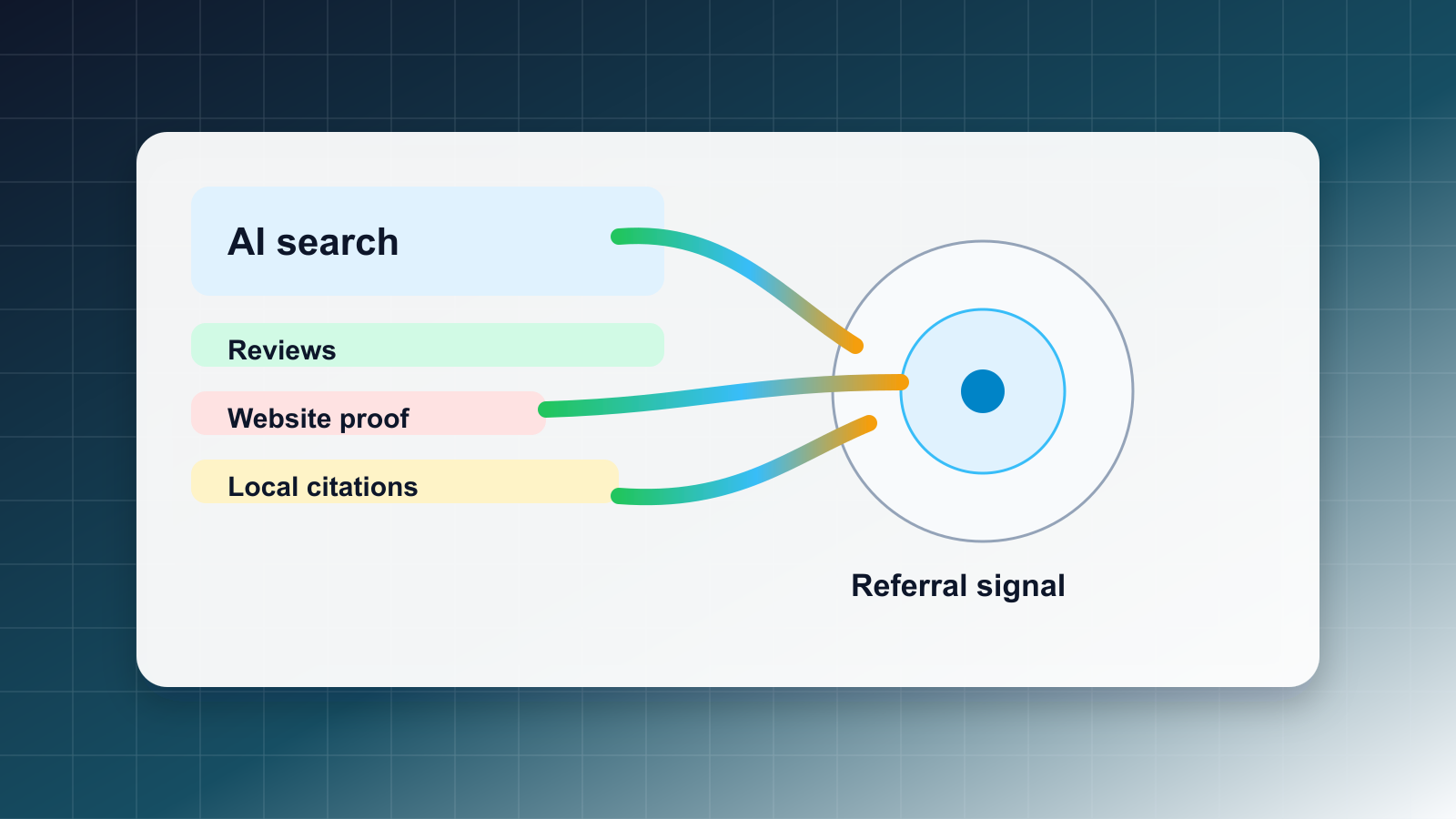
AI search does not create credibility from nothing. It works with signals it can find. For a local real estate team, those signals usually fall into five buckets.
First, there is identity consistency. The team name, agent names, brokerage affiliation, service area, phone number, office address, website URL, and profile links need to match across Google, Zillow, Realtor.com, Homes.com, Yelp, Facebook, LinkedIn, YouTube, local directories, and the business website. Inconsistent names and stale office data create friction for both people and machines.
Second, there is review depth. A review profile with fresh, specific, natural language is stronger than a profile with a small set of generic five-star comments. Reviews that mention neighborhoods, property types, relocation, negotiation, first-time buyers, probate, downsizing, luxury listings, investment properties, or communication style give AI systems more useful context. They also give humans a reason to believe the recommendation.
Third, there is website evidence. The website should support the reputation claim with pages that answer real client questions, show service-area expertise, explain the team's process, and connect proof to action. A testimonial page is not enough. AI systems and cautious buyers need context: who was helped, what problem was solved, which local market was involved, and what the client can do next.
Fourth, there is media evidence. NAR's generational trends data showed online video sites as one information source in the home search process, and photos, detailed property information, floor plans, virtual tours, and agent contact information all ranked as useful website features among internet-using buyers. That should shape the content mix. Short market videos, listing walkthroughs, neighborhood explainers, client education clips, and properly captioned images create searchable proof beyond text.
Fifth, there is operational freshness. An AI answer may surface a result, but a consumer who clicks through will notice whether the last review is old, the market page is stale, the phone number differs from a directory, or the site still promotes an expired offer. Local visibility is becoming a maintenance discipline, not a one-time campaign.
Build a citation-ready reputation system
The practical move is to treat reputation as a system of record. Start with a simple monthly audit.
Create a source inventory with every place a client might verify the business: Google Business Profile, major portals, social profiles, brokerage profile pages, directory listings, review platforms, YouTube, local sponsorship pages, podcast appearances, chamber pages, and the website. For each source, track the canonical business name, URL, phone, service area, category, primary proof points, review count, latest review date, and owner.
Then standardize the facts. Do not let old team names, inactive tracking numbers, abandoned neighborhoods, or conflicting bios remain online. AI answers are only as clean as the public evidence they synthesize.
Next, ask for better reviews without manipulating sentiment. The FTC's Consumer Reviews and Testimonials Rule went into effect on October 21, 2024 and addresses deceptive review practices. The FTC says incentives cannot be conditioned on a review expressing a particular sentiment. The operational lesson is straightforward: ask every qualified client for honest feedback, disclose incentives when used, do not gate negative experiences away from public platforms, and never use AI to fabricate testimonials.
The best review request is specific but neutral. Instead of asking for a five-star review, ask the client to describe what they were trying to accomplish, what the process was like, what helped them make decisions, and what future clients should know. That kind of review is more useful for buyers, more defensible for compliance, and more valuable for AI search because it contains context.
Turn the website into the verification layer
Most real estate websites are built as brochures. AI search rewards something closer to an evidence hub.
A strong local page should include who the page is for, the neighborhoods or property types covered, recent market observations, the process the team uses, proof from relevant reviews, links to useful resources, and a clear next action. A seller page should explain pricing, preparation, launch, negotiation, inspection, appraisal, and closing. A buyer page should explain search setup, financing coordination, showing strategy, offer structure, inspection, and post-contract communication.
This does not require writing hundreds of thin pages. It requires a small set of accurate, maintained pages with real examples. One well-maintained page on downsizing in a specific county will usually be more useful than ten generic AI-written posts about moving tips.
Teams should also connect structured data where the site supports it: organization details, local business information, author profiles, article metadata, FAQ content where appropriate, and consistent image alt text. Structured data will not manufacture authority, but it helps machines understand the evidence that already exists.
The weekly operating rhythm
AI search readiness becomes manageable when it is attached to existing operations.
Every week, review new client feedback, respond to public reviews, add one piece of local proof to the website, and check the highest-risk public profiles for drift. Every month, run a manual AI visibility check by asking major AI tools the same five local recommendation questions a client might ask. Record whether the business appears, what sources are cited, which competitors appear, and which claims are wrong or missing.
Do not chase every AI answer. Use the checks to find fixable evidence gaps. If the AI answer says the team is weak in a neighborhood where it has strong transaction experience, add proof to the website and profiles. If the answer misses the team entirely, inspect whether public citations are too thin, too inconsistent, or too dependent on one platform.
The bottom line
AI search is not replacing relationship-based real estate. It is changing how strangers decide which relationships are worth starting. The winning teams will not be the ones with the most generic content. They will be the ones with the cleanest public facts, the freshest authentic reviews, the clearest local proof, and the easiest path from recommendation to conversation.
Treat AI search as a referral channel. Feed it evidence that a cautious human would also trust.

Written by
Ben Laube
AI Implementation Strategist & Real Estate Tech Expert
Ben Laube helps real estate professionals and businesses harness the power of AI to scale operations, increase productivity, and build intelligent systems. With deep expertise in AI implementation, automation, and real estate technology, Ben delivers practical strategies that drive measurable results.
View full profile