Build a Team Capacity Scorecard Before AI Assigns Work
Build a Team Capacity Scorecard Before AI Assigns Work
AI can draft, classify, summarize, route, and remind faster than a busy real estate team can keep up. That does not mean it knows who should receive the next task. Before AI assigns work, a brokerage, sales team, or operating group needs a team capacity scorecard.
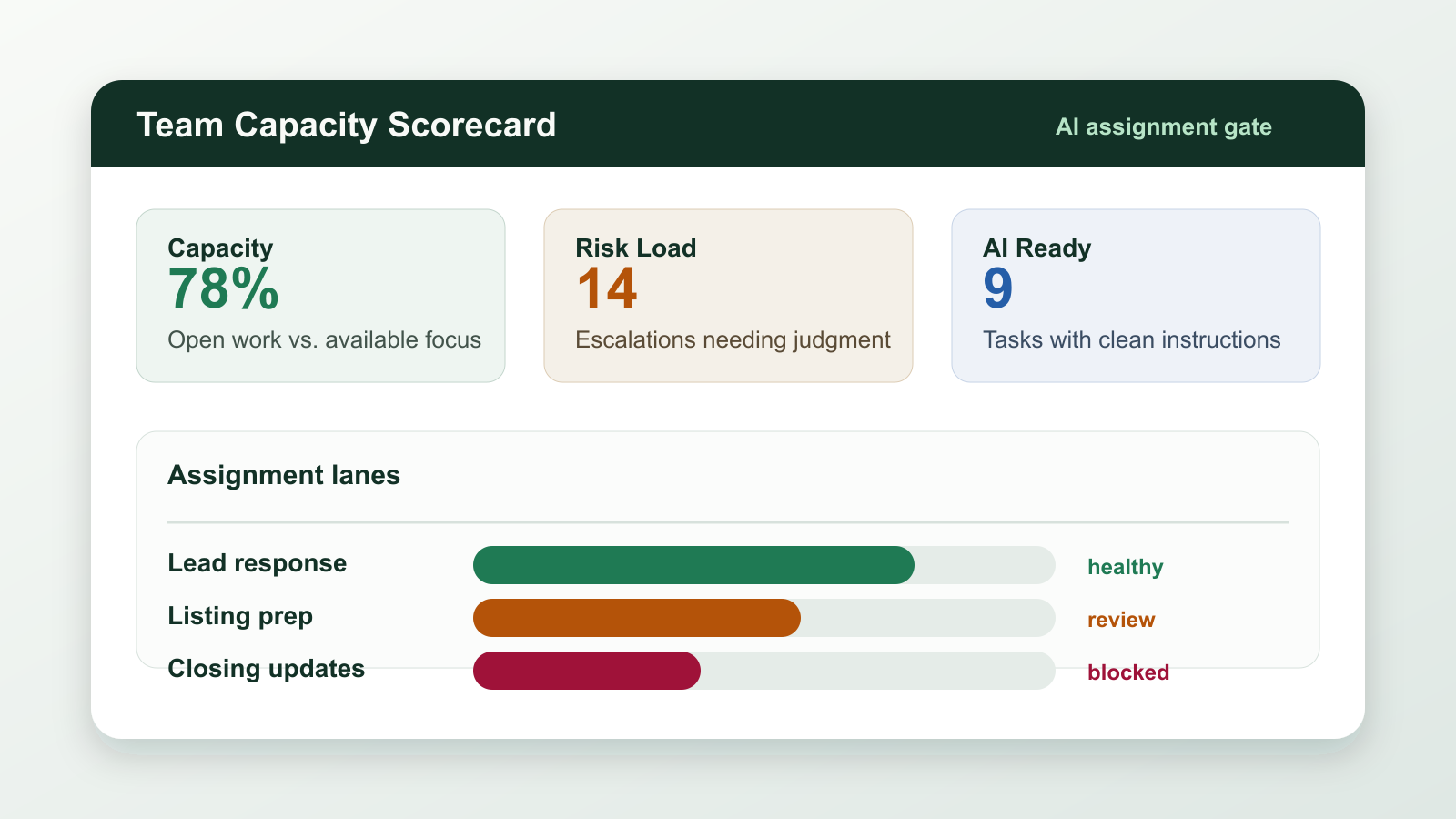
A capacity scorecard is the operating layer between the CRM and the people doing the work. It tells the system who is available, who is overloaded, which tasks need judgment, which tasks are ready for automation, and which assignments would create client risk. Without that layer, AI routing becomes a faster version of the old problem: the loudest queue gets attention, the most reliable person gets overused, and the real bottleneck stays invisible.
The timing matters because AI is moving from individual productivity into team coordination. Atlassian's State of Teams 2026 report, published April 27, 2026, argues that most AI strategies still overlook the team level, even though most work happens there. It also found that 85% of knowledge workers use AI at work, but only 29% have embedded it in their flows of work. That gap is where a capacity scorecard belongs.
Real estate teams feel the gap quickly. A buyer lead, listing issue, lender update, showing request, inspection question, review response, and past-client check-in may all hit the same CRM on the same day. AI can make each task look smaller. It can also hide the fact that three people are now waiting on the same transaction coordinator, the ISA has too many fresh leads to call well, and the listing manager is being asked to review AI-generated copy while also fixing seller feedback.
The weak version of AI assignment
The weak version starts with rules like assign new leads round-robin, send listing tasks to the listing coordinator, send closing updates to the transaction coordinator, and escalate overdue items to the team lead. Those rules are easy to configure, but they ignore capacity, context, and risk.
Round-robin assignment does not know that one agent is in inspections all afternoon. A role-based rule does not know that a coordinator has six high-risk closings this week. A generic AI assistant does not know that a client needs a senior human response because the inspection objection is tied to repair credits, financing pressure, and a frustrated seller. The system sees a task. The business has a constraint.
KPMG's April 24, 2026 AI workforce analysis makes the same point at the enterprise level: more than half of leaders now expect people to manage and direct AI agents, which shifts the burden from tool adoption to judgment, accountability, and knowing when human validation is required. A real estate scorecard turns that idea into daily operating data.
What the scorecard should track
Start with available focus, not just availability. Calendar openings are a weak signal. A person may have two free hours and still be the wrong owner for a task because they are carrying too many active clients, too many decision-heavy files, or too many same-day follow-ups. The scorecard should combine scheduled availability, active workload, response commitments, open escalations, and current role coverage.
Then separate work by risk. A property alert, database cleanup task, lead-source tag, and routine nurture email can be AI-assisted with light review. A pricing conversation, inspection dispute, wire concern, fair housing-sensitive message, commission question, or upset client needs a different lane. AI assignment should know whether a task is low-risk execution, medium-risk review, or high-risk human judgment.
Next, track instruction quality. Many tasks are not ready for AI because the required inputs are missing. A follow-up task may lack the buyer's budget, timeline, preferred neighborhoods, financing status, and last human conversation. A listing task may lack seller constraints, staging decisions, and photo deadlines. A closing update may lack lender status or title notes. The scorecard should mark tasks as AI ready only when the source record is clean enough to support useful work.
Finally, record load by lane. A small team should see lead response, buyer nurture, listing prep, market updates, transaction coordination, client service, marketing production, database hygiene, and management review as separate lanes. One green total workload number is not enough. A team can look fine overall while one lane is near failure.
Why real estate teams need this before more AI
The real estate industry is already using AI, but trust and workflow fit remain uneven. NAR reported on February 12, 2026 that an RPR survey of 225 NAR-member agents found 92% were using AI or planning to use it, while accuracy, compliance, and market-data interpretation were major concerns. That is not an argument against AI. It is an argument for better operating records around AI.
Tool fragmentation is also part of the capacity problem. RISMedia's February 26, 2026 coverage of Zillow's 2026 Agent Trends Survey reported that ease of use outranked cost as the leading factor agents consider when choosing new technology, and that a typical agent still uses two to four tools in a week. If the CRM, calendar, transaction platform, showing system, inbox, and marketing tools all generate work without a shared capacity view, AI will accelerate noise.
Deloitte's January 2026 State of AI in the Enterprise release shows the broader pattern: companies are expanding access to sanctioned AI tools, many expect to customize agents for business work, but mature governance is not keeping pace. Real estate teams do not need enterprise bureaucracy. They need a simple version of the same discipline: which AI-assisted assignments are allowed, which require review, and which should never be routed without a human decision.
A practical first version
Build the first scorecard with six fields per person: current role, available focus hours, active client load, open escalations, same-day commitments, and blocked work. Then add six fields per task: lane, risk level, client impact, required inputs, AI readiness, and next decision owner. That is enough to make better routing decisions than a generic rule engine.
Use thresholds. For example: no one receives more than a defined number of fresh lead calls in a response window; high-risk client messages go to a human owner with authority; listing prep cannot be AI-assigned until seller constraints and deadlines are present; transaction updates cannot be drafted until lender, title, and inspection statuses are current; marketing tasks can be AI-drafted but need brand or compliance review when claims are client-facing.
Then give AI bounded jobs. It can summarize the scorecard, flag overloaded lanes, identify tasks missing required inputs, suggest reassignment options, draft lower-risk work, and prepare a team lead review memo. It should not assign sensitive client work, override capacity thresholds, or hide uncertainty. When the record is incomplete, the correct AI action is to ask for the missing input or escalate.
The scorecard also improves management. A team lead can see whether growth is creating lead-response pressure, transaction risk, listing bottlenecks, or marketing backlog. Training becomes easier because overload and skill gaps are visible. Hiring decisions get cleaner because the team can see which lane is consistently constrained. AI becomes part of the operating system instead of another source of unmanaged work.
The goal is not to slow AI down. The goal is to keep speed connected to responsibility. Before AI assigns work, the team should know who has capacity, what the client risk is, whether the data is complete, and who remains accountable for the outcome. A capacity scorecard gives the business that control.

Written by
Ben Laube
AI Implementation Strategist & Real Estate Tech Expert
Ben Laube helps real estate professionals and businesses harness the power of AI to scale operations, increase productivity, and build intelligent systems. With deep expertise in AI implementation, automation, and real estate technology, Ben delivers practical strategies that drive measurable results.
View full profile