Build a Financing Readiness Tracker Before AI Advises Buyers
Build a Financing Readiness Tracker Before AI Advises Buyers
AI is getting better at explaining mortgage scenarios in plain English. It can summarize rate changes, calculate payment ranges, draft a buyer check-in, and compare loan structures. That makes it useful for real estate teams, but it also makes one operating risk sharper: if the buyer record is thin, the AI can sound confident while giving advice from stale or incomplete financing data.
Before AI advises buyers, teams need a financing readiness tracker.
A financing readiness tracker is the operating record that sits between buyer intake, lender coordination, property search, offer strategy, and contract execution. It does not replace the lender. It does not turn the agent into a loan officer. It gives the team a clean, current view of what has been verified, what is assumed, what changed, and what must be confirmed before anyone sends affordability guidance, writes an offer, or tells a buyer to stretch.
The need is practical, not theoretical. Freddie Mac reported on April 30, 2026 that the 30-year fixed-rate mortgage averaged 6.30%, up from 6.23% the prior week and below 6.76% a year earlier. The same release noted that purchase demand had accelerated as buyers reacted to modestly lower rates and more inventory. In the Mortgage Bankers Association's April 29, 2026 weekly survey, overall applications fell 1.6% from the prior week, but purchase activity rose and unadjusted purchase applications were 21% higher than the same week a year earlier. Buyers are active, but small rate moves, loan type differences, and changing inventory can alter what an individual buyer should do.
That is exactly where unstructured AI advice becomes dangerous. A buyer might have a preapproval from three weeks ago, a new debt payment, gift funds not yet documented, a job change, a rate quote that moved, an appraisal-gap expectation, or a property type that changes underwriting. If those details live in texts, lender emails, CRM notes, and the agent's memory, an AI assistant will only see fragments. A polished answer can become a liability.
The weak version of buyer AI
The weak version starts with a broad prompt: tell this buyer whether they can afford a $525,000 home. The AI can produce a monthly payment estimate and a reassuring explanation, but the estimate may miss property taxes, insurance, HOA fees, mortgage insurance, discount points, seller credits, repair reserves, local transfer costs, loan program constraints, or the lender's actual debt-to-income view.
Even worse, the buyer may interpret the answer as permission. The agent may interpret it as a next step. The lender may later correct it. By then, the buyer is disappointed, the offer strategy is weaker, and the team has created confusion that could have been prevented by separating general education from verified financing evidence.
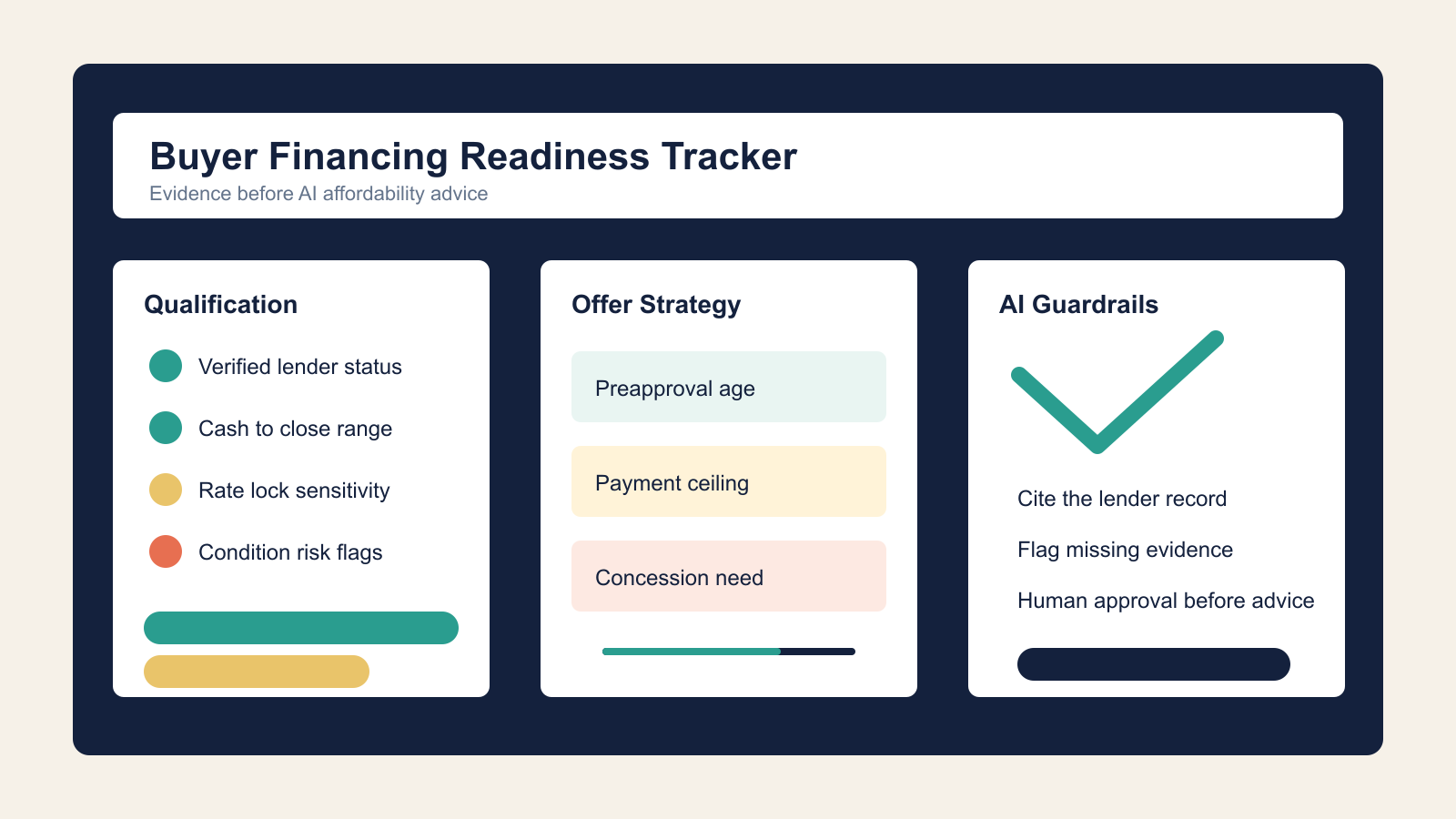
A financing readiness tracker keeps those categories distinct. It can show a buyer's stated budget, lender-verified range, payment comfort ceiling, cash-to-close range, documentation status, lender quote age, rate lock status, loan program, contingency needs, concession sensitivity, and known risks. AI can then explain the record, not invent the record.
What the tracker should capture
Start with verification status. Every active buyer should have a simple status: inquiry only, lender introduction made, prequalification received, preapproval received, fully underwritten approval, update needed, or financing paused. That status should include the source, date, lender contact, and expiration or refresh date.
Next, track payment readiness. Do not store only the top-line purchase price. Store the buyer's preferred monthly payment, maximum lender-approved payment, expected rate range, property tax assumptions, insurance assumptions, HOA sensitivity, mortgage insurance status, and whether the buyer understands how credits, points, and rate buydowns change the cash-versus-payment tradeoff.
Then track cash readiness. Record estimated down payment, earnest money, inspection funds, appraisal-gap capacity, cash-to-close range, gift fund status, reserve requirement, and whether the buyer needs proceeds from another transaction. The National Association of REALTORS 2025 Profile summary shows why this matters: first-time buyers were only 21% of the market, cash buyers reached 26%, and median down payments rose to 19% overall, 10% for first-time buyers, and 23% for repeat buyers. Buyers using financing are competing against stronger cash and equity positions, so their proof has to be organized before the offer moment.
Finally, track offer constraints. The readiness record should show whether the buyer can waive or shorten financing, appraisal, inspection, or sale contingencies; whether they need seller concessions; whether a condo, flood zone, insurance issue, repair condition, or non-warrantable property would change the loan path; and what lender response time is expected when an offer window is tight.
Where AI belongs
Once the tracker exists, AI becomes useful in bounded ways. It can summarize what has been verified, identify stale financing fields, draft a buyer-facing preparation note, explain the difference between payment comfort and lender approval, and generate a lender follow-up checklist. It can also help the agent compare three property scenarios in operational terms: what is confirmed, what must be checked, and what decision the buyer needs to make.
AI should not tell the buyer what they can afford unless the response clearly distinguishes lender-verified data from assumptions. It should not recommend waiving contingencies, changing loan terms, or using discount points without human review. It should not turn a general rate quote into an individualized lending recommendation. The rule is simple: AI can explain the readiness record, but the lender and buyer own the financing decision.
This is also a better client experience. Buyers often feel overwhelmed by lender language, payment changes, and closing-cost math. The Consumer Financial Protection Bureau has documented that mortgage pricing varies across lenders and that a 50 basis point difference can mean about $100 per month on a $300,000 loan in a higher-rate environment. CFPB's consumer guidance also tells borrowers to compare Loan Estimates, including rate, principal and interest, mortgage insurance, escrow, upfront loan costs, lender credits, and cash to close. A readiness tracker helps a real estate team encourage that comparison without pretending the agent is issuing loan advice.
The operating cadence
Build the first version in the CRM with four linked records: buyer profile, financing snapshot, property scenario, and offer readiness note. The buyer profile captures identity, search intent, price comfort, timeline, and communication permissions. The financing snapshot captures lender-verified facts and assumptions. The property scenario captures taxes, HOA, insurance, condition, concession assumptions, and likely payment impact for a specific home. The offer readiness note captures what the team knows before writing.
Set refresh rules. Any financing snapshot older than 14 days should be flagged before an offer. Any rate-sensitive buyer should have a fresh lender check when rates move materially. Any buyer who changes debt, employment, down payment source, price band, property type, or contingency preference should trigger a new readiness review. Any property with unusual insurance, HOA, flood, repair, appraisal, or condo risk should require a scenario-specific lender confirmation.
Use dashboards sparingly. The agent view should show ready, refresh needed, evidence missing, lender response pending, and offer-risk flags. The team-lead view should show buyers who are touring without current financing evidence, buyers whose stated payment comfort is below their search price, and offers where concessions or appraisal gaps are unresolved. The buyer-facing view should be simpler: verified range, documents still needed, payment assumptions to review, and next financing action.
Then give AI only the right jobs. Let it prepare buyer education from approved source language. Let it summarize missing evidence for the agent. Let it draft a lender coordination email. Let it compare scenarios after the team has entered taxes, insurance, HOA, and concession assumptions. Let it flag when a buyer's search behavior no longer matches their stated payment ceiling. Do not let it publish affordability advice without a visible evidence trail.
The payoff is speed with control. Buyers get clearer conversations. Agents stop relying on memory. Lenders receive better questions. Team leaders can see which buyers are truly ready and which are one rate move or one missing document away from trouble. AI becomes more useful because it is working from a disciplined buyer-financing record.
In a market where purchase demand can strengthen while affordability remains tight, the winning real estate team is not the one with the most confident AI prompt. It is the one that knows exactly what is verified before the AI speaks.

Written by
Ben Laube
AI Implementation Strategist & Real Estate Tech Expert
Ben Laube helps real estate professionals and businesses harness the power of AI to scale operations, increase productivity, and build intelligent systems. With deep expertise in AI implementation, automation, and real estate technology, Ben delivers practical strategies that drive measurable results.
View full profile