Build an Agent Recruiting Quality Board Before AI Sends Outreach
Build an Agent Recruiting Quality Board Before AI Sends Outreach
Recruiting is becoming one of the easiest places for a brokerage to misuse AI. The software can find agents faster, summarize production patterns, draft personalized emails, and keep follow-up moving. That is useful. It is also risky when the data behind the recommendation is thin, the source context is unclear, or the message implies a level of interest that the recruiting team has not earned.
The answer is not to avoid AI recruiting. The answer is to put a recruiting quality board in front of it.
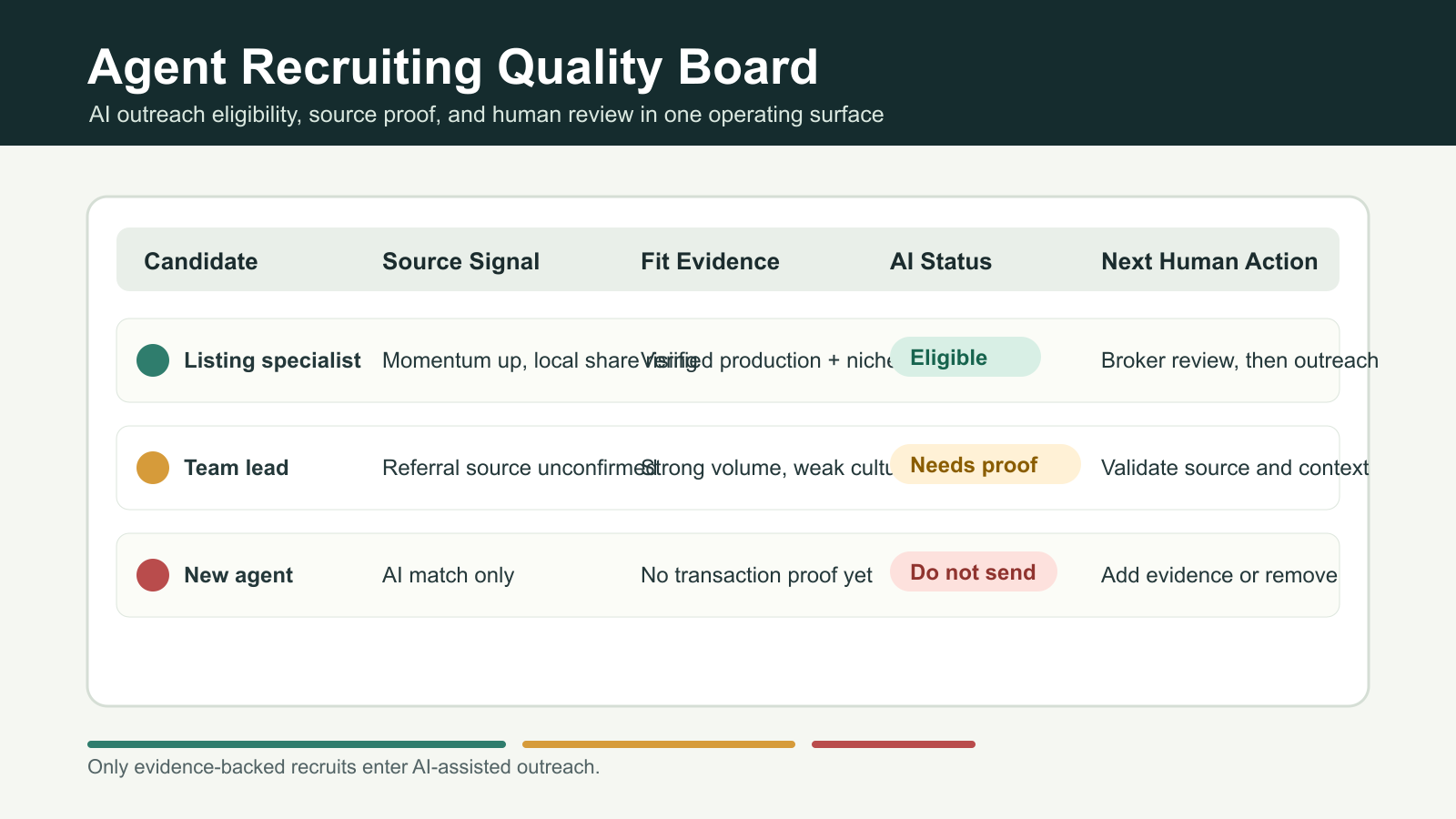
An agent recruiting quality board is the operating surface that decides which prospects are ready for AI-assisted outreach, which prospects need more human research, and which prospects should be excluded. It is not a generic pipeline. It is a proof layer. Before AI drafts an email, suggests a call script, scores a candidate, or moves someone into an automated nurture sequence, the board should show why that person belongs there.
The timing matters because hiring and recruiting are moving quickly into AI-assisted workflows. LinkedIn reported on January 7, 2026 that 66% of recruiters say it has become harder to find qualified talent over the prior year, while 93% plan to increase AI use in 2026 and 59% say AI is already helping them find candidates with skills they might not have found otherwise. ICIMS and Aptitude Research reported on April 30, 2026 that 69% of companies use AI in some talent acquisition capacity, but only 18% use it broadly across hiring processes. Their research also found that candidates are using AI heavily, with 74% of companies saying candidates now use AI in job search.
For real estate brokerages, the trend is already industry-specific. Relitix announced a real estate agent intelligence and AI recruiting product in February 2026 that packages market-wide production, recruiting prospects, competitor visibility, switch-risk signals, and AI-generated recruiting emails around MLS data. Whether a brokerage uses that product, a CRM, a spreadsheet, or a custom workflow, the direction is clear: agent recruiting is becoming more data-driven and more automated.
That makes quality control more important, not less.
The board has one job: stop weak signals from becoming polished outreach
AI is good at making uncertain data sound organized. A list of agents can become a ranked recruiting target list. A few production notes can become a personalized email. A single interaction at a closing table can become a warm-lead narrative. The quality board prevents that compression from hiding what is missing.
Each candidate row should separate five things.
First, source signal. Where did this prospect come from? MLS production trend, referral, event conversation, competitor analysis, former colleague, social engagement, review of local listing activity, past transaction counterpart, or purchased list are not equal sources. The board should record the source, the date captured, the person responsible, and the reason the candidate was added.
Second, production evidence. Do not reduce agent quality to raw volume. Store the signal that matters for your brokerage model: listing activity, buyer-side consistency, price-point fit, geographic overlap, team structure, repeat business indicators, niche experience, responsiveness in prior transactions, or community presence. If the evidence is incomplete, label it incomplete. AI should not describe a prospect as a strong fit when the only proof is a broad production estimate.
Third, brokerage fit. This is where a human operator needs to be honest. Is the person aligned with the office's service model, brand position, training capacity, compensation structure, lead distribution rules, technology expectations, and client experience standards? A high producer who would damage culture or need a support model the brokerage cannot provide is not a clean recruiting win.
Fourth, contact permission and relationship context. Real estate recruiting can get sloppy when outreach lists multiply. The board should show whether the prospect has a known relationship with the brokerage, who owns it, what has already been said, and whether any channel should be avoided. AI should not manufacture intimacy from weak context.
Fifth, next human action. Every row needs one clear next action: research, broker review, relationship intro, first outreach, nurture, hold, do not contact, or remove. AI can help draft and summarize, but the next action should be owned by a person.
Use AI eligibility instead of one universal score
A single recruiting score is tempting. It is also too blunt. The board should use AI eligibility states instead.
Eligible means the row has current source context, enough production evidence, a plausible brokerage fit, and human approval for the next outreach step. AI can draft a message, suggest talking points, prepare a pre-call brief, or create follow-up tasks.
Needs proof means the candidate may be promising, but the system is missing something important. Maybe the production signal is old, the referral source is vague, the agent's niche is unclear, or the broker has not approved the angle. AI can help gather questions or summarize the missing evidence, but it should not send or schedule outreach.
Human only means the relationship is sensitive. This could include direct competitor leadership, a candidate tied to an active transaction, someone referred through a delicate relationship, or a prospect with compensation or team-structure complexity. AI can support internal preparation, but outbound language should be manually written and reviewed.
Do not send means the row should not enter outreach. Reasons should be explicit: duplicate record, bad fit, no permission, stale data, relationship conflict, prior opt-out, or no evidence. This state matters because automation will otherwise keep recycling old names.
Those states are more useful than a numeric score because they control behavior. The question is not just who looks attractive. The question is what AI is allowed to do next.
What the workflow should look like
Start small. A brokerage does not need a full recruiting suite to create the board. It needs a repeatable intake and review rhythm.
New candidates enter the board from defined sources only. If someone adds a prospect, they must select a source type, add a reason, and assign an owner. The owner has to attach or summarize the evidence before the row can become AI eligible.
Once a week, a broker, team lead, or recruiting owner reviews candidates in the Needs proof and Human only states. The review is not a generic pipeline meeting. It answers three questions: Do we have enough evidence? Is this person a fit for our model? What is the next respectful step?
AI can be useful inside that review. It can summarize production notes, compare candidates to the brokerage's ideal profile, list missing evidence, and draft internal talking points. But the board should make the boundary obvious: AI drafts only after a human changes the status to Eligible.
For outreach, every AI-generated message should include a source note for internal review. The candidate does not need to see the note, but the recruiter should. The note should answer: what evidence shaped this message, what relationship context is being used, and what claim should not be made. That keeps personalization grounded instead of creepy or generic.
The metrics that actually matter
Recruiting dashboards often overcount activity. Calls, emails, opens, and replies matter, but they are not enough. The quality board should track whether the source created a real conversation, whether the candidate was qualified, whether the candidate matched the office model, whether the conversation advanced, and whether the eventual recruit became productive and retained.
That last part matters in real estate. NAR's 2025 Member Profile reported that the typical REALTOR had 12 years of experience, completed 10 transaction sides in 2024, and that 74% of REALTORS were very certain they would remain active in the business for at least two more years. It also reported that 87% of members were independent contractors at their firms. Recruiting is not just filling seats. It is persuading independent operators, often with deep experience and existing relationships, that your platform, leadership, and opportunity are worth their attention.
That is why source quality should outrank outreach volume. A low-volume source that creates qualified, respectful conversations with aligned agents is more valuable than a high-volume source that produces generic AI emails to people who were never a fit.
The rule for the team
The operating rule should be simple: AI can accelerate recruiting, but it cannot certify recruiting quality. Before AI sends or schedules outreach to an agent, the board must show a current source signal, production evidence, brokerage fit, relationship context, and a human-approved next action.
That rule protects the brokerage from two bad outcomes. The first is wasted automation: more messages to the wrong people. The second is reputational damage: polished outreach that feels uninformed, presumptive, or careless.
A recruiting quality board makes AI more useful because it gives the assistant a better job. Instead of guessing who to contact and what to say, AI works from evidence, constraints, and review decisions. The human team still owns judgment. The system just makes that judgment visible before outreach scales.

Written by
Ben Laube
AI Implementation Strategist & Real Estate Tech Expert
Ben Laube helps real estate professionals and businesses harness the power of AI to scale operations, increase productivity, and build intelligent systems. With deep expertise in AI implementation, automation, and real estate technology, Ben delivers practical strategies that drive measurable results.
View full profile