Build a Listing Appointment Proof Pack Before AI Advises Sellers
Build a Listing Appointment Proof Pack Before AI Advises Sellers
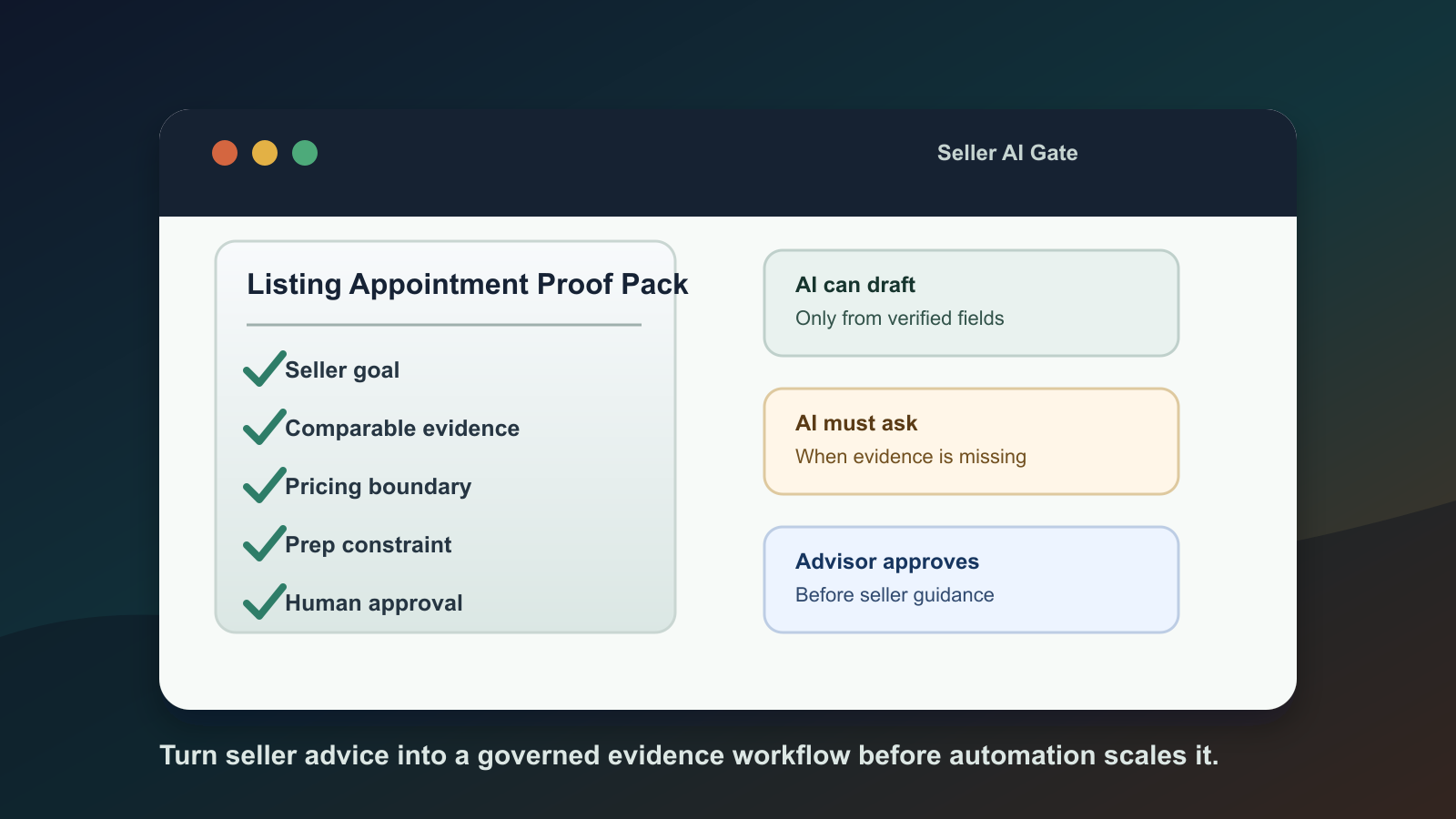
AI can help a real estate team prepare for listing appointments, draft seller follow-up, and turn market data into plain-English recommendations. It should not be allowed to invent the seller's motivation, pricing tolerance, repair appetite, or timing pressure. The useful control is a listing appointment proof pack: a small, structured record that tells the AI what is verified, what is still unknown, and where a human advisor must approve the next message.
This matters more in the 2026 seller market than it did in the easy parts of the last cycle. Realtor.com reported that March 2026 active listings were up year over year for the twenty-ninth straight month, median list prices were down 2.2% from a year earlier, and homes were taking four more days to sell than last year. Redfin separately reported that 34.2% of February 2026 home sellers cut their list price, the highest February share in its records back to 2012. Sellers are not walking into a uniform market. They are walking into a market where pricing strategy, local inventory, financing conditions, property condition, and timing all change the advice.
At the same time, sellers still value human judgment. NAR's 2025 Profile of Home Buyers and Sellers reported that 91% of sellers used a real estate agent, matching the highest percentage on record, and that sellers choose agents for help with marketing, competitive pricing, and selling within a specific time frame. Cotality's 2026 AI in housing survey found that buyers broadly assume AI is already embedded in the housing process, but the same study also found strong demand for transparency and human verification. That is the operating lesson for listing teams: use AI for speed, but make the source of truth explicit before the model advises a homeowner.
The proof pack is not another pre-listing questionnaire
Most teams already ask sellers basic questions: address, target date, preferred communication channel, and reason for moving. That is not enough for AI-enabled seller advice. A proof pack needs to separate evidence from preference and permission.
Evidence is what the team can verify: comparable sales, active competition, price reductions nearby, showing activity, property updates, inspection history, HOA constraints, insurance concerns, loan payoff estimates, and calendar deadlines. Preference is what the seller wants: a net number, a move date, a privacy boundary, a repair budget, or a willingness to test the high side of the market. Permission is what the AI is allowed to do with those facts: summarize, draft, recommend a range, flag a risk, or stop and ask for human review.
Without that separation, AI will sound confident because it has words, not because it has authority. It may draft a persuasive pricing message without knowing whether the seller needs a fast sale, whether the roof is insurable, whether a relocation deadline is fixed, or whether the nearest comparable had a concession hidden in the closing terms. The failure is not that the model writes badly. The failure is that the system lets it advise from an incomplete record.
What belongs in the seller proof pack
Start with the appointment outcome. Each seller meeting should have one explicit business goal: win the listing, reset price expectations, prepare a delayed launch, evaluate an off-market path, or decide whether the seller should wait. The AI should not choose that goal. The advisor should set it before the model drafts any agenda or follow-up.
Next, record the property evidence. Store the facts that materially change pricing and preparation: bed and bath count, finished square footage, lot constraints, renovations, age of major systems, known defects, required disclosures, recent permits, tax records, HOA rules, insurance notes, and repair estimates. Mark each field as verified, seller-stated, third-party-stated, or unknown. That single status column is what keeps AI from laundering an assumption into advice.
Then add the market evidence. A useful proof pack should include three different views: sold comparables, active competition, and listings that failed to sell or needed reductions. The point is not to overwhelm the seller with data. The point is to teach the AI which examples are allowed to support a claim. If the system can only reference approved comps, it cannot quietly pull a stale or irrelevant pattern into the recommendation.
Add the seller boundary fields. These include target net proceeds, minimum acceptable net, desired list date, required close-by date, repair budget, staging tolerance, showing restrictions, occupancy constraints, and deal-breaker terms. AI can help turn those boundaries into a cleaner plan, but only after the boundaries are captured in structured form.
Finally, add the approval record. The advisor should approve the pricing narrative, the suggested list-price range, the prep plan, and the first follow-up message. Approval does not have to be bureaucratic. It can be a checklist with initials, timestamp, and notes. The important part is that the AI system can tell the difference between draft work and approved seller guidance.
Where AI should help first
The safest first use case is appointment preparation. Give the model the verified proof pack and ask it to prepare a briefing: likely seller concerns, missing evidence, likely objections, and questions the advisor should ask live. This uses AI for synthesis, not authority.
The second use case is gap detection. If the seller wants a premium price but the proof pack lacks remodel evidence, showing flexibility, or local demand support, the AI should flag the mismatch. If the seller needs to close quickly but the property has unresolved insurance or repair concerns, the AI should flag that before the team promises a timeline.
The third use case is follow-up drafting. After the appointment, the model can summarize the conversation, generate a seller recap, list open items, and prepare next steps. But it should quote only approved proof-pack fields and clearly separate "confirmed" items from "needs review" items. The draft should make the advisor faster without making the model the decision-maker.
The control rule: no proof, no seller advice
A listing appointment proof pack works because it creates a simple rule: no proof, no seller advice. If comparable evidence is missing, AI can ask for it. If price boundaries are missing, AI can draft intake questions. If repair constraints are missing, AI can prepare a checklist. If the advisor has not approved the narrative, AI can prepare an internal draft, but it cannot send or recommend client-facing guidance.
This rule also protects marketing claims. The FTC's AI guidance hub continues to show active enforcement attention around AI claims and deceptive technology promises. For a real estate team, that means AI workflows should be designed around substantiation. Do not let a tool claim that a price is "optimal," a campaign will "maximize value," or a prep plan will "guarantee" results unless the business can support the statement and a licensed professional has approved it.
The proof pack gives the team a practical way to do that. It keeps the model inside the evidence. It makes missing facts visible. It gives the advisor an approval step. It also gives the brokerage a record of why a seller received a recommendation, which is useful when markets shift and memories get selective.
How to implement it in the CRM
Create one seller appointment object in the CRM. Link it to the contact, property, listing opportunity, tasks, files, and notes. Add required fields for appointment goal, seller motivation, target timing, net-proceeds target, price boundary, repair budget, showing constraints, and approval status.
Create a separate evidence table or section for proof items. Each proof item should have type, source, date, owner, confidence, and status. Types can include sold comp, active comp, expired listing, price reduction, repair estimate, insurance note, disclosure item, seller statement, lender payoff, or timeline constraint. Status should be simple: verified, pending, rejected, or expired.
Then add AI permissions as fields, not vibes. For example: AI may draft internal prep notes, AI may draft seller follow-up, AI may recommend missing evidence, AI may not recommend list price, AI may not send client-facing pricing language, AI may not make net-proceeds claims. A field-level permission model is more reliable than hoping every prompt remembers the rule.
Add automation only after the record is stable. When the appointment is booked, create the proof pack. Three days before the meeting, remind the owner to fill missing fields. One day before the meeting, let AI generate the internal briefing. After the meeting, require the advisor to approve the narrative before any seller-facing recap is sent.
The operating benefit
This is not about slowing down AI. It is about preventing fast advice from outrunning verified facts. The team still gets leverage: cleaner appointment prep, faster follow-up, better objection handling, and fewer repeated questions. The seller gets a more credible advisor because the recommendation is tied to the property's actual evidence, not a generic market script.
The best listing teams will not win by letting AI talk more. They will win by making AI prove what it is allowed to say. A listing appointment proof pack turns that standard into a repeatable workflow: evidence first, permission second, advice last.

Written by
Ben Laube
AI Implementation Strategist & Real Estate Tech Expert
Ben Laube helps real estate professionals and businesses harness the power of AI to scale operations, increase productivity, and build intelligent systems. With deep expertise in AI implementation, automation, and real estate technology, Ben delivers practical strategies that drive measurable results.
View full profile