Build a Housing Ad Approval Queue Before AI Launches Campaigns
Build a Housing Ad Approval Queue Before AI Launches Campaigns
AI can now draft listing ads, rewrite hooks, create audience variants, and hand a campaign to a media buyer in minutes. That speed is useful only when the brokerage has a control between the model and the ad account. For real estate teams, the control should be a housing ad approval queue: a structured review lane that proves every AI-assisted campaign has the right claims, targeting category, source evidence, and human owner before it spends a dollar.
The reason is simple. Real estate marketing sits inside two sensitive systems at once. The first is ordinary truth-in-advertising. The FTC's business guidance still starts with the same baseline: advertising claims must be truthful, not deceptive or unfair, and supported by evidence. The second is housing access. HUD's Fair Housing Act overview states that discrimination is prohibited in buying, renting, mortgage access, housing assistance, and other housing-related activities. When AI starts writing and testing ads at campaign speed, those rules do not become less important. They become easier to violate without noticing.
The issue is not that AI writes bad copy. The issue is that AI can turn weak instructions into live operational choices. A prompt like "find motivated sellers," "target first-time buyers," "use families in the suburbs," or "promote luxury buyers near the best schools" can become ad text, a landing page, a CRM segment, and an audience setting before anyone asks whether the claim is supported, whether the language implies protected-class steering, or whether the ad platform will treat the campaign as a restricted housing opportunity.
The Approval Queue Is A Launch Gate, Not A Style Review
Most teams already review creative in some informal way. Someone looks at the headline, someone checks the image, and someone asks whether the budget is right. That is not enough for AI-assisted housing campaigns because the risk often lives outside the visible headline.
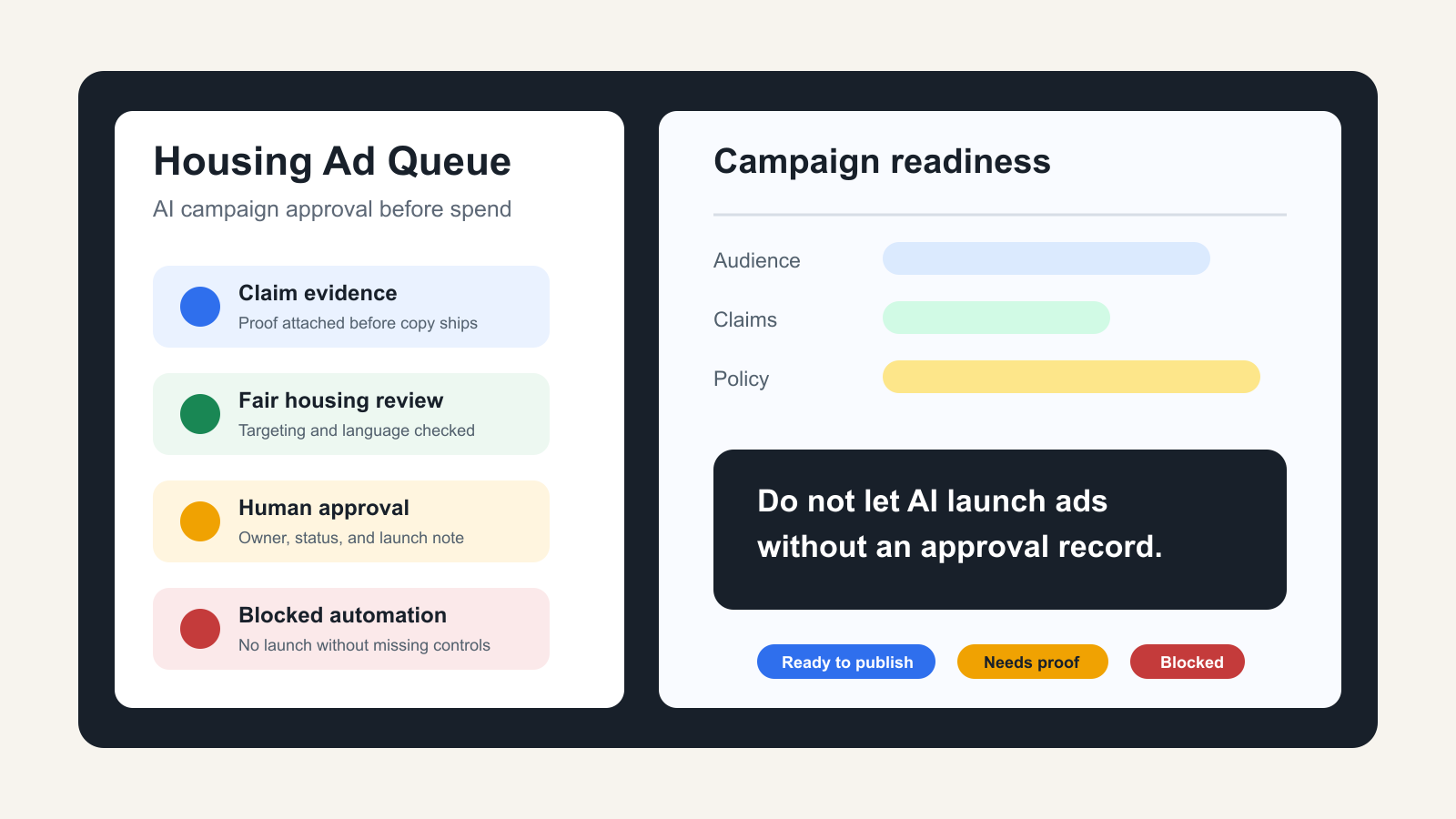
A housing ad approval queue should review five objects together: the creative, the audience, the landing page, the source evidence, and the automation permission. If any one of those objects is missing, the campaign stays blocked.
The creative review asks whether the ad makes a claim the team can prove. "Sell faster," "highest price," "best neighborhood," "safe community," and "guaranteed buyers" are not harmless phrases just because a model wrote them. They need evidence, qualification, or removal. The approval record should attach the data source behind market claims, the owner who approved the statement, and the date the claim expires.
The audience review asks whether the campaign is being treated as housing wherever the platform requires it. Google Ads personalized advertising policy restricts certain audience features for housing, employment, and consumer finance ads in the United States and Canada, including use of ZIP code targeting and certain demographics for housing ads. That means a real estate team cannot treat audience setup as a media-buyer afterthought. The campaign record should show the platform, objective, geography, included audiences, excluded audiences, and the policy category selected.
The landing page review asks whether the destination repeats the same promises and restrictions. A clean ad can still route users to a page with unsupported claims, selective neighborhood language, missing disclosures, or an AI chatbot that answers questions the ad itself avoided. The approval queue needs to capture the final landing URL, the reviewed snapshot, and the chatbot or form behavior connected to that campaign.
The source evidence review asks whether facts are current. Mortgage-rate references, inventory statistics, price-cut claims, days-on-market comparisons, buyer demand claims, and local event claims all decay. A source that was accurate when the prompt was written may be stale by the time the ad runs. Approval should include a source date and a review-by date, not just a link.
The automation permission review asks what the AI is allowed to change after launch. Can it rewrite headlines? Can it pause weak variants? Can it create new ad groups? Can it expand geography? Can it alter landing-page copy? If the answer is not explicitly logged, the system should default to human review.
Why This Matters Now
AI use in real estate marketing is no longer theoretical. NAR's 2025 Technology Survey reported that social media is one of the most widely used tools by REALTORS, and that 46% reported using AI-generated content such as listing descriptions. An RPR survey covered by NAR in February 2026 found that AI has moved into day-to-day real estate workflows, while agents still cite accuracy and compliance as major concerns.
That combination creates a practical risk. Teams are using AI where marketing velocity matters, but the control layer often still assumes human-scale production. A single agent might ask a model for five ad hooks, paste the best one into a platform, and let automated creative testing take over. A team admin might use AI to localize a campaign for ten neighborhoods. A brokerage might connect CRM segments to audience uploads. Each step feels small. Together they create a publishing system.
The approval queue is how the team admits that it has a publishing system and governs it accordingly.
What The Queue Should Capture
Start with a campaign intake record. Every AI-assisted ad should have a campaign name, business goal, property or service promoted, target geography, channel, budget, owner, launch date, and expiration date. The expiration date matters because stale campaigns are where unsupported claims accumulate.
Next, capture the AI contribution. Was AI used for headline drafting, image generation, audience suggestions, landing-page copy, chatbot responses, or performance optimization? This does not need to be moralized. It needs to be logged. If an issue appears later, the team should know whether it came from the model, the media platform, the landing page, or a human edit.
Then capture the claim ledger. Each claim gets a type, source, evidence link, approval owner, and expiration date. Market claims get market data. Service claims get internal proof or removed. Testimonial or review language gets endorsement and review scrutiny. Any superlative gets either substantiation or softer wording.
Then capture the fair-housing screen. This should check whether the ad uses protected-class proxies, subjective neighborhood labels, selective community language, exclusionary phrasing, or vague terms that invite steering. NAR's steering guidance is useful operationally: when language is vague, translate it into objective criteria and third-party sources rather than personal judgments about communities.
Then capture the platform policy screen. For housing campaigns, the queue should force the reviewer to confirm the selected ad category, geography method, audience source, exclusions, uploaded lists, remarketing source, and landing-page category. If a platform restricts a feature for housing, the queue should record how the team complied, not rely on memory.
Finally, capture the approval decision. Use four statuses: ready, needs proof, needs revision, and blocked. Ready means the campaign can launch. Needs proof means the concept may be usable, but claims or data are missing. Needs revision means the ad can be rewritten without changing the strategy. Blocked means the campaign should not ship because the targeting, claim, source, or fair-housing issue is material.
The Queue Belongs In Operations, Not Legal
Legal review is useful for edge cases, but the day-to-day control has to live where campaigns are built. Put the queue inside the same workflow that creates the ad brief, landing page, and CRM segment. The media buyer, marketing lead, team lead, and compliance owner should see the same status.
The queue also needs a hard stop. If the approval status is not ready, the campaign cannot be marked launchable. If the evidence date has expired, the campaign cannot be duplicated. If the AI permission is set to human review, the system cannot create new live variants automatically. These are operational controls, not suggestions.
For small teams, the first version can be a structured table. The minimum fields are campaign, channel, AI use, claim, evidence URL, evidence date, housing category confirmation, audience source, landing URL, review owner, decision, and expiration date. For larger teams, connect the queue to the CRM and ad account so approvals can be audited against actual launches.
The Weekly Review
Once a week, review three queues: blocked campaigns, launched campaigns with expiring evidence, and AI-generated variants awaiting approval. This is where the system improves.
Blocked campaigns reveal prompt patterns that need to be removed from templates. Expiring evidence reveals claims that should be rewritten as evergreen language. Pending variants reveal whether the team is using AI for useful testing or just creating review debt.
The review should also compare approved intent against live output. Did the platform display the approved creative? Did the landing page change? Did an AI chatbot answer housing questions using unapproved language? Did a CRM segment feed an uploaded audience that was not in the approval record? Those checks turn the queue from paperwork into a control loop.
The Business Benefit
The approval queue protects more than compliance. It makes marketing better. Claims become sharper because they need evidence. Campaigns become easier to reuse because the approval record shows what was reviewed. Media buyers move faster because they are not guessing whether a campaign is safe to launch. Team leaders can explain why an ad ran, what it promised, and who approved it.
AI should help real estate teams produce more campaigns, but it should not be allowed to blur the difference between an idea and a live housing advertisement. Build the queue before the model gets connected to budget, audience, or publishing rights.

Written by
Ben Laube
AI Implementation Strategist & Real Estate Tech Expert
Ben Laube helps real estate professionals and businesses harness the power of AI to scale operations, increase productivity, and build intelligent systems. With deep expertise in AI implementation, automation, and real estate technology, Ben delivers practical strategies that drive measurable results.
View full profile