Build an Inspection Repair Decision Log Before AI Negotiates Credits
Build an Inspection Repair Decision Log Before AI Negotiates Credits
Inspection repair negotiations are becoming a better test of real estate operating discipline. AI can summarize reports, draft seller responses, compare repair bids, and produce clean client updates. That does not mean it should decide which inspection items matter, which credits are defensible, or when a concession is safer than a rushed repair.
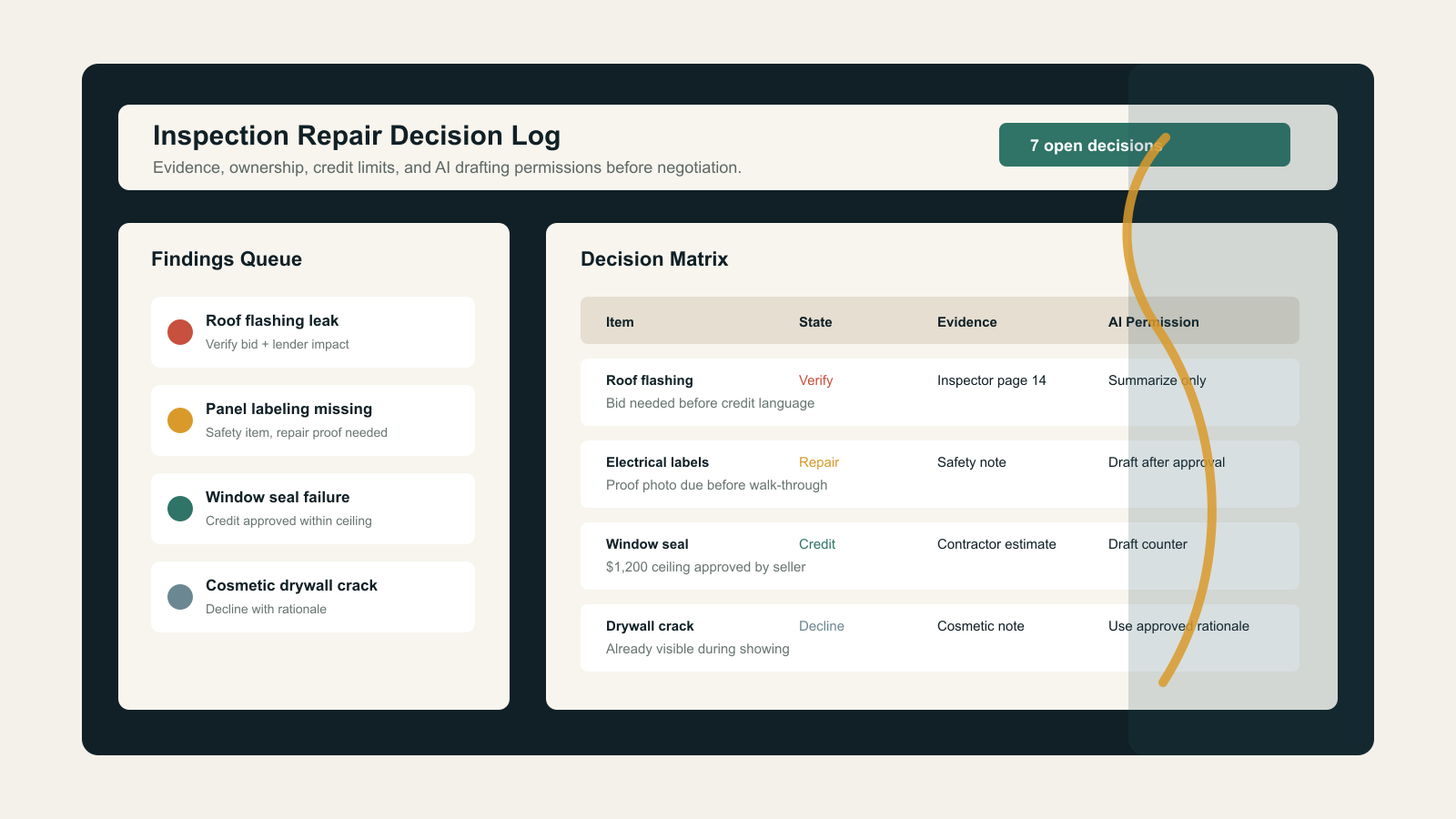
The missing system is an inspection repair decision log: a structured record that turns each finding into a business decision with evidence, ownership, dollar exposure, lender constraints, and a client-approved response. Without that log, AI is just making a persuasive argument from messy inputs.
Why this belongs in the operating system
Current market data makes inspection discipline more important, not less. NAR's latest REALTORS Confidence Index showed that only 18 percent of buyers waived the inspection contingency, down from 20 percent a month earlier and 22 percent a year earlier. That means more transactions are carrying inspection rights into the negotiation window.
At the same time, NAR reported that 5 percent of contracts were terminated and 13 percent had delayed settlements in the prior three months. Inspection problems are not the only reason deals slip, but repair negotiations are one of the moments where vague communication, missing bids, and emotional client updates can turn a manageable issue into a closing risk.
Repair cost pressure is not theoretical either. Harvard's Joint Center for Housing Studies revised its 2026 remodeling outlook in April and still expects owner-occupied improvement and repair spending to reach about $518 billion by year-end. Angi's 2025 homeowner pulse found that 62 percent of surveyed homeowners were more concerned about maintenance affordability than they were at the end of 2024, and 71 percent had postponed at least one project.
That matters because inspection findings now collide with tighter buyer budgets, seller net-proceeds sensitivity, and contractors who may not be available before closing. AI can help process the paperwork, but the team needs a decision model before automation touches the negotiation.
What the log should capture
Start with a row per inspection finding. Do not summarize the whole report into one note. The useful unit is the item that can be assigned, priced, accepted, rejected, credited, disclosed, or escalated.
Each row should include:
- Finding category: safety, structural, mechanical, moisture, pest, cosmetic, maintenance, disclosure, lender-required, or unknown.
- Source evidence: inspection page, photo number, inspector language, seller disclosure reference, prior repair receipt, contractor bid, or local rule.
- Severity and urgency: immediate safety issue, major system risk, near-term repair, minor maintenance, or buyer preference.
- Decision owner: buyer agent, listing agent, transaction coordinator, seller, buyer, lender, attorney, inspector, contractor, or broker.
- Financial range: buyer ask, seller counter, independent estimate, credit ceiling, and net-proceeds impact.
- Timing risk: can be completed before closing, requires post-close work, threatens underwriting, or needs extension.
- AI permission: summarize only, draft client language, compare bids, prepare counter language, or escalate to a human before drafting.
The important part is not the spreadsheet. The important part is forcing every item into a decision state. AI cannot responsibly draft a repair response while the team has not decided whether an item is safety-critical, negotiable, already disclosed, lender-required, or simply cosmetic.
The decision states
A practical log needs a small set of states that everyone uses the same way.
Use verify when the finding needs outside evidence before anyone frames it as a concession. This is common for roof age, HVAC performance, moisture, foundation movement, septic, electrical panels, and anything where the inspector noted risk but did not produce a repair scope.
Use repair when the seller should complete the work before closing because the item affects safety, habitability, financing, insurance, or the buyer's willingness to proceed. Repairs need owner, deadline, proof standard, and final walk-through evidence.
Use credit when speed, contractor availability, workmanship risk, or buyer preference makes money cleaner than work. Redfin's April 2026 seller guidance notes that credits can keep a closing moving, but they also need validation because buyer numbers can be inflated and lender restrictions may apply.
Use price adjustment when the repair issue changes the economics of the deal rather than the closing checklist. This belongs in the log because it affects seller proceeds, buyer cash needs, appraisal context, and the final negotiation story.
Use decline when the request is cosmetic, already priced into the offer, already disclosed, unsupported by evidence, or outside the agreed inspection scope. Declines still need language and rationale. A weak decline invites another round of conflict.
Use escalate when the finding touches legal exposure, insurance availability, loan conditions, safety, undisclosed defects, or a client decision that should not be outsourced to AI.
Where AI helps
AI is useful after the log exists. It can extract findings from the report, group duplicates, normalize contractor bids, produce a client-friendly summary, draft a seller response matrix, and flag items that lack evidence.
The best prompt is not "write a repair request." It is: "Using this decision log, draft a client update that separates verified safety issues, negotiable credits, cosmetic declines, and open evidence gaps. Do not invent costs. Do not convert unresolved items into recommendations. Mark every missing owner, deadline, or proof standard."
That prompt works because the operating system already decided what the AI is allowed to do. It is not asking the model to guess negotiation strategy from a 70-page PDF. It is asking the model to communicate approved decisions clearly.
CRM fields to add now
Put the inspection repair decision log inside the CRM or transaction platform, not in a detached inbox thread. At minimum, add fields for inspection contingency deadline, response deadline, repair request status, total requested credit, approved seller credit, repair proof received, lender-required items, contractor bid status, client approval timestamp, and final walk-through risk.
Then add three saved views:
- Deals with unresolved inspection findings inside five days of the response deadline.
- Deals where the buyer ask exceeds verified bids or the seller's approved ceiling.
- Deals where AI drafted language but a broker, attorney, lender, or client approval is still missing.
These views turn inspection work into an operating queue. They also give AI a safer context window because it can see deadlines, state, ownership, and proof instead of relying on stale emails.
The weekly operating review
A team that wants AI in transaction coordination should review inspection repair logs weekly. Look for repeated findings by property type, agents who need better pre-offer coaching, vendors with slow bid turnaround, lenders who reject certain credit structures, sellers who need clearer pre-listing prep, and inspection items that repeatedly become client confusion.
That review turns inspection data into upstream improvement. Buyer consultations get better. Listing prep gets sharper. Vendor lists get cleaner. AI drafts become less generic because the team has a real pattern library from closed and lost deals.
The implementation rule
Do not let AI negotiate from the inspection report alone. First create the repair decision log, assign each item to a state, attach evidence, set credit and repair boundaries, and record client approval. Then let AI summarize, draft, and compare within those boundaries.
Inspection negotiations are too close to money, risk, deadlines, and client trust to run on a loose summary. The teams that get value from AI here will not be the ones with the flashiest report parser. They will be the ones with the cleanest decision record before the model starts writing.

Written by
Ben Laube
AI Implementation Strategist & Real Estate Tech Expert
Ben Laube helps real estate professionals and businesses harness the power of AI to scale operations, increase productivity, and build intelligent systems. With deep expertise in AI implementation, automation, and real estate technology, Ben delivers practical strategies that drive measurable results.
View full profile