Build an Offer-Term Decision Ledger Before AI Drafts Counteroffers
Build an Offer-Term Decision Ledger Before AI Drafts Counteroffers
AI can already summarize an offer, compare it with a listing packet, draft a counteroffer email, and suggest language for price, credits, contingencies, possession, and closing timing. That can save time, but it creates a dangerous shortcut when the system does not know which terms actually matter to the client.
An offer-term decision ledger is the control layer between the transaction record and any AI tool that helps draft negotiation language. It is not a replacement for an agent, broker, attorney, or client decision. It is a narrow operating record that proves the team has captured the client's priorities, the deal constraints, the known risks, and the approved next move before an AI assistant writes anything that could shape negotiation behavior.
The market makes this more important now. The latest NAR REALTORS Confidence Index shows a mixed negotiation environment: homes still received an average of 2.2 offers, 18% sold above list price, 13% of contracts had delayed settlements, and buyers continued to waive inspection and appraisal contingencies in meaningful shares. Redfin's spring 2026 reporting points in the other direction in some markets, with a record 34.2% of February sellers cutting list prices and 13.7% of February home-sale agreements falling through. Those facts do not produce one universal negotiation script. They prove why an AI system needs local deal evidence before it drafts one.
The ledger exists to separate facts from preferences
Most offer files mix facts, preferences, and guesses in the same communication stream. One note says the buyer wants a fast close. Another says the seller needs post-closing occupancy. A lender update mentions rate volatility. A text thread says inspection is important, but an earlier intake form says the buyer will waive inspection for the right home. AI can read all of that and produce fluent language. Fluency is not the same as authority.
The ledger should force every proposed term into one of four buckets: verified fact, client preference, negotiable tradeoff, or blocked term. A verified fact is something the team can prove from a document or current party confirmation. A client preference is a ranked priority. A negotiable tradeoff is a term the client may exchange for something else. A blocked term is outside the client's instruction, broker policy, risk tolerance, lender constraint, or legal review boundary.
That structure gives AI a useful job. It can summarize, flag conflicts, and draft within approved boundaries. It cannot invent a client's risk appetite from scattered notes.
Start with the client's priority stack
The first section should be a ranked priority stack. For a buyer, that might include total cash to close, monthly payment ceiling, inspection protection, appraisal exposure, closing date, possession timing, seller credits, and repair tolerance. For a seller, it might include net proceeds, certainty of close, timing, appraisal risk, inspection risk, buyer financing strength, rent-back needs, and personal-property exclusions.
Each priority needs three fields: desired state, minimum acceptable state, and owner confirmation timestamp. The timestamp matters because negotiation priorities change quickly. A buyer who was comfortable with a larger appraisal gap last week may feel different after a lender refresh. A seller who wanted the highest price on Monday may care more about certainty by Friday if a relocation deadline moves.
Do not let AI use old priority notes unless the ledger marks them current. Stale preferences should trigger a confirmation task, not a counteroffer draft.
Track every material term as a decision row
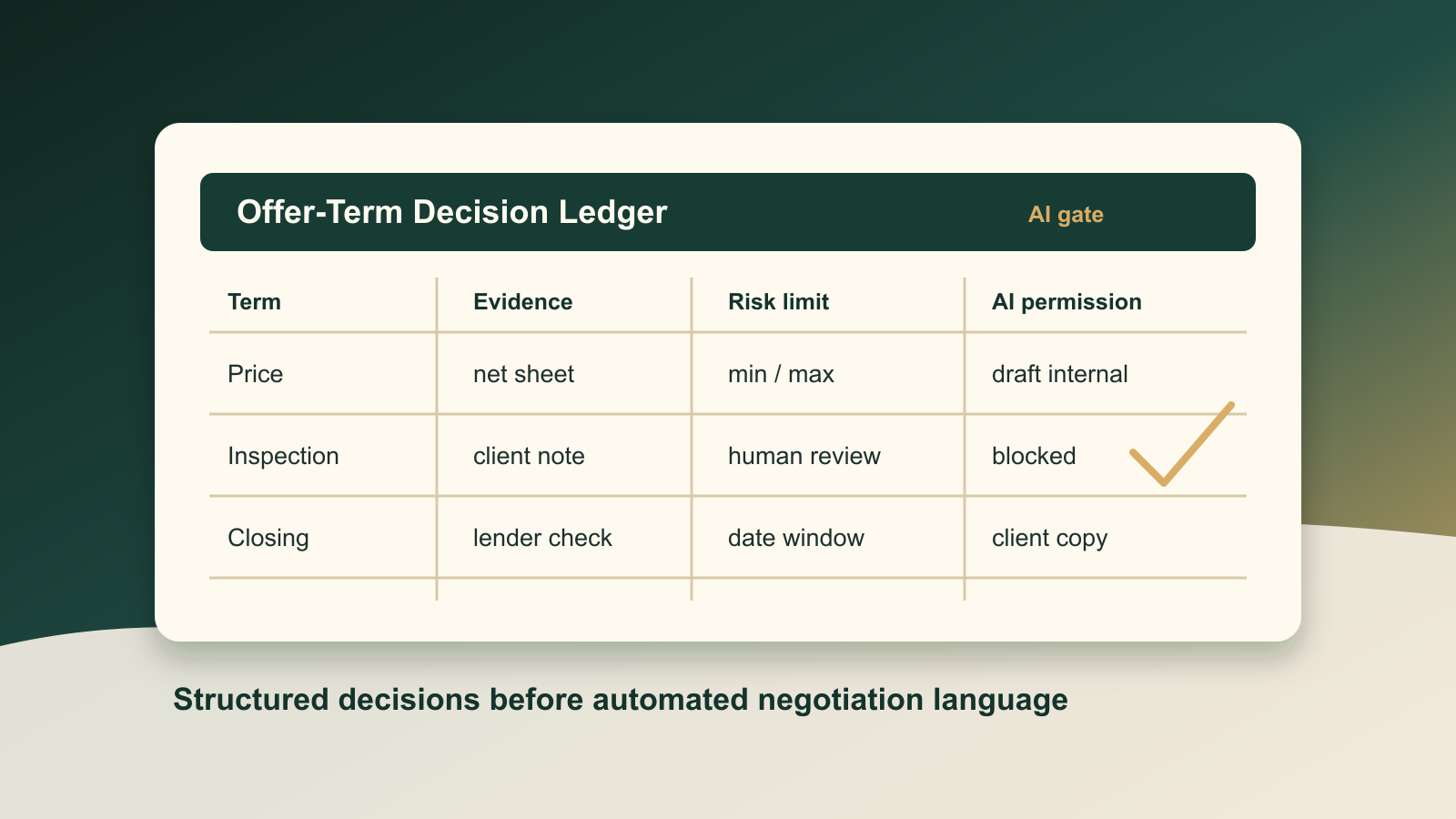
The second section should use one row per material offer term. Keep the rows boring and consistent:
- Term name: price, earnest money, loan type, down payment, appraisal, inspection, repairs, credits, closing date, occupancy, included items, exclusions, expiration, or special condition
- Current offer value
- Client target
- Minimum or maximum acceptable value
- Evidence source
- Risk note
- Approved AI action
- Human owner
- Expiration timestamp
The risk note is the field that stops generic AI negotiation language. If the buyer needs lender approval for seller credits, say that. If the seller cannot accept delayed possession because of a purchase contingency on the next home, say that. If a repair credit cannot be promised before inspection review, say that. AI can draft better language when the tradeoff is explicit. More importantly, it can be blocked from drafting when the tradeoff is not approved.
Give AI permission by term, not by deal
The most common mistake is treating an accepted deal file as automation-ready. A transaction can be ready for AI summary while still being unsafe for AI counteroffer drafting.
Use term-level permissions. AI may be allowed to summarize the offer and draft a neutral comparison. It may be allowed to propose questions for the agent to ask the client. It may be allowed to draft counter language for closing date but blocked from drafting price, inspection waiver, appraisal gap, or seller-credit language. That is the right level of control because risk is not evenly distributed across the contract.
For each term, use one of five permissions: summarize only, ask for confirmation, draft internal option, draft client-facing language, or blocked. The default should be summarize only. Client-facing language should require current priorities, complete evidence, a responsible human owner, and a non-expired approval.
Use lender and closing constraints as hard gates
Offer terms do not live only inside the real estate team's CRM. They touch mortgage timing, cash-to-close, loan structure, appraisal exposure, closing disclosures, and settlement logistics. CFPB guidance on choosing a loan offer emphasizes that once a specific home is under contract, buyers compare Loan Estimates, fine-tune options, and choose a lender in a process that can move quickly. That is exactly why AI should not treat financing terms as static background data.
The ledger should include lender-reviewed fields when a term affects financing: maximum seller credit, loan program constraints, appraisal gap capacity, rate-lock deadline, cash-to-close range, required reserves, and closing timeline confidence. If those fields are unknown or stale, AI can draft a lender question or internal checklist. It should not draft a confident counteroffer that assumes the buyer can absorb the term.
This matters for sellers too. A seller considering two offers needs more than headline price. The ledger should show financing strength, contingency exposure, settlement risk, appraisal exposure, possession fit, and any term that could cause a delay. AI can help compare those rows, but the team needs the rows first.
Keep the approval trail visible
Every AI-assisted counteroffer should have a small audit trail: who approved the term boundary, what evidence they reviewed, when the approval expires, and what the AI was allowed to draft. The approval trail should be visible inside the CRM or transaction workspace, not buried in a chat transcript.
That is a practical governance issue, not just a compliance concern. If a deal falls apart, the team needs to know whether the problem was a bad term, stale lender data, missing client confirmation, or AI language that exceeded the approved boundary. Without a ledger, every issue becomes a message-search exercise. With a ledger, coaching and process improvement become specific.
The FTC's current AI enforcement page is a useful reminder that regulators continue to watch AI-related business claims and consumer-facing practices. Real estate teams should not wait for a platform vendor to solve this for them. If AI is helping draft communications that influence financial or contractual decisions, the business needs its own proof that the system stayed inside approved facts and instructions.
A simple rollout pattern
Start with three offer scenarios: buyer counter, seller counter, and multiple-offer comparison. For the first two weeks, AI should only summarize terms, identify missing evidence, and draft internal options. Require a human to write or approve every client-facing message.
After the ledger is producing clean rows, allow AI to draft client-facing language only for terms marked current, within approved min-max boundaries, and owned by a responsible human. Keep price, appraisal gap, inspection waiver, financing, and seller-credit language in human-review mode until the team has enough examples to prove the controls work.
The implementation test is simple: if the AI disappeared tomorrow, could the agent still explain why each counteroffer term was recommended, who approved it, and what evidence supported it? If the answer is yes, the ledger is doing its job.
The goal is not to make AI negotiate. The goal is to make the team's negotiation logic explicit enough that AI can help without guessing. Counteroffers are not just words. They are client priorities, financial constraints, risk tradeoffs, and timing pressure compressed into a document. Treat them like structured decisions before you let automation write the next sentence.

Written by
Ben Laube
AI Implementation Strategist & Real Estate Tech Expert
Ben Laube helps real estate professionals and businesses harness the power of AI to scale operations, increase productivity, and build intelligent systems. With deep expertise in AI implementation, automation, and real estate technology, Ben delivers practical strategies that drive measurable results.
View full profile