Build a Listing Media Rights Ledger Before AI Reuses Photos
Build a Listing Media Rights Ledger Before AI Reuses Photos
Real estate teams are about to run into a quieter AI problem than hallucinated copy: rights confusion. The same listing photo can now feed a brochure, social post, recruiting deck, remarketing ad, video short, neighborhood page, valuation email, and AI-generated variant. That feels efficient until nobody can answer who owns the original asset, what the photographer licensed, whether the seller approved reuse, whether the MLS display rules allow the new channel, and whether AI materially changed the property representation.
The fix is not another generic brand guideline. It is a listing media rights ledger: a simple operating table that says which media can be reused, transformed, disclosed, retired, or escalated before AI tools touch it.
Why this belongs in operations now
NAR's listing-content guidance is a useful reminder that listing media is not just decoration. Photos, virtual tours, artistic renderings, floor plans, architectural drawings, and creative listing descriptions can be protectable content. NAR also flags copyright issues around listing photographs. That matters because AI makes reuse feel frictionless. A team member can drop a photo into a generator, make a twilight version, remove furniture, extend a room, turn it into a reel, or prompt a new image in the same style before anyone checks the original permissions.
Consumer trust is moving in the same direction. Gartner reported in March 2026 that half of U.S. consumers prefer brands that do not use GenAI in consumer-facing messages, advertising, and content. The same survey found broad skepticism about whether online information is reliable or real. In January, Gartner also predicted that brands will spend more on content authenticity initiatives, including identity verification, provenance checks, and anti-deepfake measures, as AI-generated content becomes more visible in search and marketing environments.
Real estate teams do not need enterprise-scale provenance software to start. They need a defensible approval queue that stops AI-generated listing media from becoming a rights, trust, or compliance problem.
The ledger should track rights before creativity
Most teams organize media by property folder. That helps people find assets, but it does not answer the operational question: what is this asset allowed to do?
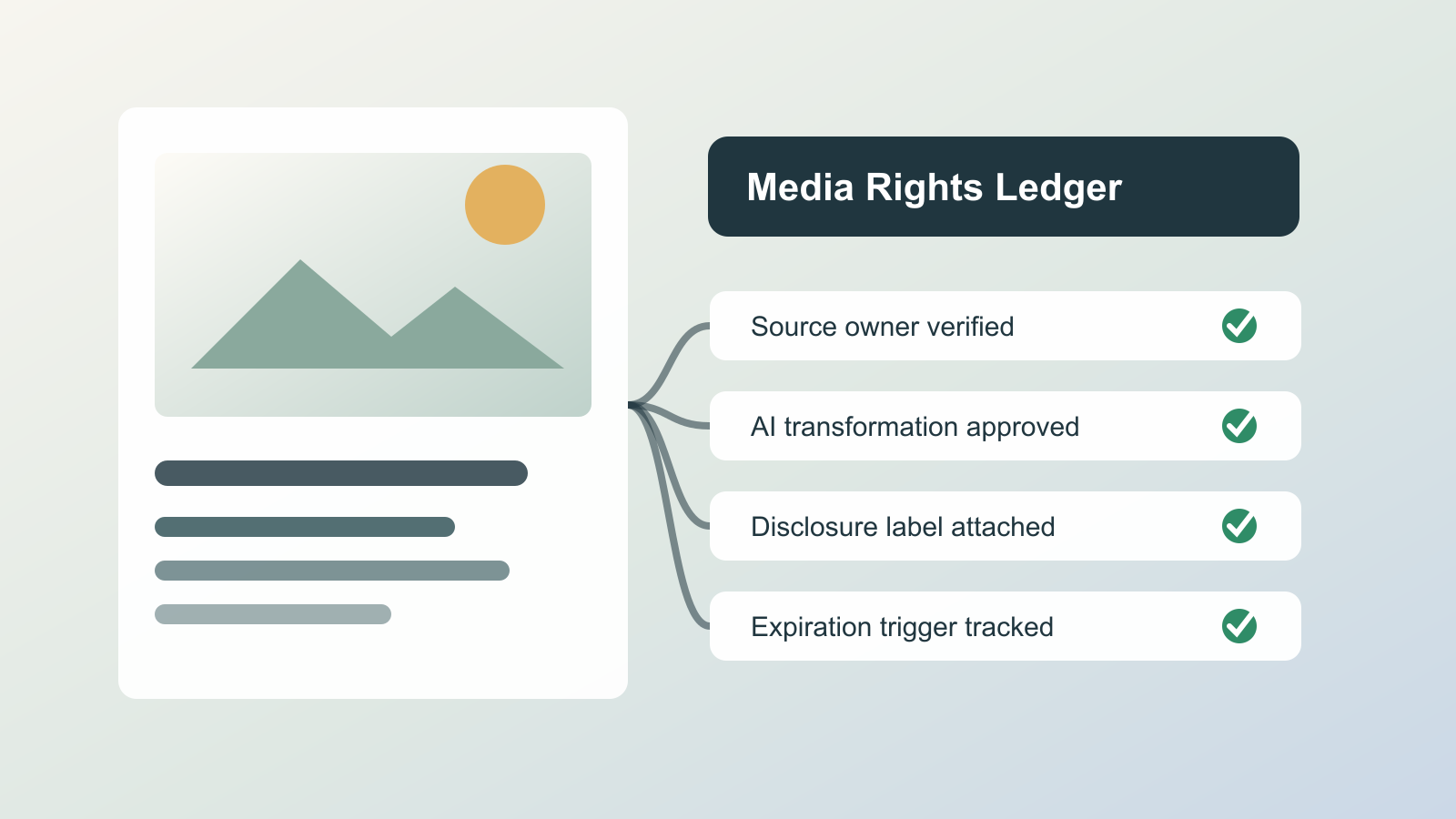
The ledger should track five things for every photo, video, floor plan, rendering, and listing-description block:
- Source owner: who created it, who paid for it, and who signed the license.
- Allowed channels: MLS, IDX, brokerage site, paid social, organic social, print, email, recruiting, listing presentation, buyer education, seller nurture, and internal training.
- Transformation rules: whether cropping, retouching, virtual staging, object removal, generative expansion, style transfer, voiceover, or derivative AI imagery is allowed.
- Disclosure requirement: whether the team must label the media as digitally altered, AI-assisted, virtually staged, illustrative, historical, or sample-only.
- Expiration and retirement: when the listing status, seller instruction, photographer agreement, MLS rule, or campaign context requires the asset to come down.
That structure changes the conversation from "can AI make this look better?" to "is this asset cleared for this use?" That is the question a scalable team can govern.
Give AI a permissions boundary, not a folder
An AI workflow should never have broad access to every image in the listing archive. The operating rule should be narrower: AI can only retrieve assets whose rights ledger says the requested use is approved.
For example, a listing photo approved for MLS and the property landing page should not automatically be eligible for paid ads, a market-update email, or a future seller presentation after the listing closes. A virtually staged image should not automatically become training material for neighborhood content. A photographer's image from one campaign should not become the visual base for a different property type just because the model can remix it.
This is where the ledger becomes an automation control. When the marketing system receives a request, it checks the asset status first. If the channel, transformation type, or disclosure label is missing, the request goes to human review. If the asset is expired, the request is blocked. If the asset is approved, the AI workflow receives the asset plus the required label and usage limits.
Separate three queues
Do not run every media decision through the same approval bucket. Split the workflow into three queues.
The first queue is rights clearance. This is where the team checks photographer agreements, seller permissions, MLS usage terms, stock licenses, brokerage brand rules, and whether the asset can be used outside the original listing context.
The second queue is representation review. This is where someone confirms that edits do not mislead buyers or sellers. Standard exposure correction is different from changing a view, removing a defect, widening a room, replacing landscaping, or implying a renovation that does not exist.
The third queue is disclosure and provenance. This is where the team records whether a post, email, ad, reel, or landing page needs a label, watermark, caption note, alt-text note, internal provenance tag, or link to unaltered media.
Those queues prevent the most common failure mode: a creative approval that accidentally pretends to be a legal, MLS, and disclosure approval.
Make the audit trail boring
The ledger does not need to be complex. A good first version can live in the CRM, project-management system, Airtable, or a Postgres table. What matters is that every AI-assisted output has a traceable answer to four questions:
- Which source asset did it use?
- Which permission allowed this channel and transformation?
- Who approved any exception?
- What disclosure went live with the final asset?
Gartner's January 2026 zero-trust data governance prediction points to the same pattern at enterprise scale: organizations will need to identify and tag AI-generated data instead of assuming content is human-created or trustworthy by default. For real estate operators, the practical version is metadata on every listing asset and every derivative output.
The Federal Trade Commission's advertising guidance keeps the business reason plain: advertising claims must be truthful, not deceptive or unfair, and evidence-based. A listing image is not a pricing claim, but it can still shape a buyer's understanding of condition, space, finish, view, or marketability. That means the team should treat visual edits and AI-generated derivatives as client-facing claims that need evidence and context.
Start with the assets most likely to leak
Do not inventory every historic folder before improving the workflow. Start where reuse pressure is highest:
- Active listing photos used in paid ads.
- Sold listing photos used in seller presentations.
- Before-and-after renovation images.
- Virtually staged rooms.
- Drone footage and neighborhood footage.
- Floor plans and architectural drawings.
- Testimonial, team, and client-event photos.
- Any image that AI tools use to create new variants.
For each category, mark assets as approved, limited, needs review, expired, or blocked. That gives the team immediate routing logic without pretending the archive is already perfect.
The practical implementation
Build the ledger as a small table before buying another AI creative tool. Use fields for property, asset type, source owner, license file, original channel, approved channels, transformation permission, required disclosure, expiration trigger, final public URL, and reviewer. Then connect the creative request form to that table.
When someone asks AI to create an ad, newsletter image, social carousel, listing video, or seller report visual, the form should require a campaign goal and destination channel. The system checks the ledger, attaches only approved assets, and writes the output back as a derivative asset with its own status. If the request needs a disclosure or human review, the system blocks publishing until that step is complete.
This is not bureaucracy. It is how a real estate team keeps creative velocity without losing control of client assets, seller expectations, photographer rights, MLS obligations, and consumer trust.
AI can make every listing asset more reusable. That is exactly why the team needs to decide what reuse is allowed before the model gets the file.

Written by
Ben Laube
AI Implementation Strategist & Real Estate Tech Expert
Ben Laube helps real estate professionals and businesses harness the power of AI to scale operations, increase productivity, and build intelligent systems. With deep expertise in AI implementation, automation, and real estate technology, Ben delivers practical strategies that drive measurable results.
View full profile