Build a Pipeline Stage Gate Before AI Forecasts Revenue
Build a Pipeline Stage Gate Before AI Forecasts Revenue
AI forecasting is becoming easier to buy and easier to demo. That does not mean the forecast is ready to trust.
The problem is not whether a model can read CRM records, summarize activity, and predict which deals look likely to close. The problem is whether the CRM stage means what the business thinks it means. If a deal can move from discovery to proposal without a verified problem, a real owner, a next meeting, and a written commercial path, the model is not forecasting revenue. It is forecasting whatever your team lets into the pipeline.
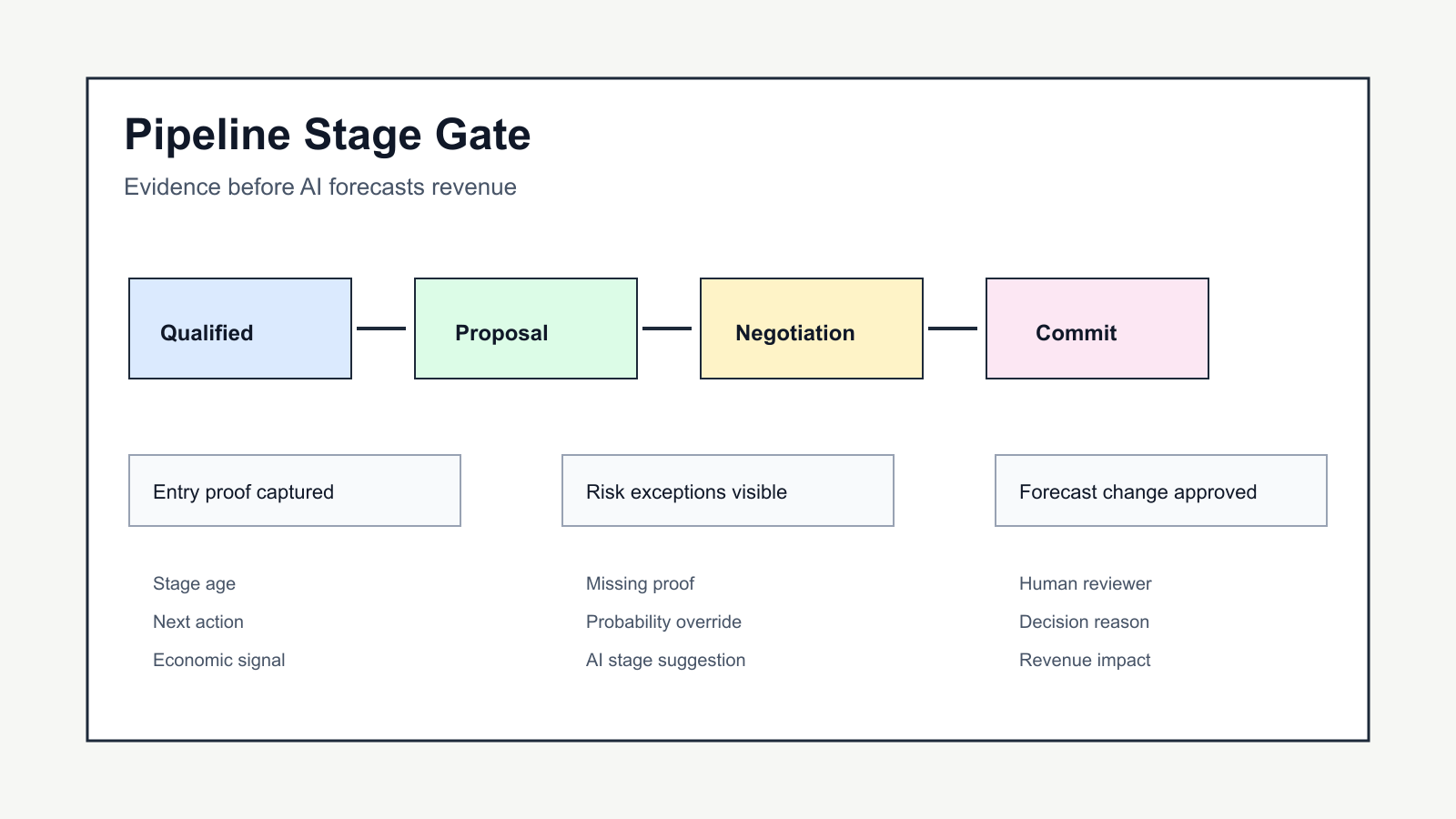
The operating layer to build first is a pipeline stage gate. It is a simple control system that defines what evidence must exist before a deal enters or leaves each stage. It also defines which fields AI may use, which fields require human confirmation, and which exceptions should be escalated before the forecast changes.
This is narrower than cleaning the CRM. CRM cleanup removes duplicates and fills missing fields. A stage gate decides whether the record deserves its current revenue weight.
Why this matters now
Current sales research is pointing in the same direction: AI can help teams move faster, but weak operating data blocks the payoff.
Gartner wrote on May 4, 2026 that traditional sales productivity metrics are failing many chief sales officers because lagging indicators like win rate and deal size hide the real drivers of seller performance. Its recommended AI-driven lens includes account reach, account engagement, and average interaction value, but Gartner also names data quality and system maturity as major implementation hurdles.
Salesforce's 2026 State of Sales announcement makes the data issue more concrete. Sales teams are naming AI and AI agents as their top growth tactic for 2026, and Salesforce says 87 percent of sales organizations are already using some form of AI. But the same report says 51 percent of sales leaders with AI are slowed by disconnected systems, 74 percent of sales professionals are focusing on data cleansing, and high performers prioritize data hygiene more aggressively than underperformers.
HubSpot's Spring 2026 Spotlight shows where CRM products are headed. Its Smart Deal Progression feature analyzes calls against full deal history, customer records, pipeline definitions, deal stages, and forecasting logic before suggesting CRM updates. That is the right direction, but it also exposes the dependency: if the stage definitions and forecasting logic are loose, the AI inherits loose judgment.
For real estate operators, agencies, service firms, and local growth teams, the lesson is practical. Do not ask AI to forecast from a pipeline where every stage is a label and no stage is a contract with the team.
The stage gate is a contract
A usable stage gate has three parts.
First, it defines entry proof. A lead should not become a qualified opportunity just because a call happened. A buyer should not become active just because they replied to a text. A listing prospect should not move to proposal just because an agent sent a CMA. Each stage needs evidence: source, intent, decision maker, timeline, budget or financing, next action, and owner.
Second, it defines exit proof. A deal should not leave consultation, proposal, negotiation, or contract because someone feels good about it. It leaves when the required evidence exists. That might be a signed buyer agreement, lender pre-approval date, listing agreement draft, approved pricing range, inspection deadline, vendor quote, client decision, or next scheduled meeting.
Third, it defines forecast weight. The CRM should not let every rep, agent, or coordinator attach probability however they want. If a stage carries 60 percent forecast weight, the gate needs to explain why. A stage with no next meeting, no client-approved timeline, or no economic owner should automatically lose forecast weight or move to an exception view.
This makes the forecast less flattering and more useful.
What to put in the gate
Start with the smallest set of fields that changes decision quality.
For every active opportunity, require:
- Current stage and stage-entered date.
- Stage owner and next-action owner.
- Next scheduled event, not just a vague task.
- Client intent signal and evidence source.
- Decision maker or household stakeholder status.
- Economic condition: budget, price range, lender status, commission model, or expected revenue basis.
- Forecast amount and probability source.
- Last meaningful interaction date.
- Missing-proof reason when a required field is blank.
- AI permission level: summarize, recommend next action, change stage suggestion, forecast adjustment suggestion, or no AI action.
The key is the missing-proof reason. Blank fields create ambiguity. A missing-proof reason creates management visibility. There is a difference between "no lender letter uploaded because the buyer has not spoken with a lender" and "no lender letter uploaded because the agent forgot to attach it." AI should treat those differently.
Separate activity from evidence
Most bad forecasts are built from activity volume. A rep made calls. An agent sent emails. A coordinator logged tasks. A marketing workflow created replies. That activity matters, but it is not the same as deal evidence.
The stage gate should sort signals into three buckets.
Activity signals show work happened: calls, emails, meetings, texts, portal views, campaign clicks, property tours, proposal sends, and reminders.
Evidence signals show the opportunity changed: a buyer submitted documents, a seller approved a pricing range, a stakeholder joined the meeting, a lender confirmed a condition, a client accepted terms, a decision date moved, or a competing option appeared.
Risk signals show the forecast may be overstated: no next event, stale stage age, missing owner, duplicate opportunity, vague source, unconfirmed budget, pushed close date, unsigned paperwork, or an AI-generated update without human approval.
AI can read all three buckets, but the forecast should privilege evidence and risk over activity. A busy opportunity with no evidence should not outrank a quieter opportunity with verified intent and a clean next step.
Build the exception views first
The quickest way to make this operational is not a big dashboard. It is a set of exception views that managers, agents, and operators can clear every week.
Create a view for "forecasted deals missing proof." This should include any opportunity with a forecast amount but no verified next event, no decision maker, no economic condition, or no stage-entry evidence.
Create a view for "stage age exceeds standard." Every stage should have an expected age range. If a buyer has been in consultation for 24 days with no lender status, or a listing prospect has been in proposal for 18 days with no seller decision, the issue should surface before the forecast meeting.
Create a view for "AI changed or suggested stage movement." AI should be allowed to suggest that a deal moved, but the gate should capture the evidence, the model output, and the human approval. If the suggestion was wrong, the team needs to know whether the prompt failed, the CRM data was stale, or the stage rule was unclear.
Create a view for "probability override." Overrides are not always bad. A senior operator may know something the CRM does not. But every override should have a reason and an expiration date. Otherwise the forecast slowly turns into opinion with prettier charts.
How AI should use the gate
Once the gate exists, AI becomes more useful because it has a standard to enforce.
It can summarize which opportunities are blocked by missing proof. It can draft the next client or internal follow-up based on the specific missing field. It can flag deals where activity is high but evidence is weak. It can compare current stage age against team norms. It can prepare a manager's coaching list before the pipeline meeting. It can suggest a forecast adjustment while showing the evidence that supports the suggestion.
The model should not silently change the forecast. It should present a proposed change, cite the gate rule, cite the CRM fields it used, and ask for approval when the change affects revenue, capacity planning, client promises, or marketing spend.
That distinction matters. The goal is not to make AI timid. The goal is to make it accountable to the same operating rules the team uses.
A practical rollout
Do this in four passes.
Pass one is definitions. Write one sentence for each stage, then list the required entry and exit proof. If the team cannot define a stage in plain language, AI will not fix it.
Pass two is fields. Add only the required fields and the missing-proof reason. Do not rebuild the whole CRM. Make the gate visible inside the workflow people already use.
Pass three is exceptions. Launch the three or four exception views before launching a management dashboard. If the team cannot clear exceptions, the dashboard will only decorate the mess.
Pass four is AI permissions. Let AI summarize and recommend first. Then let it draft follow-ups tied to missing proof. Then let it suggest stage and probability changes. Keep human approval on any change that affects forecasted revenue or client-facing commitments.
The implementation rule
Do not connect AI forecasting to an undefined pipeline. First create a stage gate that proves why each opportunity belongs where it is, what evidence is missing, who owns the next action, and when the forecast weight should change.
The teams that win with AI forecasting will not be the teams with the most optimistic model. They will be the teams with the cleanest stage contract: clear entry proof, clear exit proof, visible exceptions, and a human approval trail for revenue-impacting decisions.

Written by
Ben Laube
AI Implementation Strategist & Real Estate Tech Expert
Ben Laube helps real estate professionals and businesses harness the power of AI to scale operations, increase productivity, and build intelligent systems. With deep expertise in AI implementation, automation, and real estate technology, Ben delivers practical strategies that drive measurable results.
View full profile